


AI Needs More Power Than the Grid Can Give, and These 7 Stocks Sell the Fix
Key Points
Only a small number of utility companies are extremely well-positioned to deliver much-needed electricity to the AI industry.
More and more AI data centers are taking power production matters into their own hands.
Perhaps the lowest-hanging fruit on this front is the adoption of more power-efficient electricity distribution technologies, including retrofitting existing AI data centers.
- 10 stocks we like better than Eaton Plc ›
The ongoing proliferation of artificial intelligence (AI) data centers continues to outpace the availability of electricity to power them, and will do so for a while. That's the latest assessment from analysts at Morgan Stanley, which recently calculated that -- as things stand -- U.S. data centers alone will face a 32-gigawatt electricity shortfall by 2028.
This warning echoes similar ones that have been circulating since shortly after the November 2022 launch of OpenAI's ChatGPT, which set off an AI arms race that's still heating up rather than cooling off. Indeed, globally, Goldman Sachs says demand for power in data centers is set to grow by 170% between last year and 2030, up from a five-year growth estimate of only 117% earlier this year. Much like the United States, the rest of the world isn't ready to meet that need either.
Missed AI’s "Act 1"? Act 2 Could Be 15x Bigger. Most investors think they missed the AI boat because they didn't buy Nvidia in 2005. But according to our analysts, we’re only at the end of "Act 1"—the R&D phase. "Act 2" is the global rollout. Continue »
Some companies benefit from this growing electricity shortage, of course, although these investment opportunities are as nuanced and complex as the solution to the power shortfall itself. Here's a framework for how investors might want to view and navigate the matter.
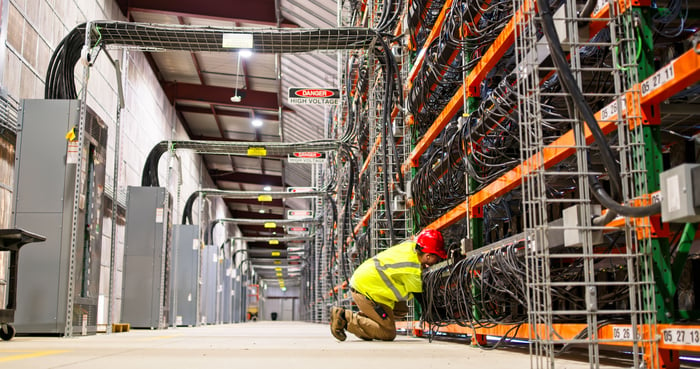
Image source: Getty Images.
Conventional power delivery
Utility companies that are already generating electricity are obvious beneficiaries of the movement. Not all are equally positioned to deliver this needed power when and where it's needed, though. The best-positioned names in the power utility business right now are Constellation Energy (NASDAQ: CEG), NextEra Energy (NYSE: NEE), and Vistra (NYSE: VST), largely because these outfits operate existing nuclear power plants that can be uprated relatively quickly. Constellation operates more nuclear power plants than any other U.S. utility, and nuclear accounts for over 80% of its total power production.
Data center owners/operators have taken notice too. In late 2024, software giant Microsoft convinced Constellation to restart one of the idle nuclear reactors at Three Mile Island in Pennsylvania to generate electricity needed by nearby data centers. And just last week, Google parent Alphabet agreed to purchase power from several of Constellation's nuclear power facilities in Illinois, Pennsylvania, and New Jersey, also to support AI data centers. Operating in the right geography helped, of course.
That said, Vistra and NextEra Energy are competitively positioned as well. Texas-based Vistra has also recently inked a long-term nuclear power-supply deal with Facebook parent Meta Platforms. Such custom-designed partnerships that support utilities' investments in their own nuclear power plant fleets are quickly becoming the norm.
Onsite power generation
That being said, sometimes even custom-built power-purchase partnerships aren't quite the solution that's needed. In an increasing number of instances, AI data center owners/operators are opting to generate their own electricity right where it's needed.
Enter GE Vernova (NYSE: GEV). While this energy-oriented offshoot of the old GE manufactures a range of power-production equipment including wind turbines, hydropower tech, and even nuclear reactor components, its natural gas turbines are its big story right now.
Initially intended for power utility companies, these turbines -- some of which are capable of generating over 571 megawatts' worth of electricity -- are being installed adjacent to data centers as a secondary or even primary source of power. Although not just due to AI-driven demand, this company's backlog now stands at $176 billion versus this year's projected top line of only $46 billion.
Another name worth adding to your artificial intelligence infrastructure watch list is Bloom Energy (NYSE: BE). It's arguably the most unusual of the seven names in focus here simply because it's doing something relatively new that's not been well commercialized by any other outfit. That's facilitating the use of fuel cells as a source of electricity at enough scale to power an entire building.
In simplest terms, fuel cells convert a gas like hydrogen or natural gas into electricity using an electrochemical process rather than a mechanical or combustion one. While relatively expensive up front, fuel cells have minimal long-term maintenance costs because they have no moving parts.
Bloom Energy also helps curb some of these costs by increasingly offering electricity generation as a service rather than simply selling its equipment. However, most of its second-quarter revenue of just over $1 billion still reflects product sales.
The kicker: Bloom Energy is now firmly profitable, reaching profitability far sooner than many investors thought it might.
Energy management equipment
Perhaps the least appreciated opportunity stemming from the rise of AI data centers everywhere is the equipment other than the racks, servers, and processors that go into them. This includes cooling equipment, although the most meaningful leap right now is on the energy management front, with wares manufactured by the likes of Eaton (NYSE: ETN) and Vertiv (NYSE: VRT).
Take Vertiv's EXL S1 uninterruptible power supply as an example. This power distribution tech, capable of handling loads anywhere from 250 kilowatts to 1,200 kilowatts, automatically handles any fluctuations detected in grid-supplied power, keeping AI data centers up and running when they otherwise might be forced to temporarily stop operations.
Vertiv also offers increasingly popular 800-volt grid-to-chip power infrastructure solutions. This equipment is only about one-tenth as expensive to own and operate as the lower-voltage, higher-amperage equipment commonly used in most AI data centers built so far.
With monthly electricity costs easily reaching hundreds of thousands of dollars, though, data center owners will gladly invest in any improvement in cost-effectiveness. That's why an outlook from Precedence Research suggests the worldwide data center power management equipment market alone is poised to double in size between last year and 2035.
Connecting the dots
Other related stocks are worth your consideration. In fact, many of the aforementioned tickers are already more than fully priced based on presumptions about future demand. You may want to wait on a pullback from some of these stocks before diving in.
Just embrace the bigger picture no matter what you decide to do next. There's clearly a lot of opportunity in AI's growth, beyond the chips that handle all of this heavy-duty computing work. These seven stocks are a place to start looking beyond those obvious names, but certainly aren't the only worthy ways to plug into the trend and the subsequent power shortage.
Should you buy stock in Eaton Plc right now?
Before you buy stock in Eaton Plc, consider this:
The Motley Fool Stock Advisor analyst team just identified what they believe are the 10 best stocks for investors to buy now… and Eaton Plc wasn’t one of them. The 10 stocks that made the cut could produce monster returns in the coming years.
Consider when Netflix made this list on December 17, 2004... if you invested $1,000 at the time of our recommendation, you’d have $379,986!* Or when Nvidia made this list on April 15, 2005... if you invested $1,000 at the time of our recommendation, you’d have $1,404,152!*
Now, it’s worth noting Stock Advisor’s total average return is 948% — a market-crushing outperformance compared to 215% for the S&P 500. Don't miss the latest top 10 list, available with Stock Advisor, and join an investing community built by individual investors for individual investors.
See the 10 stocks »
*Stock Advisor returns as of October 15, 2026.
James Brumley has positions in Alphabet. The Motley Fool has positions in and recommends Alphabet, Bloom Energy, Constellation Energy, Eaton Plc, GE Vernova, Goldman Sachs Group, Meta Platforms, Microsoft, NextEra Energy, Vertiv, and Vistra. The Motley Fool has a disclosure policy.
Recommended Articles


