


Jim Cramer Calls CoreWeave the "Real Deal," but the Stock Crashed 15% the Very Next Day. Should You Buy the Dip?
Key Points
Last night, Jim Cramer endorsed CoreWeave over other artificial intelligence (AI) neoclouds.
Today, Silicon Valley investor Chamath Palihapitiya highlighted soaring yields on CoreWeave's growing debt.
CoreWeave stock sank 15% as investors increasingly price in risk to the artificial intelligence (AI) infrastructure trade.
- Motley Fool Issues Rare "Total Conviction" Buy Alert ›
During last night's episode of Mad Money, Jim Cramer called CoreWeave (NASDAQ: CRWV) the "real deal" and described the company as the only artificial intelligence (AI) neocloud he trusts. Less than 24 hours later, CoreWeave stock plunged 15%.
The sell-off isn't simply an example of the market moving against Cramer's recommendation. Instead, investors are becoming concerned about CoreWeave's debt load and whether the company can generate sufficient cash flow to finance its AI infrastructure.
Missed AI’s "Act 1"? Act 2 Could Be 15x Bigger. Most investors think they missed the AI boat because they didn't buy Nvidia in 2005. But according to our analysts, we’re only at the end of "Act 1"—the R&D phase. "Act 2" is the global rollout. Continue »
These concerns raise an interesting question: Is CoreWeave's decline a lucrative buying opportunity or a warning sign?
Image source: The Motley Fool.
Cramer prefers CoreWeave over other neoclouds
Cramer's comments came during his Lightning Round, when a caller asked for his opinion about Iren. Iren has garnered attention following reports of a multiyear cloud computing agreement with Anthropic, the developer behind Claude.
Interestingly, Cramer wasn't interested in discussing Iren. Instead, he segued right to CoreWeave.
To understand his preference, it's important to explain what a neocloud actually does. Traditional cloud providers such as Amazon Web Services (AWS) and Microsoft Azure offer broad collections of computing services. Neoclouds, by contrast, specialize in renting computing infrastructure, particularly servers equipped with Nvidia graphics processing units (GPUs).
Rather than incurring up-front costs and time to build their own data centers, AI developers can rent capacity from companies like CoreWeave. This model appeals to the hyperscalers, as CoreWeave has forged relationships with Microsoft, OpenAI, Meta Platforms, and a host of other enterprise customers.
At the end of the second quarter, CoreWeave boasted $104 billion in revenue backlog. This stresses the scale of demand for neocloud infrastructure and helps explain why Cramer prefers CoreWeave over less-established competitors. Nevertheless, there is a key difference between signing customers and generating enough cash to finance the infrastructure to support them.
Why is CoreWeave stock falling?
On Oct. 14, CoreWeave stock cratered roughly 15%. The immediate catalyst was an essay published by venture capitalist and billionaire Chamath Palihapitiya. He noted that CoreWeave's $1.25 billion bond tranche due in 2032 briefly yielded 15% in the secondary market. This is meaningfully higher than the 9.6% at which these bonds were issued in June.
When investors become concerned about a company's ability to repay its debts, they sell its bonds. As bond prices decline, yields rise. In CoreWeave's case, the bond market is sending a warning about the company's aggressive borrowing strategy.
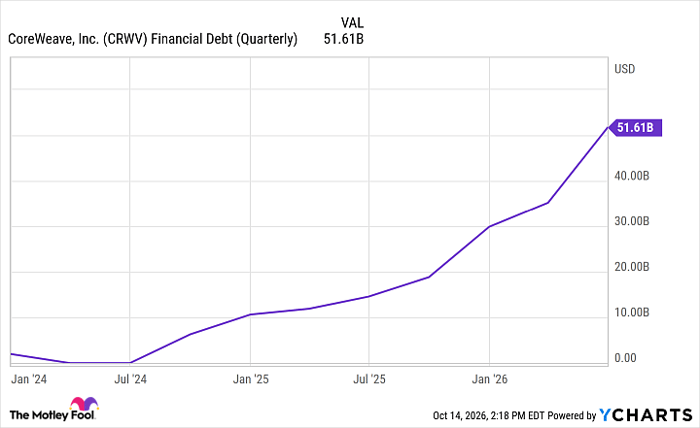
At the end of the second quarter, CoreWeave reported approximately $35.1 billion in debt on its balance sheet. When combined with operating and financial leases, the company's debt obligations approached $51.6 billion -- a figure that has soared throughout the AI revolution. Essentially, CoreWeave is using substantial amounts of borrowed capital today in anticipation of higher revenue tomorrow. This is far from a guaranteed payoff.
CRWV Financial Debt (Quarterly) data by YCharts
Is CoreWeave going bankrupt?
During the first six months of 2026, CoreWeave generated approximately $3.7 billion in operating cash flow. For comparison, the company had $6.2 billion in principal and interest payments during the same time frame.
Meanwhile, according to consensus estimates tracked by Visible Alpha, CoreWeave is projected to generate negative free cash flow of $25 billion in 2026, followed by deficits of $28 billion in 2027 and $18 billion in 2028. Continuous cash burn implies that CoreWeave will have to continue relying on outside financing while its existing infrastructure matures and begins producing cash.
This is where private credit enters the picture, which refers to loans provided by investment firms and other lenders rather than traditional banks.
The problem with funding AI infrastructure with too much debt is that these up-front investments are front-loaded while the resulting revenue is expected to arrive gradually. If demand remains strong, CoreWeave's strategy could generate attractive returns. But if AI spending slows, customers delay deployments, or Nvidia's next-generation chips make older equipment less valuable, CoreWeave could find itself servicing expensive debt on less-profitable infrastructure than originally anticipated.
So, will CoreWeave go bankrupt? Not necessarily. The important distinction here is that strong customer demand doesn't automatically translate to financial stability.
For now, CoreWeave's highly leveraged business model has introduced risks that cannot be ignored. With interest rates rising and Wall Street projecting years of negative free cash flow, I wouldn't rush to buy the dip in CoreWeave stock. Chasing the downward spiral could turn out to be a trap, catching a falling knife. I consider CoreWeave too speculative for most long-term investors and would prefer to see improving unit economics and a healthier balance sheet before buying.
Should you buy stock in CoreWeave right now?
Before you buy stock in CoreWeave, consider this:
The Motley Fool Stock Advisor analyst team just identified what they believe are the 10 best stocks for investors to buy now… and CoreWeave wasn’t one of them. The 10 stocks that made the cut could produce monster returns in the coming years.
Consider when Netflix made this list on December 17, 2004... if you invested $1,000 at the time of our recommendation, you’d have $379,986!* Or when Nvidia made this list on April 15, 2005... if you invested $1,000 at the time of our recommendation, you’d have $1,404,152!*
Now, it’s worth noting Stock Advisor’s total average return is 948% — a market-crushing outperformance compared to 215% for the S&P 500. Don't miss the latest top 10 list, available with Stock Advisor, and join an investing community built by individual investors for individual investors.
See the 10 stocks »
*Stock Advisor returns as of October 14, 2026.
Adam Spatacco has positions in Amazon, Microsoft, and Nvidia. The Motley Fool has positions in and recommends Amazon, Meta Platforms, Microsoft, and Nvidia. The Motley Fool has a disclosure policy.
Recommended Articles


