


CXMT Advances 4F² DRAM, Heightening Competition Concerns: Is Samsung Electronics Still Worth Holding?
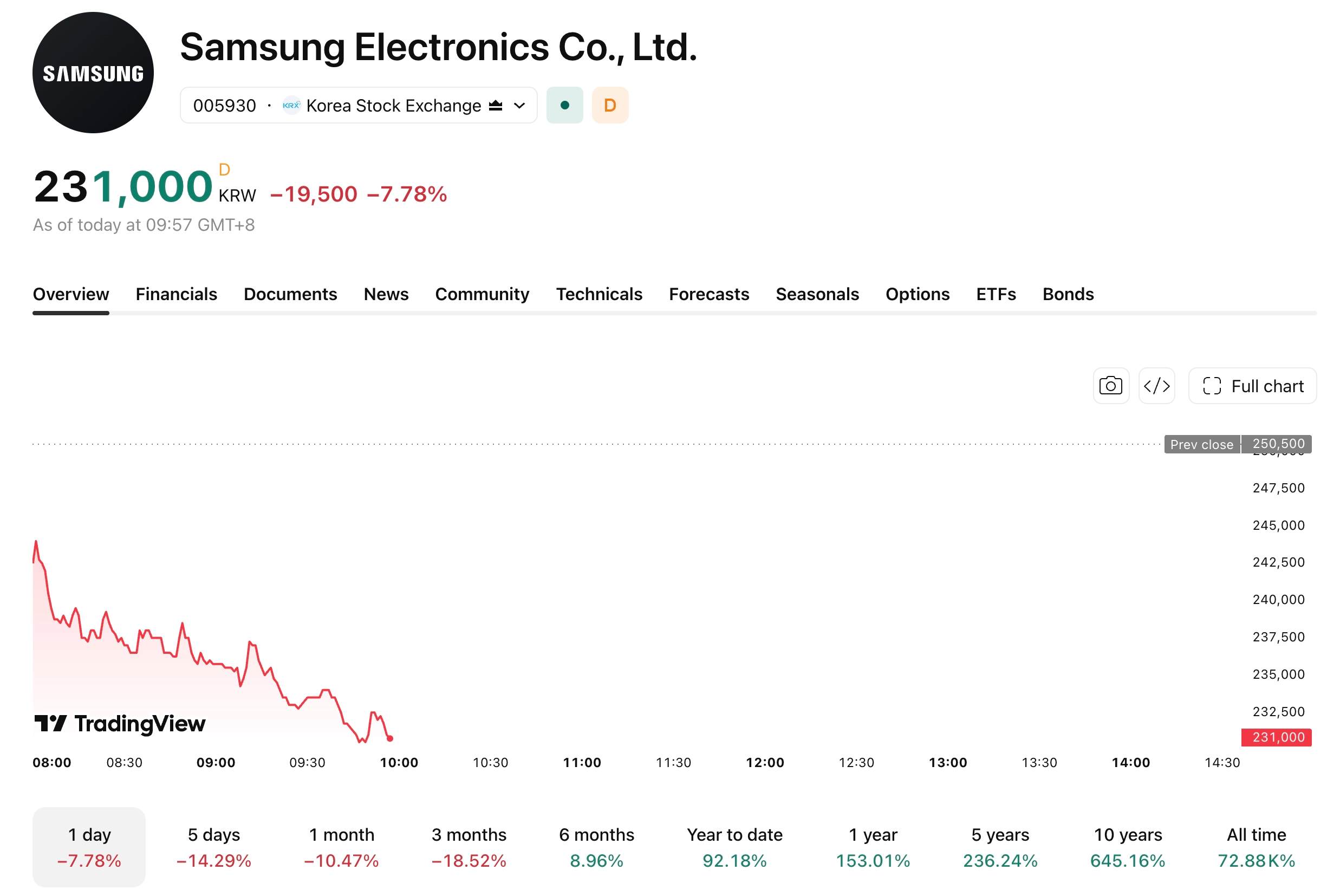
TradingKey - On October 12, Seoul time, Samsung Electronics closed down 4.39% at 250,500 won. In early trading on October 13, as of press time, the stock fell further by about 7.78%, briefly dropping to around 231,000 won and breaching the key 250,000-won level.
[Source: TradingView]
The main reason for this decline is that ChangXin Memory Technologies plans to launch a next-generation DDR5 RDIMM featuring a 4F² cell structure and hybrid bonding technology by the end of 2026, fueling market concerns over intensifying competition in server DRAM.
CXMT Advances 4F², Server DRAM Competition May Intensify
Mainstream DRAM currently mostly uses a 6F² architecture. The 4F² architecture can compress the memory cell area to two-thirds of its original size, theoretically boosting storage density, but the actual result still depends on peripheral circuit design and yield.
ChangXin Memory Technologies (CXMT) stated that its 4F² solution uses self-developed vertical channel transistors and connects the memory array to peripheral logic via hybrid bonding, with plans to first apply it to server DDR5 RDIMMs.
However, launching products by the end of 2026 does not mean immediate large-scale supply. Server memory still needs to pass compatibility and reliability certifications from CPU platforms, system manufacturers, and data center customers, and there is no public data on yields, costs, or mass production scale.
Short-term pressure mainly stems from market expectations. If CXMT can expand its supply of standard server DRAM, Samsung's product prices and market share in the Chinese market may come under pressure. The impact on the HBM business will be limited, as the two differ significantly in packaging and customer qualification.
Can Record Profits Offset Competitive Pressures?
Samsung Electronics' preliminary third-quarter results showed consolidated revenue of approximately 195 trillion won and operating profit of about 107.4 trillion won, both hitting record highs. The company has not yet disclosed divisional revenue, net profit, or product mix, with full financial results expected to be released on October 29.
Rising memory prices and AI server demand remain the primary drivers of profit growth. Samsung is advancing its 4F² DRAM architecture; according to media reports, the company plans to adopt this structure in subsequent 10nm-class DRAM products, targeting mass production in 2028. CXMT's timeline is earlier, which may force Samsung to accelerate its R&D and mass-production verification.
Samsung's future stock price will mainly depend on whether CXMT's products can be shipped on schedule, their actual yield rates, and customer qualification progress, as well as whether Samsung's revenue from HBM4 and server DRAM can continue to grow.
If competition remains confined to China's standard DRAM market, the impact on Samsung's overall profitability will be limited; however, if CXMT further penetrates global server customers, pressure on prices and market share will rise significantly.
Samsung Electronics Technical Analysis: 230,000 Won Becomes Key Support
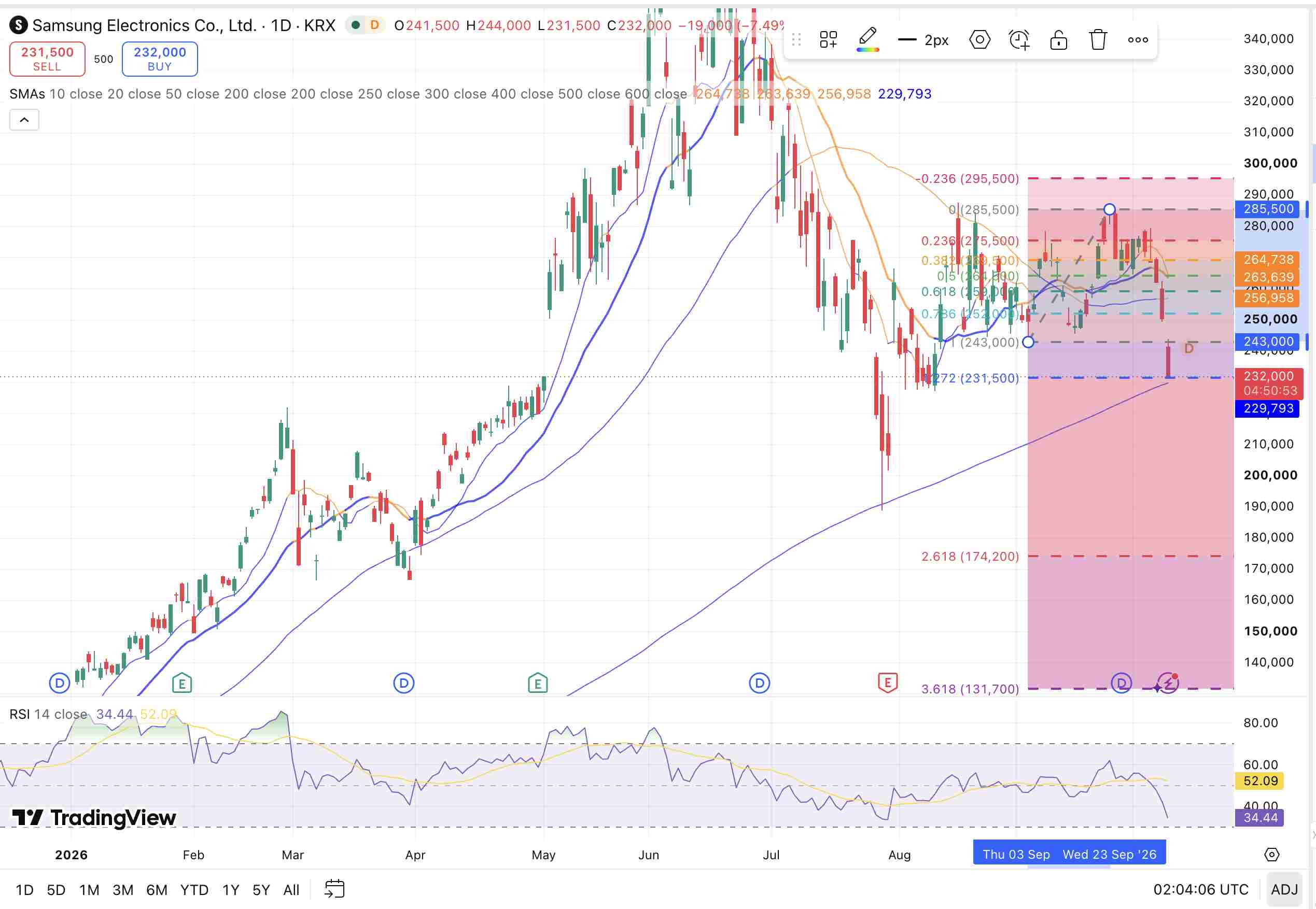
Based on the low of 243,000 won on September 3 and the high of 285,500 won on September 23, the 0.786 Fibonacci retracement level is approximately 252,100 won. Samsung Electronics' stock price has fallen below this level and the previous low of 243,000 won, weakening its short-term momentum.
[Source: TradingView]
The current stock price is around 231,000 won, having fallen below the observation zone of 238,000–240,000 won. If the daily chart continues to close below 230,000 won, the next support level to watch is 220,000–225,000 won.
The 14-day RSI is around 34, approaching the traditional oversold threshold of 30, indicating that selling pressure remains heavy, though a clear reversal signal has not yet formed.
On the upside, the stock price first needs to reclaim 238,000–240,000 won, followed by attention on the resistance zone of 249,500–252,000 won. If it reclaims 252,000 won, the next target range to watch is 259,000–264,000 won; if broken, the resistance level lies at 269,000–276,000 won.
Currently, 230,000 won serves as key short-term support, while 238,000–240,000 won has turned into the primary resistance on any rebound. If it fails to reclaim this area, the stock price may remain weak; if it breaks below 230,000 won, caution is required for a potential further drop toward 220,000–225,000 won.
Is Samsung Electronics Still Worth Holding?
Samsung Electronics' long-term value remains dependent on the competitiveness of its HBM, server DRAM, and advanced nodes. CXMT's 4F² technology has increased uncertainty in the standard DRAM market, but it has not yet proven that it can rapidly replace Samsung's high-end products. If Samsung can boost HBM4 shipments and yields, there is still room for profitability to improve.
Looking ahead, key items for investors to watch include segment-level data in the full Q3 financial report, progress on HBM4E orders, and whether CXMT's 4F² products can be shipped on schedule.
Recommended Articles


