


Beyond S&P 500 Index Funds: Here's the 1 Sector I'd Buy First as a New Investor
Key Points
Broad diversification is still smart for the foundational buy-and-hold portion of your portfolio.
There are options that combine diversifying with selective, strategic industry-based bets, though.
One particular sector has spectacularly outperformed the S&P 500’s average annual gain.
- 10 stocks we like better than Vanguard Information Technology ETF ›
Even if you've only been investing in the stock market for a little while, you've almost certainly learned that stocks sometimes make completely unexpected and illogical moves. Watching stocks zig and zag for no reason that you can understand can wreak havoc on your confidence and lead you to make ill-advised portfolio moves. Maybe even keep you from branching out beyond your starting point of index funds that track the S&P 500. I've been there.
But I've also been investing for a long while and can tell you that the good news is that experience can help you figure out when to embrace the most basic of stock-picking and portfolio management rules and when to bend them.
Missed Nvidia in 2009? This Rare Signal Is Flashing Again. In 2009, a "Double Down" signal flashed for a little-known chipmaker called Nvidia. For the first time in years, that same "Total Conviction" signal is flashing for a company 1/100th the size of Nvidia. Continue »
Here's a tip for even new investors: Make a point of being invested in at least one particular sector beyond broad-based index funds. And I'll tell you what sector I think is the place to be.
Beyond basics
Don't misread the message. I'm a huge fan of funds like the SPDR S&P 500 ETF Trust (NYSEMKT: SPY) or the Vanguard S&P 500 ETF (NYSEMKT: VOO), both of which are exchange-traded funds meant to mirror the performance of the S&P 500 index. Like super-investor Warren Buffett, I remain quite convinced that the average investor isn't going to beat the overall market by buying and selling the right stocks at the right time. Your best statistical move is betting on the S&P 500 index's average annual gain of 10%, even if some of those years are outright horrific losers.

Image source: Getty Images.
Over the long term, stocks have always bounced back.
But I'd be remiss to not also point out that one specific sector has consistently outperformed the overall market for nearly three decades now, and investors could be well served investing in it. That's the technology sector.
Over the course of the past 30 years, these stocks have more than doubled -- nearly tripled, in fact -- the total collective return of the S&P 500 (when reinvesting dividends). That's an average annual gain of just over 14.2%, versus the overall market's typical yearly gain of just 10%. When compounded over time, this modest difference can end up being a pretty big deal.
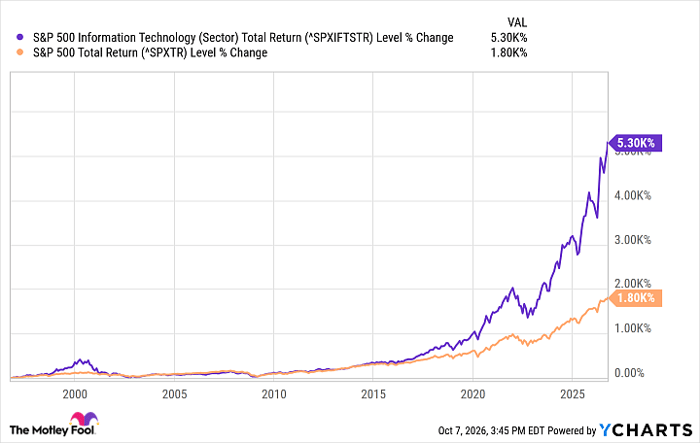
^SPXIFTSTR data by YCharts
It's not too difficult to understand why this is the case, either. These companies have innovated to help create enduring societal change.
For instance, Apple's (NASDAQ: AAPL) introduction of the iPhone in 2007 set off a race that would eventually make smartphones a crucial piece of daily life for many people. Alphabet (NASDAQ: GOOG) (NASDAQ: GOOGL) gave us Google and YouTube, among other things. Amazon (NASDAQ: AMZN) changed the way consumers think about shopping. And Amazon founder Jeff Bezos has invested heavily in a start-up called CuspAI that's utilizing artificial intelligence to discover new materials to use in semiconductors. It's unlikely these sorts of tech-led cultural revolutions are going to slow down in the foreseeable future, if ever.
So tech is where it's at. But you don't have to try to pick the sector's next winners, as we come back around to owning baskets of stocks. With long-term stakes in sectorwide funds like the Vanguard Information Technology ETF (NYSEMKT: VGT), the Technology Select Sector SPDR Fund (NYSEMKT: XLK), or the iShares U.S. Technology ETF (NYSEMKT: IYW), you can scoop up exposure to all of the primary tech trends as well as most of the ancillary ones.
But you won't want to make an all-or-nothing bet on technology stocks. Smart investors will hold exposure to the tech sector side by side with positions in more diversified index funds, dialing back some of the impact of volatility that most technology names dish out.
And don't forget this important rule: Too much jumping in and out tends to do more harm than good to an investor's portfolio. Invest for the long term and let your winners run.
Should you buy stock in Vanguard Information Technology ETF right now?
Before you buy stock in Vanguard Information Technology ETF, consider this:
The Motley Fool Stock Advisor analyst team just identified what they believe are the 10 best stocks for investors to buy now… and Vanguard Information Technology ETF wasn’t one of them. The 10 stocks that made the cut could produce monster returns in the coming years.
Consider when Netflix made this list on December 17, 2004... if you invested $1,000 at the time of our recommendation, you’d have $379,123!* Or when Nvidia made this list on April 15, 2005... if you invested $1,000 at the time of our recommendation, you’d have $1,408,822!*
Now, it’s worth noting Stock Advisor’s total average return is 950% — a market-crushing outperformance compared to 215% for the S&P 500. Don't miss the latest top 10 list, available with Stock Advisor, and join an investing community built by individual investors for individual investors.
See the 10 stocks »
*Stock Advisor returns as of October 11, 2026.
James Brumley has positions in Alphabet. The Motley Fool has positions in and recommends Alphabet, Amazon, Apple, and Vanguard S&P 500 ETF. The Motley Fool has a disclosure policy.
Recommended Articles


