


Amazon and Alphabet Just Committed $420 Billion to Data Centers. 1 Stock Is the Better Buy.
Key Points
Amazon's operating profits are soaring due to the rapid growth of AWS.
Google Cloud is just over half the size of AWS, and growing at about twice its rate.
- 10 stocks we like better than Amazon ›
Amazon (NASDAQ: AMZN) and Alphabet (NASDAQ: GOOG) (NASDAQ: GOOGL) are two of the biggest spenders in the artificial intelligence (AI) industry. Each has a sprawling cloud computing business with far more demand than capacity, so they're spending unprecedented amounts of money to expand their data center footprints.
For 2026, Amazon plans to spend about $220 billion on capital expenditures, while Alphabet expects to lay out about $200 billion. Nearly all of that will go toward building out data centers.
Missed Nvidia in 2009? This Rare Signal Is Flashing Again. In 2009, a "Double Down" signal flashed for a little-known chipmaker called Nvidia. For the first time in years, that same "Total Conviction" signal is flashing for a company 1/100th the size of Nvidia. Continue »
While I think both stocks are strong investments, I believe Amazon has far more to gain. But don't sleep on Alphabet, as it's growing at an incredibly fast rate.

Image source: Getty Images.
AWS is a major part of Amazon's overall picture
The reason why I think Amazon has more to gain from its cloud computing investment is the position of Amazon Web Services (AWS) within Amazon as a whole. In Q2, AWS accounted for about 21% of Amazon's total revenue. However, AWS produced 60% of Amazon's operating profits.
That's a natural result of the fact that e-commerce and retail generally are relatively low-margin businesses; AWS' operating margin is far higher. This magnifies the effect that revenue growth from AWS has on the overall company's profitability. So its net sales rose 20 year over year in Q2, but its operating income increased by 43%. As Amazon continues to invest big time in AWS, its added capacity will translate directly into impressive revenue growth and even larger profit growth.
Likewise, Alphabet is benefiting from Google Cloud's growth, but not to the same degree. The company's core business is advertising from its Google family of products, and that already has a pretty strong operating margin.
Companywide, Alphabet had an operating margin of 34% in Q2. Google Cloud did slightly better, with a 36% operating margin, but since it's already pretty close to the company's overall margin, it doesn't have the outsized effect on profits that AWS has on Amazon.
But don't disregard Google Cloud, either. Google Cloud's revenue growth in Q2 was 82% year over year, while AWS's was 37%. That mismatch shows how Alphabet is rapidly expanding its cloud segment. However, it's doing so off a much smaller base. Amazon is the world's largest cloud infrastructure provider, with a 28% market share as of Q2. While No. 3 Alphabet is slowly cutting into that lead, it still accounts for just 15% of the market. Google Cloud booked $24.8 billion in revenue in Q2, while AWS booked $42.2 billion.
While AWS' margins may have a bigger impact on Alphabet's bottom line, Google Cloud's pure growth nearly overcomes that advantage. As a result, I think both of these stocks could be excellent buys, as each has something special going for it in the cloud segment. And given the scale of their spending to expand their respective cloud segments, there's a lot more growth to come for each of them.
But is there a discrepancy that an investor can take advantage of from a valuation perspective?
Amazon and Alphabet trade at about the same valuation
Both Amazon and Alphabet have seen several of their investments in outside companies rise in value recently, so their earnings per share metrics are skewed by these gains. Measuring them based on their operating profits strips out the impact of those gains.
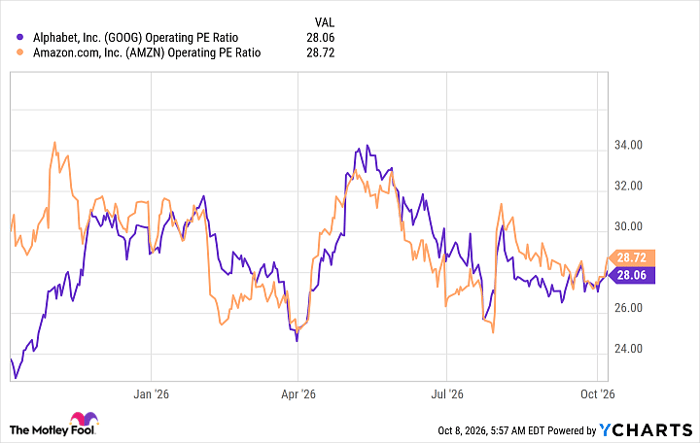
GOOG Operating PE Ratio data by YCharts.
Ever since Alphabet's rally started last year, these two have traded at nearly the same operating P/E ratio, and that's still the case today. As a result, there isn't much of an advantage to choosing one or the other based solely on valuation.
So if you're trying to pick between them as investments, the choice boils down to personal preferences and whether you prefer raw revenue growth or outsize profit growth. I'm in the latter camp, so I'm choosing Amazon. But this is really splitting hairs -- Alphabet is also a worthy investment.
Should you buy stock in Amazon right now?
Before you buy stock in Amazon, consider this:
The Motley Fool Stock Advisor analyst team just identified what they believe are the 10 best stocks for investors to buy now… and Amazon wasn’t one of them. The 10 stocks that made the cut could produce monster returns in the coming years.
Consider when Netflix made this list on December 17, 2004... if you invested $1,000 at the time of our recommendation, you’d have $379,123!* Or when Nvidia made this list on April 15, 2005... if you invested $1,000 at the time of our recommendation, you’d have $1,408,822!*
Now, it’s worth noting Stock Advisor’s total average return is 950% — a market-crushing outperformance compared to 215% for the S&P 500. Don't miss the latest top 10 list, available with Stock Advisor, and join an investing community built by individual investors for individual investors.
See the 10 stocks »
*Stock Advisor returns as of October 11, 2026.
Keithen Drury has positions in Alphabet and Amazon. The Motley Fool has positions in and recommends Alphabet and Amazon. The Motley Fool has a disclosure policy.
Recommended Articles


