


Warren Buffett Held Wells Fargo Stock for More Than 30 Years Before Selling It. Here's the Lesson for Bank Stocks.
Key Points
Wells Fargo was a key Berkshire Hathaway stock for roughly three decades.
However, Buffett soured on Wells Fargo after its phony accounts scandal.
There are lessons to learn from Buffett's long-term investment in Wells Fargo regarding bank stocks and investing in general.
- 10 stocks we like better than Wells Fargo ›
Through decades of investing, Warren Buffett has made more than a few interesting investments. Some stocks Buffett bought in the 1980s remain in Berkshire Hathaway's large stock portfolio today, even though Buffett has now officially left the company.
Even Buffett will admit that he's made mistakes, despite his incredible track record. Wells Fargo (NYSE: WFC) is an interesting case study in Buffett's investments.
Missed Nvidia in 2009? This Rare Signal Is Flashing Again. In 2009, a "Double Down" signal flashed for a little-known chipmaker called Nvidia. For the first time in years, that same "Total Conviction" signal is flashing for a company 1/100th the size of Nvidia. Continue »
Buffett began buying the large bank stock in 1989. But after an extraordinary scandal at the bank, Berkshire eventually exited the position in 2022. Here's what bank investors can learn from this.
Image source: The Motley Fool.
It was initially a love affair
At their core, Buffett and Berkshire are value investors who seek to purchase stocks trading below their intrinsic value. In a 1990 letter to shareholders, Buffett wrote, "Lethargy bordering on sloth remains the cornerstone of our investment style."
In the same letter, Buffett also noted that the company had increased its stake in Wells Fargo to just below 10% that year. The savings and loan crisis had just begun a few years prior, making investors incredibly bearish on the banking sector, an environment that Buffett and his team thrived in and took advantage of:
As one huge loss after another was unveiled -- often on the heels of managerial assurances that all was well -- investors understandably concluded that no bank's numbers were to be trusted... Wells Fargo is big -- it has $56 billion in assets -- and has been earning more than 20% on equity and 1.25% on assets. Our purchase of one-tenth of the bank may be thought of as roughly equivalent to our buying 100% of a $5 billion bank with identical financial characteristics. But were we to make such a purchase, we would have to pay about twice the $290 million we paid for Wells Fargo.
Wells Fargo would remain a core part of Berkshire's portfolio for nearly three decades. However, in 2016, media outlets began reporting on a major scandal at the bank, in which employees had opened roughly 2 million deposit and credit card accounts without customers' consent. The scandal blew up, putting Wells Fargo in the reputational and regulatory hot seat.
In the years after the scandal, the bank would go on to fire many employees and replace top executives and board members. Wells Fargo would also pay billions in fines, undertake a lengthy overhaul of its regulatory infrastructure, and be subject to an asset cap for seven years.
The cap prevented the bank from expanding its balance sheet, a key way banks make money. Buffett began to openly criticize Wells Fargo in 2017, trimming his position.
By 2020, the Oracle of Omaha was calling it a "total disaster," and by 2022, Berkshire had exited the stock. Some reports suggest that Buffett became frustrated with Wells Fargo's board when they ignored his advice and hired banking veteran Charlie Scharf to run the bank.
Several lessons to learn from Buffett's experience with Wells Fargo
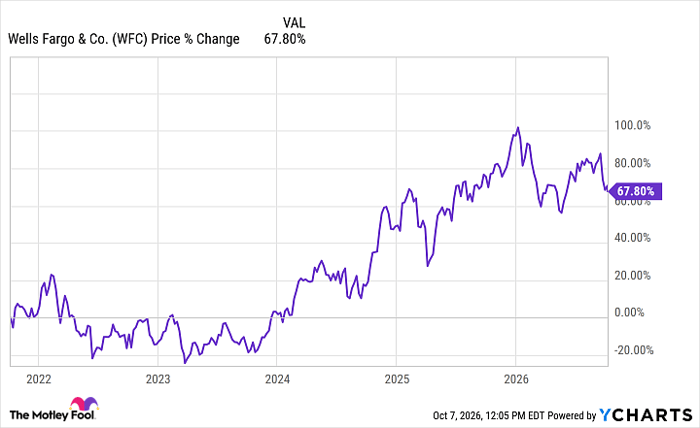
The interesting thing about Wells Fargo after Buffett exited the stock is that Scharf did a good job of turning the bank around and correcting its regulatory deficiencies.
WFC data by YCharts
In fairness to Buffett, the bank may have gotten some help from the Trump administration, which quickly ended many of the remaining consent orders and the bank's asset cap in 2025. It would have happened eventually, but likely not as quickly.
Scharf also made many operational changes at the bank, and Buffett may not have shared in his long-term vision. Wells Fargo's returns also lagged behind its peers for some time as it dealt with regulatory issues.
The first lesson for bank investors is that reputation is immensely important in the sector. Businesses and consumers are less likely to do business with a bank when it suffers reputational damage.
Another lesson is where Buffett may have missed the mark. Even though the stock certainly struggled during periods when it was dealing with regulatory issues, when Scharf came aboard, he frequently spoke about opportunities to make the bank more efficient and to scale capital-light businesses.
Scharf laid out a turnaround plan and executed it. Having followed the bank during this time, I thought he made a clear, compelling case for the stock and ultimately proved that he was the right man for the job.
Buffett's typical investing style is to buy stocks when they are out of style, as long as the thesis makes sense, so I was confused why he was so keen to exit at the time.
I can certainly understand Buffett's frustration. He had held Wells Fargo for years amid the regulatory mess, and it was impossible to tell when the asset cap and other consent orders would be lifted, so he may have felt he couldn't see what the long-term future would look like.
But the other lesson is one Buffett frequently preached throughout his career: Find beaten-down stocks and see if there is a viable long-term turnaround plan. This is one of the most challenging parts of investing, but it can also be the most rewarding.
Should you buy stock in Wells Fargo right now?
Before you buy stock in Wells Fargo, consider this:
The Motley Fool Stock Advisor analyst team just identified what they believe are the 10 best stocks for investors to buy now… and Wells Fargo wasn’t one of them. The 10 stocks that made the cut could produce monster returns in the coming years.
Consider when Netflix made this list on December 17, 2004... if you invested $1,000 at the time of our recommendation, you’d have $385,972!* Or when Nvidia made this list on April 15, 2005... if you invested $1,000 at the time of our recommendation, you’d have $1,416,196!*
Now, it’s worth noting Stock Advisor’s total average return is 951% — a market-crushing outperformance compared to 214% for the S&P 500. Don't miss the latest top 10 list, available with Stock Advisor, and join an investing community built by individual investors for individual investors.
See the 10 stocks »
*Stock Advisor returns as of October 10, 2026.
Wells Fargo is an advertising partner of Motley Fool Money. Bram Berkowitz has no position in any of the stocks mentioned. The Motley Fool has positions in and recommends Berkshire Hathaway. The Motley Fool has a disclosure policy.
Recommended Articles


