


10 Words From the Fed Chair That Could Reshape Market Expectations
Key Points
After the Federal Reserve's Jackson Hole meeting, Kevin Warsh explained that "the Fed's predominant focus right now should be on prices."
Warsh was basically highlighting that inflation is running too high, which the Fed generally fights with rate increases.
If the Fed shifts its stance, altering just 10 words, investors would likely breathe a sigh of relief.
- These 10 stocks could mint the next wave of millionaires ›
Kevin Warsh has dramatically changed the way the Federal Reserve communicates to the markets. His push to provide less guidance is a very big deal, leaving investors to judge the future for themselves. In response, bond yields have risen dramatically over a very short period. Why? Because inflation is running hot right now and, despite the lack of guidance, investors are expecting the Fed to raise interest rates.
Warsh's Jackson Hole speech did nothing to assuage those concerns, as he highlighted that "the Fed's predominant focus right now should be on prices." Those 10 little words are an important statement about the future direction of interest rates. Any adjustment to that wording after the next Fed meeting could reshape market expectations. Here's what you need to know.
Missed AI’s "Act 1"? Act 2 Could Be 15x Bigger. Most investors think they missed the AI boat because they didn't buy Nvidia in 2005. But according to our analysts, we’re only at the end of "Act 1"—the R&D phase. "Act 2" is the global rollout. Continue »

Image source: The Federal Reserve
The dual mandate is currently focused on one thing
The Federal Reserve has a dual mandate to ensure high employment and low inflation. Those two goals can sometimes be at odds, as employment tends to be strongest during periods of rapid economic growth. And rapid economic growth often leads to high inflation. So investors are always trying to parse the Fed chief's words to gauge where the Federal Reserve stands on these two issues.
After the Fed's Jackson Hole meeting, Warsh was very clear on both the employment and inflation pictures. Regarding employment, he stated, "As of now, I believe the labor markets are consistent with full employment." There's no ambiguity in that. Warsh isn't worrying about the employment picture. However, he also noted that, "Inflation is running above our 2 percent target." Again, no ambiguity.
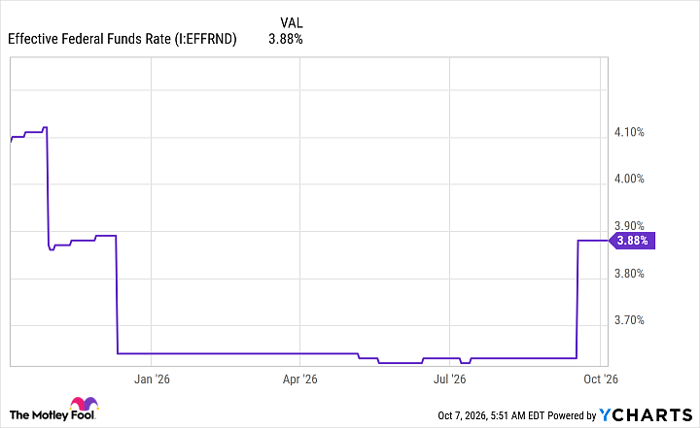
Effective Federal Funds Rate data by YCharts
However, he wasn't done, adding very specifically that, "the Fed's predominant focus right now should be on prices." Although Warsh has declined to provide investors with explicit guidance about interest rates, those 10 words are a clear tell that interest rates are likely to head higher. Notably, Fed interest rate adjustments tend to occur over multiple rate moves, and the last change was an increase.
What could change the interest rate story?
That said, the August personal consumption expenditures price index rose 3.4%. Taking out food and energy costs, which creates a "core" number, the increase was 3%. Both were lower than many market watchers had expected, suggesting that inflation is cooling off. While 3% is still well above the stated 2% target the Fed uses, it is possible that the improvement could lead the Fed to hold off on additional increases in the near term to see where things go from here.
Federal Reserve Board member Neel Kashkari, however, isn't letting up on inflation concerns. He recently told CNBC that "inflation is still too high." Kashkari is just one of many people in the group that ultimately sets interest rates, so his statement is just one view. However, when you consider the backdrop and the 2% Fed inflation target, it seems highly likely that more rate increases are on tap.
Which is why Wall Street will be closely monitoring Kevin Warsh's words, as he heads up the committee that sets rates. If he shifts the language around the Fed's "predominant focus," it could be an indication of what to expect from the Fed in the months ahead.
Don't overlook the opportunities being created
The lack of guidance from the Fed has left investors more concerned about the future. With bond yields on the rise, dividend stocks in sectors such as real estate investment trusts, utilities, and consumer staples have been selling off as investors switch from high-yield stocks to bonds. Only bonds are a static financial commitment, and the interest being paid doesn't change. Companies can grow, and their dividends can increase.
The uncertain rate environment is challenging, but it could also open an opportunity for long-term dividend investors to buy well-run businesses at attractive prices. That remains true regardless of what Warsh is saying to the market.
Where to invest $1,000 right now
When our analyst team has a stock tip, it can pay to listen. After all, Stock Advisor’s total average return is 951%* — a market-crushing outperformance compared to 214% for the S&P 500.
They just revealed what they believe are the 10 best stocks for investors to buy right now, available when you join Stock Advisor.
See the stocks »
*Stock Advisor returns as of October 9, 2026.
The Motley Fool has a disclosure policy.
Recommended Articles


