


Netflix Is Reportedly Cutting 5% of Its Staff. Its 2022 Layoffs Came Days After the Stock Bottomed.
Key Points
Netflix had around 16,000 full-time employees at the end of 2025, so a 5% cut would be about 800 jobs.
Netflix's marketing, technology, and administrative costs climbed 18% in the second quarter of 2026, while revenue grew 13%.
The first of Netflix's two big 2022 layoff rounds came four trading days after the stock's lowest close in that slide.
- 10 stocks we like better than Netflix ›
Netflix (NASDAQ:NFLX) plans a restructuring that would cut around 5% of its staff and may be announced as early as next week, Puck reported on Friday. Netflix declined to comment, so for now the cuts are only reported.
But the scale stands out. The streaming giant had around 16,000 full-time employees at the end of 2025, which puts a 5% cut at about 800 jobs. That'd be over the 450 or so jobs Netflix shed across two rounds in 2022, its latest big layoffs.
Missed AI’s "Act 1"? Act 2 Could Be 15x Bigger. Most investors think they missed the AI boat because they didn't buy Nvidia in 2005. But according to our analysts, we’re only at the end of "Act 1"—the R&D phase. "Act 2" is the global rollout. Continue »
And the first of those 2022 rounds came just four trading days after the stock's lowest close in that slump.
Shares trade around $71 as of this writing -- about four times the 2022 low, but still 47% under the record close of $133.91 the stock set in June 2025. Does a fresh round of cuts mean what it meant then?
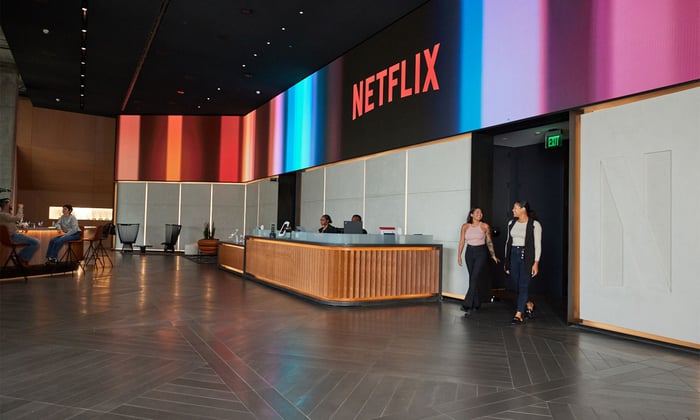
Image source: Netflix.
Spending is growing faster than sales
Netflix's spending outside content helps explain why management may want a smaller staff.
Showing how fast these costs are climbing, Netflix's sales and marketing, technology and development, and general and administrative expenses rose a combined 18% year over year in the second quarter of 2026, to around $2.3 billion. In the same three months, revenue grew 13% to $12.6 billion. Technology and development, the line that includes most of the pay for Netflix's tech workers, jumped 22% by itself. Netflix said the increase came mostly from a $142 million rise in personnel-related costs.
Headcount also kept rising. Netflix finished 2025 with around 2,000 more full-time employees than it did a year before.
The spending gap is opening while revenue growth slows. Netflix's revenue climbed 18% year over year in the fourth quarter of 2025. Growth then cooled to 16% in 2026's first quarter and to 13% from April through June. Management's forecast is for around 12% in the third quarter.
Meanwhile, Netflix is still targeting a 31.5% operating margin for 2026, up from 29.5% in 2025. Shedding around 5% of its staff won't do much to its content costs, the company's largest expense. But it might help bring these other costs back toward the rate of revenue growth, and I think that's where the cuts are most likely aimed.
The 2022 cuts
Netflix has done this before, for almost the same reason.
In April 2022, the streamer reported a drop of 200,000 paid memberships in the first quarter, its first such decline in over a decade. It also forecast a loss of 2 million more in the second quarter, and its first-quarter revenue growth had cooled to 10%. The stock fell 35% the next day.
Shares kept slipping until May 11, 2022, when they closed at around $16.64 on a split-adjusted basis. On May 17, Netflix let around 150 workers go. A second round of about 300 followed on June 23.
"While we continue to invest significantly in the business, we made these adjustments so that our costs are growing in line with our slower revenue growth," a Netflix spokesperson said about the June cuts.
Looking back, the first round came near the bottom. But the stock closed at about $16.75 on June 14, just above its May low, so the layoffs didn't turn it around by themselves.
The recovery arguably owed more to new revenue. Netflix launched a cheaper ad-supported plan in November 2022 and rolled out charges for account sharing widely in 2023.
Is this 2022 again?
I don't think so, at least not on the numbers. In 2022, Netflix was losing members and said it would manage to a minimum operating margin of around 19% to 20% as it worked to reaccelerate growth. Today, it's still growing revenue at a double-digit pace, and its operating margin in the second quarter of 2026 was 33.4%.
In other words, this round looks less like a defensive step and more like a company trying to keep profit growth ahead of slowing sales. What's more, Netflix says its 2026 forecast implies operating income growth of over 20%.
Of course, investors aren't paying a growth stock price for that.
At roughly $71, the shares trade at about 19 times earnings, using analysts' average estimate of 2027 profits. It's a modest price-to-earnings ratio for a business expecting profit growth like that, and I think the price already assumes growth keeps easing.
Still, I'm not seeing this round of cuts as a sign that the stock has bottomed. The 2022 layoffs lined up with the low, but what boosted the shares after that was growth coming back, first in members and then in revenue. Netflix's revenue growth is still slowing now, and cutting around 800 jobs can help its margin without doing much to speed up sales.
Should you buy stock in Netflix right now?
Before you buy stock in Netflix, consider this:
The Motley Fool Stock Advisor analyst team just identified what they believe are the 10 best stocks for investors to buy now… and Netflix wasn’t one of them. The 10 stocks that made the cut could produce monster returns in the coming years.
Consider when Netflix made this list on December 17, 2004... if you invested $1,000 at the time of our recommendation, you’d have $385,972!* Or when Nvidia made this list on April 15, 2005... if you invested $1,000 at the time of our recommendation, you’d have $1,416,196!*
Now, it’s worth noting Stock Advisor’s total average return is 951% — a market-crushing outperformance compared to 214% for the S&P 500. Don't miss the latest top 10 list, available with Stock Advisor, and join an investing community built by individual investors for individual investors.
See the 10 stocks »
*Stock Advisor returns as of October 9, 2026.
Daniel Sparks and his clients do not have positions in any of the stocks mentioned. The Motley Fool has positions in and recommends Netflix. The Motley Fool has a disclosure policy.
Recommended Articles


