


Prediction: This Will Be AMD's Stock Price in 1 Year
Key Points
AMD has made its growth expectations for 2027 clear, yet the market still prices it at a huge premium.
AMD's stock price could decline in 2027 if its valuation returns to a level more in line with those of its peers.
- 10 stocks we like better than Advanced Micro Devices ›
AMD (NASDAQ: AMD) has had an incredible 2026, and since January, the stock has tripled in price to about $650 per share. Investors love to see a stock do that well, but past returns mean nothing now; all that matters is what's coming in the future.
So, where will AMD's stock price be a year from now?
Missed Nvidia in 2009? This Rare Signal Is Flashing Again. In 2009, a "Double Down" signal flashed for a little-known chipmaker called Nvidia. For the first time in years, that same "Total Conviction" signal is flashing for a company 1/100th the size of Nvidia. Continue »
Image source: The Motley Fool.
AMD's monster rally comes at a cost
AMD has delivered huge stock price growth, but there's one problem: It hasn't been matched on the business side. In the second quarter, AMD's revenue grew 50% year over year. In a vacuum, that's a pretty impressive growth rate. But when you compare it to its peers, it's actually pretty slow. The reason is that AMD's data center segment makes up comparatively less of the overall business. Data center revenue grew 107% year over year in Q2 to about $5.8 billion, a little more than half of its overall total. That was a great performance, but it still lags its peers.
Despite this, AMD stock has gone on an absolute tear over the past few months, pushing its valuation to extreme levels.
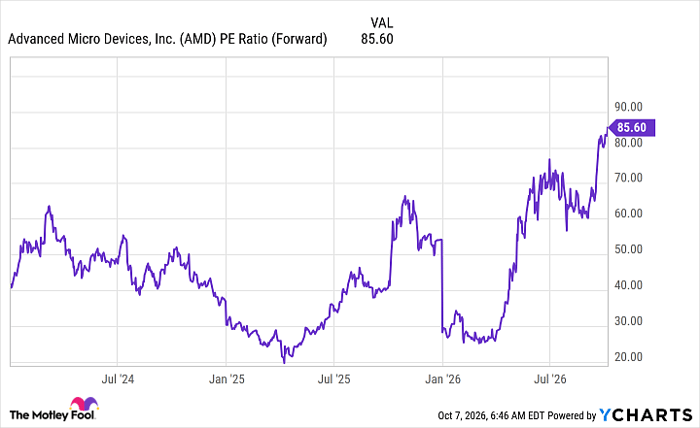
AMD PE Ratio (Forward) data by YCharts.
The question is, what is a reasonable price to pay for an AI computing company like AMD? I'd argue that 30 times forward earnings is more than a fair price to pay, considering industry peers Nvidia (NASDAQ: NVDA) and Broadcom (NASDAQ: AVGO) trade at 26 and 32 times forward earnings, respectively, and are growing far faster than AMD.
So, at face value, AMD's stock looks dramatically overvalued. But if it can deliver strong growth in 2027, that overrides that projection.
Based on analysts' earnings estimates for AMD in 2027, the stock trades at 41 times next year's earnings.
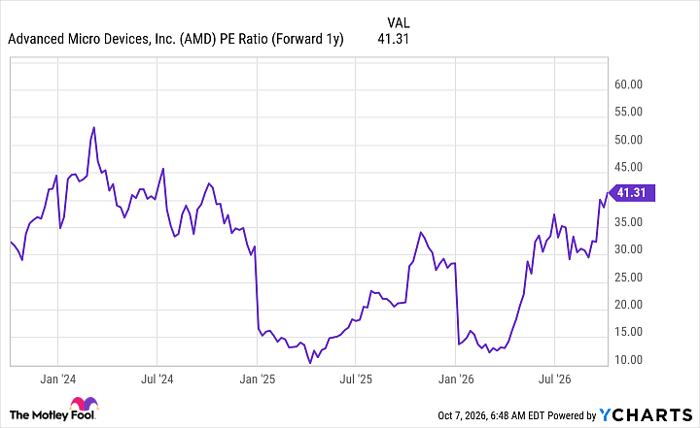
AMD PE Ratio (Forward 1y) data by YCharts.
So, even after Wall Street projects AMD will more than double its 2026 earnings next year, the stock is still 25% higher than our target valuation.
With that in mind, I wouldn't be surprised to see AMD's stock trading 25% lower this time next year, at about $500 per share. However, that assumes that Wall Street analysts' projections for next year are correct. AMD could get a few major chip orders for 2027 that boost its earnings to far higher levels.
However, most of the deals for 2027 chipmaking capacity are already assigned, so AMD's near future is going to be determined more by matters of execution. I think a lot of that is priced in already, and expecting AMD to rise any further over the coming year from a fundamental business standpoint is not realistic. Hubris can take a stock a long way, so I'm not actively betting against AMD. However, there are better AI investments out there, and investors should look at those first.
Should you buy stock in Advanced Micro Devices right now?
Before you buy stock in Advanced Micro Devices, consider this:
The Motley Fool Stock Advisor analyst team just identified what they believe are the 10 best stocks for investors to buy now… and Advanced Micro Devices wasn’t one of them. The 10 stocks that made the cut could produce monster returns in the coming years.
Consider when Netflix made this list on December 17, 2004... if you invested $1,000 at the time of our recommendation, you’d have $385,972!* Or when Nvidia made this list on April 15, 2005... if you invested $1,000 at the time of our recommendation, you’d have $1,416,196!*
Now, it’s worth noting Stock Advisor’s total average return is 951% — a market-crushing outperformance compared to 214% for the S&P 500. Don't miss the latest top 10 list, available with Stock Advisor, and join an investing community built by individual investors for individual investors.
See the 10 stocks »
*Stock Advisor returns as of October 9, 2026.
Keithen Drury has positions in Broadcom and Nvidia. The Motley Fool has positions in and recommends Advanced Micro Devices, Broadcom, and Nvidia. The Motley Fool has a disclosure policy.
Recommended Articles


