


Nvidia and AMD Lead the AI Market. 1 Chip Stock Has Far Greater Upside.
Key Points
AMD's valuation has gotten a bit out of hand.
Nvidia's growth is set to continue and outpace AMD's.
- 10 stocks we like better than Advanced Micro Devices ›
Nvidia (NASDAQ: NVDA) and Advanced Micro Devices (NASDAQ: AMD) are two of the biggest names in AI computing. While Nvidia holds a larger market share and was the first to dominate the AI computing space, AMD has emerged as a viable competitor in recent months. In 2026, AMD's stock has outperformed Nvidia's, rising about 200% compared to Nvidia's 30% rise. But the past is in the past. Which stock has more upside in the future?
Let's take a look at what's going on with these two and see which one makes the most sense for your investment dollars.
Missed AI’s "Act 1"? Act 2 Could Be 15x Bigger. Most investors think they missed the AI boat because they didn't buy Nvidia in 2005. But according to our analysts, we’re only at the end of "Act 1"—the R&D phase. "Act 2" is the global rollout. Continue »
Image source: The Motley Fool.
AMD has a premium valuation to Nvidia
Let's look at valuation. When a stock triples in a year, it has a tendency to become overvalued, as a ton of future growth expectations are pulled into it. That's exactly what has happened with AMD, as it has gotten pretty pricey.
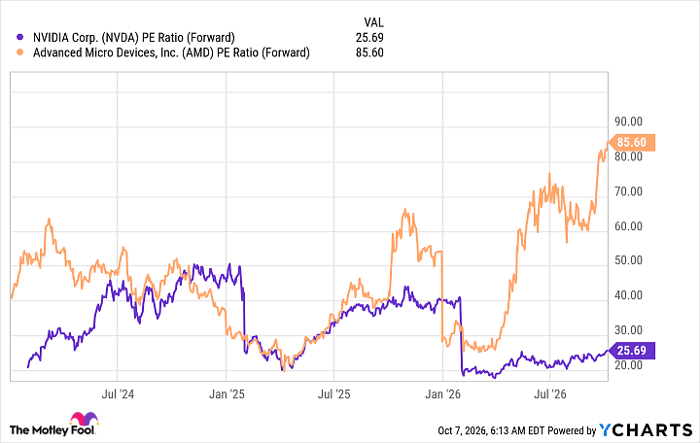
NVDA PE Ratio (Forward) data by YCharts. PE = price-to-earnings.
AMD's forward price-to-earnings ratio has taken off over the past six months, with another rally in recent weeks. This rally was triggered by AMD announcing a 10% price hike in mid-September. However, AMD shares are more than triple the price tag of Nvidia shares, and that is the biggest red flag for it right now.
Essentially, a single Nvidia share represents over three times as much of the company as an AMD share does. This is an issue, as Nvidia is still growing faster than AMD is.
AMD still doesn't compare to Nvidia
With how well AMD has done in 2026, you'd think it would be crushing Nvidia, but it's not.
During the second quarter, Nvidia's data center divisions grew at a 117% pace to $89 billion. Overall, revenue growth was 106% year over year to $96 billion.
AMD's business is far more diversified than Nvidia's, and it isn't as concentrated in data center revenue as Nvidia is. This is hurting AMD's overall results, as it grew 50% year over year to $11.5 billion. Its data center division fared better, rising 107% to $6.7 billion, but that is still slower than Nvidia's growth, despite it being a much smaller company.
Over the next year, AMD has several positive catalysts, such as a 6-gigawatt agreement to provide OpenAI with computing power. AMD is also powering Meta Platforms' (NASDAQ: META) blockbuster AI agent, Meta Muse. This has triggered recent demand for the stock, but there's one problem: it's already priced into AMD's stock. This is the biggest problem, as AMD must triple its earnings after 2026 to get to a valuation comparable to Nvidia's current level.
The problem is, Nvidia is no slouch, either. Nvidia has several major agreements with the AI hyperscalers in place to deliver huge amounts of computing power as well. Nvidia's products are still the industry standard, and any product AMD launches will always be compared to Nvidia.
Furthermore, Nvidia has a new chip architecture launching in the second half of this year, Vera Rubin. Investors have long pointed to AMD's product potentially rising in popularity as AI shifts more to inference versus training workloads. Still, Vera Rubin chips can deliver 10 times less token cost per inference versus previous-generation Blackwell chips.
This puts a damper on the "AMD will steal market share" thesis, and with Nvidia's management team telling investors that it estimates it will grow revenue at a 70% pace in 2027, it looks like a solid stock pick.
Nvidia has far greater upside than AMD, given its modest valuation and the potential for faster growth from its higher exposure to data center revenue. This makes it a better stock to pick, and despite being the world's largest company, I think Nvidia has way more upside.
Should you buy stock in Advanced Micro Devices right now?
Before you buy stock in Advanced Micro Devices, consider this:
The Motley Fool Stock Advisor analyst team just identified what they believe are the 10 best stocks for investors to buy now… and Advanced Micro Devices wasn’t one of them. The 10 stocks that made the cut could produce monster returns in the coming years.
Consider when Netflix made this list on December 17, 2004... if you invested $1,000 at the time of our recommendation, you’d have $385,972!* Or when Nvidia made this list on April 15, 2005... if you invested $1,000 at the time of our recommendation, you’d have $1,416,196!*
Now, it’s worth noting Stock Advisor’s total average return is 951% — a market-crushing outperformance compared to 214% for the S&P 500. Don't miss the latest top 10 list, available with Stock Advisor, and join an investing community built by individual investors for individual investors.
See the 10 stocks »
*Stock Advisor returns as of October 9, 2026.
Keithen Drury has positions in Meta Platforms and Nvidia. The Motley Fool has positions in and recommends Advanced Micro Devices, Meta Platforms, and Nvidia. The Motley Fool has a disclosure policy.
Recommended Articles


