


Broadcom Stock Forecast: $115 Billion AI Outlook Meets a New $60 Billion Financing Test
TradingKey - Broadcom (NASDAQ: AVGO) starts October with its AI accelerator and networking businesses soaring, but investors are starting to look more closely at how next-gen AI infrastructure will be funded. AVGO closed October 8 at $360.14, down 4.35%, after the selling in the semiconductor space renewed worries about AI spending, and more debt being piled on to support large AI deployments.
What's interesting is the selloff is not reflective of AI chip businesses having weak current operating performance. Broadcom just reported record revenue, operating profit and free cash flow, while AI semiconductor revenue more than tripled year over year. The conversation has moved beyond the existence of demand and to Broadcom’s ability to keep monetizing that demand without becoming over-leveraged financially to its customers.
Broadcom Unveils Its Next AI Networking Platform
On October 8, Broadcom published the AI networking technologies that it will feature at the 2026 Open Compute Project Global Summit, scheduled from October 12 to October 15, in San Jose. The technologies feature third-generation TH6-Davisson co-packaged optics, Tomahawk 6 and Tomahawk Ultra switches, Jericho 4 switches, Thor Ultra and Thor 2 AI Ethernet NICs, and other next-generation AI networking products and technologies.
Hyperscalers are increasingly building very large AI clusters composed of hundreds of thousands of accelerators. These very large AI clusters introduce unique challenges that weren’t present in earlier, smaller AI clusters. For example, along with thousands of high performance computing (HPC) accelerators, very large AI clusters require AI networking products that enhance bandwidth, reduce latency, and improve power and optics efficiency.
I see Broadcom in a unique position to benefit from the megatrends of AI. Hyperscalers and national labs are building huge AI clusters. Broadcom is uniquely positioned to capitalize on both the processors (XPUs) as well as the AI connectivity fabric. Broadcom can participate in HPC and AI cluster infrastructure spending in multiple ways.
Q3 AI Semiconductor Revenue Jumps 221%
Broadcom reported Q3 revenue of $29.59 billion, up 86% year-over-year. GAAP operating income was $15.96 billion and non-GAAP operating income was $20.10 billion, up 92% year-over-year. Non-GAAP diluted EPS was $3.32, up 96% year-over-year.
Revenue from AI semiconductors was $16.7 billion, up 221% year-over-year and up 54% sequentially. That business represented more than 50% of Q3 revenue and is quickly becoming the biggest driver of Broadcom’s valuation.
According to CEO Hock Tan, the company is projecting AI semiconductor revenue to be $21.7 billion in Q4, up 236% year-over-year. Keep in mind that these are staggering growth numbers even after the company has already operated at this large scale.
The $115 Billion and $230 Billion AI Outlook Changes the Valuation Debate
According to management, Broadcom expects approximately $115 billion in revenue from AI semiconductors in fiscal 2027, and has line of sight to approximately $230 billion in fiscal 2028. As stated by Broadcom management, $115 billion and $230 billion reflect the company’s visibility into customer deployments and secured supply, and the multi-year buildout of the custom accelerators and networking infrastructure.
This outlook highlights why Broadcom is now trading like a core AI infrastructure company, versus a broad line semiconductor and software company. It raises the bar for Broadcom significantly. Investors are pricing in not only strong current demand, but sustained, and arguably the most significant and largest customer demand in the industry, over a multi-year period.
Concentration risk remains. Broadcom is benefiting from long-duration programs with frontier AI labs and hyperscale customers, however, Hyperscalers are deploying extraordinary levels of Capex. If market conditions change, or if the deployment schedule changes, Broadcom’s revenue outlook could change, and the volatility in Broadcom’s revenue may not correlate with the headline demand.
Custom XPUs Differentiate Broadcom From Nvidia
The custom AI accelerator business is the main area of differentiation between Broadcom and Nvidia. At this time, Broadcom is heavily engaged across the hyperscale cloud and edge in frontier AI. Broadcom’s customers have designs that are tailored to specific customer needs, offering an alternative to relying on general purpose Nvidia GPUs.
Meta is an example. Meta is working with Broadcom to help design its Iris AI chip under the MTIA program, while TSMC manufactures the chip.
OpenAI is another good example. Broadcom co-designed OpenAI’s Jalapeño processor, which is manufactured by TSMC. Its AI platform is also used in other projects tied to Google and Anthropic.
Broadcom’s model is strategically attractive as it lets customers build the AI chips they want and still rely on Broadcom for the chip and networking design. It is also attractive as it allows customers to take a different approach from Nvidia. Broadcom is also benefitting from this model.
Anthropic Financing Is Becoming a New Credit Risk
There have been new disclosures around financing. Anthropic disclosed in its IPO prospectus that Broadcom agreed to provide up to $42 billion of financing for Anthropic’s infrastructure and TPU leasing.
It's more complex than a typical term loan. According to Reuters, Broadcom can designate financing partners and the arrangement includes convertible-note mechanics. Separately, Bloomberg reported that Broadcom’s Wall Street syndicate was gathering $60 billion of fresh AI-chip financing to benefit Anthropic and other customers.
As reported, the planned $60 billion package includes a $42 billion senior-secured tranche that Broadcom would backstop through residual-value support, plus an $18 billion junior tranche led by Blackstone without the same Broadcom support. Broadcom is therefore not simply writing a $60 billion check.
For investors, there are some changes from Broadcom's traditional semiconductor business. In particular, revenue can grow faster as customers can deploy end-to-end infrastructure faster. However, credit, counterparty, and concentration risk is elevated.
OpenAI Financing Adds Another Layer
The Wall Street Journal reported that Broadcom was lining up about $50 billion of financing tied to OpenAI’s AI infrastructure. Like the funding announcement for OpenAI, this structure is not finalized, and as such, should be considered a proposed financing program.
This is important because more scrutiny is being placed on the recent disclosures by OpenAI on their revenue. Reuters reported on October 8 that OpenAI’s September annualized revenue was approximately $50 billion, not the nearly $70 billion, as earlier reported.
This doesn’t preclude OpenAI from funding additional infrastructure, but it shows the broader market concern of AI labs accelerating their compute commitments faster than the maturity of their cash generation. Broadcom’s customer demand remains, but the quality of financing for that demand is becoming more crucial.
VMware Is Becoming a Second AI Platform
Broadcom’s infrastructure software business is also meaningfully growing. In Q3, infrastructure software revenue grew about 29% year-over-year to approximately $8.75 billion, and annual recurring revenue continued to trend up.
The VMware acquisition is being focused on private AI more and more. Also, Broadcom has been investing in products that would let customers run AI agents and models in their private cloud to control their data and workloads.
Broadcom is building a hard and soft private AI investment platform with VMware. Hyperscalers and frontier labs can buy custom accelerators and networking hardware from Broadcom. Enterprises can procure private AI infrastructure through VMware. The combination gives Broadcom an edge in both directions of the same spend cycle.
Free Cash Flow Remains Exceptionally Strong
One of the key advantages of Broadcom is the cash the company is able to generate. Cash flow from operations in Q3 was $14.2 billion. Capital expenditures were only about $500 million. As a result, free cash flow for the quarter was $13.7 billion. Free cash flow as a percent of revenue was approximately 46%.
The company also maintained its quarterly common dividend at $0.65 per share. Capital intensive construction of data center campuses is not required of Broadcom, like it is of the cloud hyperscalers. As a result, Broadcom is able to fund its cash dividend at a very high rate.
It is important to note, Broadcom’s cash flow generation is going to become even more important to monitor. Financing provided by Broadcom to its end customers is likely going to constrain Broadcom’s financial flexibility to a greater extent, to a counterparty whose infrastructure and capital intensive projects are more heavily regulated.
Q4 Guidance Sets Another High Bar
For Fiscal Q4, Broadcom is expecting revenue of approximately $34.8 billion, an increase of approximately 93% from the year ago quarter. Non-GAAP operating income is anticipated to be approximately 66% of revenue.
There is no confirmed date for Broadcom’s Fiscal Q4 2026 earnings release at this time. I would look for updates and treatment of the December time frame, as tentative.
For the next earnings release, I would monitor progress towards the $21.7 billion AI semiconductor revenue target. Additionally, updates on the custom XPU deployments, networking growth, revenue recognition for VMware, Anthropic and OpenAI financing and any other color would be appreciated.
Valuation Still Prices in Exceptional Execution
As of the close on October 8, Broadcom’s market cap was roughly $1.72 trillion. The stock trades at around 46x trailing earnings and 21x forward earnings, reflective of the market’s view that AI growth will be extraordinary going forward.
Broadcom is growing quickly, but the forward multiple is not extreme, and the revenue assumptions are large. Broadcom is running out of ways to grow beyond networking and VMware, and is starting to enter more dangerous and risky areas (like frontier AI labs), while avoiding major credit losses.
I think this is the key investment question. If Broadcom’s AI business continues to be large and profitable while not jeopardizing Broadcom’s own financials, then a premium is justified. However, Broadcom is starting to finance customer AI projects to an increasing degree (i.e. becoming a bank), and the growth begins to be less quality and more questionable.
Broadcom Technical Analysis: AVGO Drops 4.35% as $358 Support Faces Fresh Pressure
Broadcom closed at $360.14 on October 8, down 4.35% and back below the $370 level. The current pattern has price moving up to a resistance zone before moving down to a support zone. The recent move down from the $371.83 to $372.18 zone and the break of both the moving averages at $366.97 to $371.83 was bearish. Broadcom has also broken the rising trendline and bearish variation of a rising wedge pattern.
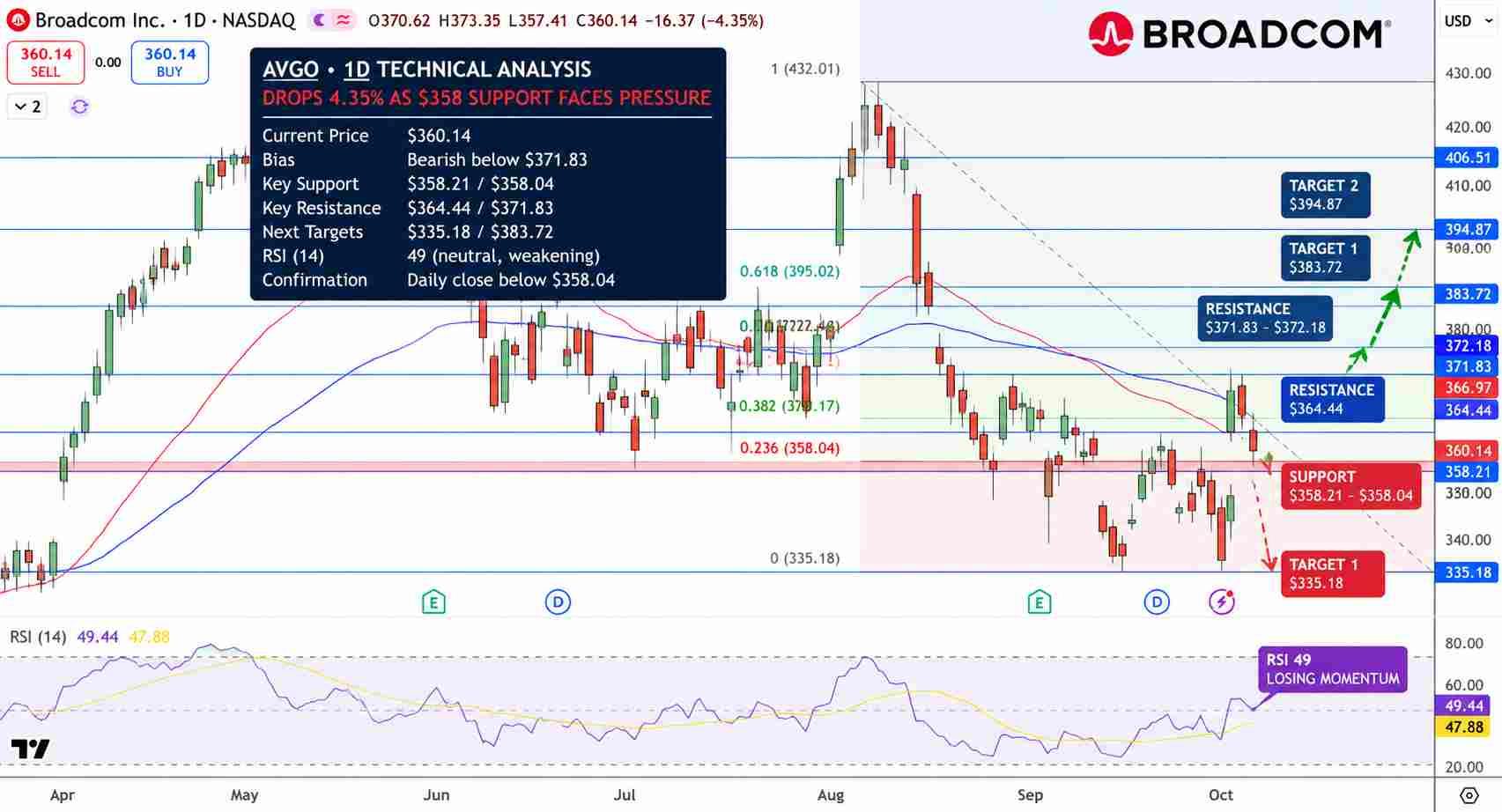
Broadcom Stock Price Chart - Source: Tradingview
Relative Strength Index (RSI) is around 49, slightly above its signal line at 48, but still below the neutral 50 level. This suggests the recent positive price move may be slowing, but a decisive bearish move is not present.
The nearest support zone is at $358.21 to $358.04. This zone also aligns with the 23.6% Fibonacci retracement from the recent move up to the $364.44 to $366.97 area. A breakdown below this zone would expose the $335.18 level.
The $364.44 to $366.97 area is the first target on the upside, with the $371.83 to $372.18 area the next target. The $383.72 level is the next major target beyond the $372.18 area. A break and close above the $372.18 area would negate the bearish bias. Broadcom is currently bearish below the $371.83 to $372.18 area.
Why is Broadcom stock in focus now?
AI semiconductor revenue surged 221% in Q3. Management expects approximately $115 billion of AI semiconductor revenue in fiscal 2027. Additionally, Broadcom has been part of the financing structures to support major AI customers like Anthropic and OpenAI.
What level confirms a stronger AVGO recovery?
A daily close above $372.18 confirms that the key resistance cluster has been reclaimed and supports a move to $383.72. A close below $358.04 reaffirms the bearish setup and supports a move to $335.18.
Bottom Line
Broadcom has one of the strongest AI growth profiles in the semiconductor industry for October. All divisions from Custom Chips, Semiconductor, Networking to VMWare are participating in this growth. Q3 free cash flow reached an impressive $13.7 billion and management's AI revenue outlook is exceptional.
Risk is that financing structures around that growth are becoming complex. Broadcom is clearly selling chips, but also has a financing relationship with customers that allows them to grow their AI businesses. From a technical viewpoint, the $372.18 level is crucial resistance, but above that, the focus is on whether Broadcom can deliver $115 billion of expected AI revenue without taking on the majority of the risk.
Recommended Articles


