


Palantir Looks Like a Consulting Company. Its Numbers Tell a Different Story.
Key Points
Palantir uses a consulting strategy to sell its Artificial Intelligence Platform (AIP).
While its business model looks like that of a consulting agency, Palantir generates extremely high profit margins.
Palantir's valuation makes the stock look expensive, but the company's AI-driven growth may justify the premium.
- 10 stocks we like better than Palantir Technologies ›
There is a criticism of Palantir Technologies (NASDAQ: PLTR) that refuses to go away. For all the praise surrounding its artificial intelligence (AI) software, Palantir sends engineers directly into customer organizations to solve problems. On the surface, this sounds like consulting.
While there is some truth to that comparison, Palantir's forward deployed engineers work alongside customers rather than simply handing them a software toolkit and walking away. Focusing on this process misses what Palantir is actually selling -- and, more importantly for investors, the economics of the business.
Missed AI’s "Act 1"? Act 2 Could Be 15x Bigger. Most investors think they missed the AI boat because they didn't buy Nvidia in 2005. But according to our analysts, we’re only at the end of "Act 1"—the R&D phase. "Act 2" is the global rollout. Continue »
If Palantir were really a consulting firm disguised as an AI company, its financial statements would eventually expose that. Instead, they're telling almost the exact opposite story.
Image source: Getty Images.
Palantir's engineers are not traditional consultants
Palantir calls its sales approach forward deployed engineering. The idea is straightforward: engineers go directly into organizations, learn how those businesses operate, integrate Palantir's technology with their systems, and build data workflows around real-world problems.
Although this has consulting characteristics, there's an important difference. A traditional consulting firm like Accenture, Booz Allen Hamilton, or McKinsey, primarily monetize the time and expertise of its employees. Palantir's engineers are deploying the company's Artificial Intelligence Platform (AIP), a suite of software programs that can be used across an entire organization in different departments.
Palantir's AIP Bootcamps reinforce the business model. Prospective customers can demo AIP and work directly with Palantir to build use cases in a matter of hours or days. Once customers see how the software works against their own pain points, Palantir can expand the relationship quickly -- keeping customers sticky in the process.
Palantir's financials look nothing like a consulting firm
Palantir's second-quarter results were remarkable. Total revenue surged 93% year over year to $1.94 billion. U.S. commercial revenue accelerated 149% to $764 million, while U.S. government revenue climbed 90% to $809 million.
During the quarter, Palantir closed 220 deals worth at least $1 million, including 73 worth at least $10 million. Meanwhile, U.S. commercial remaining deal value (RDV) increased 124% to $6.24 billion.
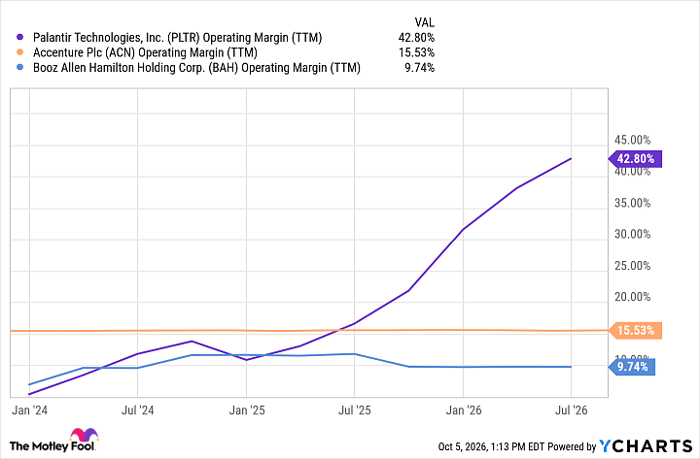
Margins tell investors the most important part of the story. Palantir generated $1.2 billion in adjusted operating income, producing a jaw-dropping 62% adjusted operating margin. Adjusted free cash flow also reached $1.2 billion, representing a 63% margin. Those aren't the economics of a consulting company.
PLTR Operating Margin (TTM) data by YCharts
Consulting is inherently labor intensive, meaning it is low-margin. Palantir, by contrast, is demonstrating impressive operating leverage as revenue scales. Think of it this way: Palantir's software can be deployed across customers without expenses rising proportionately with sales.
What's even more encouraging is Palantir has multiple avenues for expansion. AIP and Foundry are penetrating commercial enterprises while Gotham is increasingly embedded across defense agencies and national security workloads. In addition, sovereign governments increasingly want AI capabilities and secure data infrastructure. This gives Palantir exposure to commercial AI, defense modernization, and sovereign technology spending all at once.
Palantir's valuation is another blemish
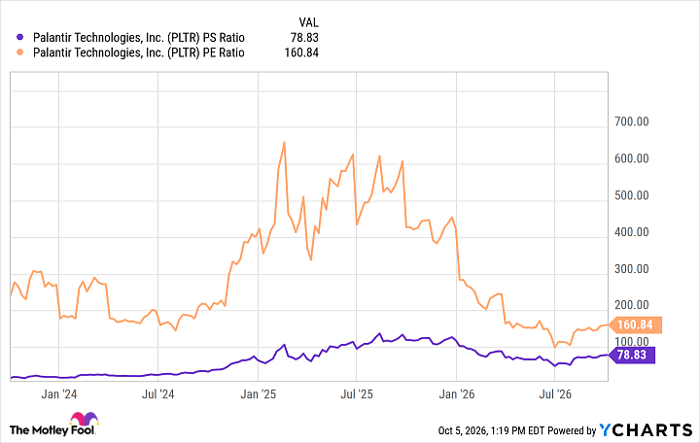
Another argument against Palantir stock revolves around valuation. As of this writing (Oct. 5), Palantir trades at roughly $189 per share and commands a market capitalization around $453 billion. The stock boasts a price-to-sales (P/S) ratio of 78 and a price-to-earnings (P/E) multiple of 160.
PLTR PS Ratio data by YCharts
Under conventional valuation frameworks, those multiples are difficult to justify. I see another side to the argument, though. A P/S ratio becomes considerably less informative when revenue is growing 93% year over year while operating margins simultaneously expand. Likewise, as the chart above illustrates, a P/E ratio can fall surprisingly quickly when earnings compound rapidly.
While this does not mean I'd buy into Palantir's momentum at any price, I do think the trends above should encourage investors to think more deeply about what the company's profitability profile could look like several years from now rather than simply looking at today's ratios and stopping there.
All told, Palantir's forward deployed engineers might make the company look like a consultancy, but its financial trajectory resembles an unusually scalable software business. This makes Palantir one of the most interesting long-term AI stocks.
I view Palantir as a stock to accumulate selectively rather than chasing after big rallies. By using dollar-cost averaging, investors can steadily build a position in Palantir at different price points over a long-term time horizon. This will give you the flexibility to build or trim your position as you see fit based on the company's growth over the next several years.
Should you buy stock in Palantir Technologies right now?
Before you buy stock in Palantir Technologies, consider this:
The Motley Fool Stock Advisor analyst team just identified what they believe are the 10 best stocks for investors to buy now… and Palantir Technologies wasn’t one of them. The 10 stocks that made the cut could produce monster returns in the coming years.
Consider when Netflix made this list on December 17, 2004... if you invested $1,000 at the time of our recommendation, you’d have $375,887!* Or when Nvidia made this list on April 15, 2005... if you invested $1,000 at the time of our recommendation, you’d have $1,459,146!*
Now, it’s worth noting Stock Advisor’s total average return is 955% — a market-crushing outperformance compared to 215% for the S&P 500. Don't miss the latest top 10 list, available with Stock Advisor, and join an investing community built by individual investors for individual investors.
See the 10 stocks »
*Stock Advisor returns as of October 8, 2026.
Adam Spatacco has positions in Palantir Technologies. The Motley Fool has positions in and recommends Accenture Plc, Booz Allen Hamilton, and Palantir Technologies. The Motley Fool recommends the following options: long January 2028 $260 calls on Accenture Plc and short January 2028 $280 calls on Accenture Plc. The Motley Fool has a disclosure policy.
Recommended Articles


