


Should You Buy Stocks in October? History’s Answer is Strikingly Clear.
Key Points
The S&P 500 is advancing in the double digits in 2026, but headwinds have multiplied.
AI stocks powered the benchmark higher in recent years.
- 10 stocks we like better than S&P 500 Index ›
October has been known for some of the worst stock market events in history, from the crash of 1929 to Black Monday in 1987. And more recently, the subprime market collapse triggered a stock market crash that also took place in the month of October.
That is why many investors may worry about investing right now. Though the S&P 500 has advanced in the double digits this year, a number of concerns have periodically weighed on the market -- and at any point, one or more of these could lead to declines. These include general risks such as a difficult economy, as well as industry-specific concerns such as the pace of investment in the artificial intelligence (AI) infrastructure build-out.
Missed AI’s "Act 1"? Act 2 Could Be 15x Bigger. Most investors think they missed the AI boat because they didn't buy Nvidia in 2005. But according to our analysts, we’re only at the end of "Act 1"—the R&D phase. "Act 2" is the global rollout. Continue »
Though August was a bright month for stocks, with the S&P 500 climbing more than 2% and corporate earnings hitting it out of the park, September finished in the doldrums with a loss of 0.4%. Against this backdrop, you may be asking yourself whether you should buy stocks in October. History's answer is strikingly clear.

Image source: Getty Images.
What's driven this bull market
First, let's take a closer look at what's driven this bull market in recent years and the elements of concern that have emerged. AI stocks have powered benchmarks, including the S&P 500, higher over the past few years amid optimism regarding this technology's potential to supercharge earnings growth. AI applied to the needs of businesses could make them more efficient, lower their costs, and support innovation. And these are just a few of the benefits AI can bring. All of this is very positive for a company's long-term financial picture.
As a result, investors piled into AI stocks, and these players -- often tech giants heavily weighted in the S&P 500 -- drove the benchmark higher. But, as the spending levels of these companies increased to pay for the AI build-out, some investors worried that they may be spending too much too quickly. Big tech players have pledged to invest nearly $700 billion this year alone in the ramp-up. The concern is that the future revenue opportunity may not justify such spending levels.
Meanwhile, the general economic environment has become less favorable for growth, with inflation climbing and an initial interest rate increase put into place to tame it.
All of this has weighed on the minds of investors in recent times, and that's hurt appetite for growth stocks, particularly those in the AI space.
Some of the worst market events ever
Now, let's turn to our question: Against this backdrop, should you really buy stocks in October? As I mentioned above, this month has been known for some of the worst market events in history. But if we look at market performance overall in the month of October, it actually isn't bad. From 1991 through today, the S&P 500 rose 66% of the time in the month of October, according to E*TRADE from Morgan Stanley. And 61% of Octobers since 1957 have been positive, the data show.
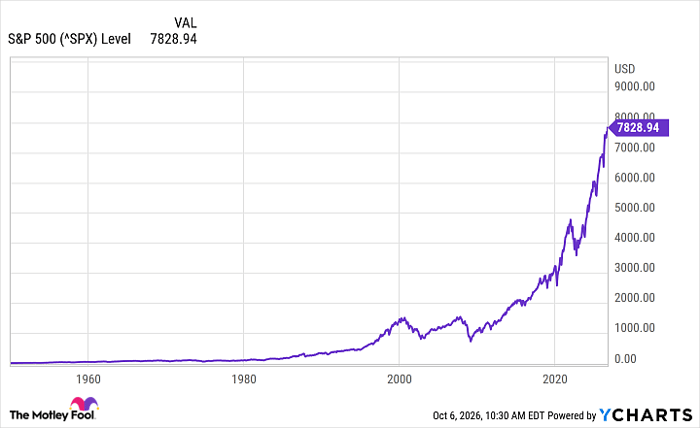
Meanwhile, it's important to consider stocks and the index beyond just one month. Performance over time shows the S&P 500 has always gone on to deliver a win to investors who have held on for a period of years.
^SPX data by YCharts
So if you happen to buy stocks even right before a tough time, if you hold on for the long term, you're likely to score a win. For example, if you had invested right before Black Monday in 1987 and held on for five years, your investment would have climbed 68%, according to BlackRock's iShares. The data show that this trend holds true after other crashes, too, though in some cases investors had to hold on longer than five years.
History's answer to our question is strikingly clear: Yes, you should invest in October as long as you choose quality stocks that are trading at reasonable levels. If you hold on for the long term, one-month performance is almost meaningless -- and this means that any time could be the right time to get in on stocks.
Should you buy stock in S&P 500 Index right now?
Before you buy stock in S&P 500 Index, consider this:
The Motley Fool Stock Advisor analyst team just identified what they believe are the 10 best stocks for investors to buy now… and S&P 500 Index wasn’t one of them. The 10 stocks that made the cut could produce monster returns in the coming years.
Consider when Netflix made this list on December 17, 2004... if you invested $1,000 at the time of our recommendation, you’d have $370,440!* Or when Nvidia made this list on April 15, 2005... if you invested $1,000 at the time of our recommendation, you’d have $1,470,022!*
Now, it’s worth noting Stock Advisor’s total average return is 955% — a market-crushing outperformance compared to 215% for the S&P 500. Don't miss the latest top 10 list, available with Stock Advisor, and join an investing community built by individual investors for individual investors.
See the 10 stocks »
*Stock Advisor returns as of October 8, 2026.
Adria Cimino has no position in any of the stocks mentioned. The Motley Fool has positions in and recommends BlackRock. The Motley Fool has a disclosure policy.
Recommended Articles


