


Own American Express By Oct. 9 to Qualify for Its Nov. 10 Dividend. Here's How Many Shares of the Warren Buffett Stock You'd Need for $1,000 in Yearly Dividends
Key Points
American Express has been one of Berkshire Hathaway’s best long-term compounders.
Its business model is notably different from Visa and Mastercard.
The company rewards shareholders with growing earnings that support stock buybacks and dividends.
- 10 stocks we like better than American Express ›
American Express (NYSE: AXP) has been a staple of Berkshire Hathaway's (NYSE: BRKA) (NYSE: BRKB) portfolio for decades -- with Warren Buffett essentially completing purchases of the stock by 1995. Buffett's hand-picked successor -- Greg Abel -- expects American Express to remain a long-term compounder and a core Berkshire holding because it's a business Berkshire understands well and trusts its management team.
American Express also features a growing dividend. It doesn't raise it every year, but even during the 2008 financial crisis, when many banks and financial services companies were slashing their payouts, American Express held its quarterly dividend steady at $0.18 per share.
Missed Nvidia in 2009? This Rare Signal Is Flashing Again. In 2009, a "Double Down" signal flashed for a little-known chipmaker called Nvidia. For the first time in years, that same "Total Conviction" signal is flashing for a company 1/100th the size of Nvidia. Continue »
American Express has substantially increased its dividend since then. The next payment of $0.95 per share is payable on Nov. 10 to shareholders on record as of Oct. 9.
Here's how many shares of American Express you'd need to generate $1,000 in yearly dividends, and the three levers American Express pulls to reward long-term shareholders.

Image source: Getty Images.
American Express is down 18.2% in 2026
Buying and holding a stock for decades takes steadfast dedication, patience, and the ability to endure drawdowns. American Express is currently in a fairly steep sell-off -- down 18.2% year-to-date compared to a 2.4% decline in the financial sector and a 12.8% increase in the S&P 500 (SNPINDEX: ^GSPC).
The sell-off has pushed American Express's dividend yield up to 1.3% -- which isn't high-yield territory, but it is greater than the S&P 500 dividend yield of 1.1%.
With a quarterly dividend of $0.95 per share, investors would need to own about 263 American Express shares to generate $1,000 in annual dividends. That's no small feat, as American Express is $302.78 per share at the time of this writing -- making a 263-share position worth a whopping $79,631.
The good news is that investors can expect the yield on that initial investment to increase substantially over time, thanks to American Express's loyal customer base and excellent business model.
American Express has greater growth potential than Visa and Mastercard
American Express operates a closed-loop network in which it issues cards and bears the credit risk, unlike open-loop networks operated by Visa (NYSE: V) and Mastercard (NYSE: MA), which partner with financial institutions to issue cards. Visa and Mastercard tend to have higher margins than American Express, but they also have fewer opportunities for growth.
American Express has a closer relationship with its customers, which can reduce switching costs. American Express caters to an affluent customer base, and its cards charge relatively high annual fees. But American Express also rewards customers with generous perks and points, which incentivize customers to use their American Express cards for as many purchases as possible – thereby boosting American Express's swipe fees.
American Express has a track record for managing risk, with very low net write-off rates and delinquencies. And because it issues cards and other products, such as personal banking and loans, it collects revenue from interest on outstanding balances.
American Express's sales and earnings have grown in lockstep with its expanding customer base and services. However, its margins have been declining due to higher operating costs, particularly those associated with its cardholder benefits.
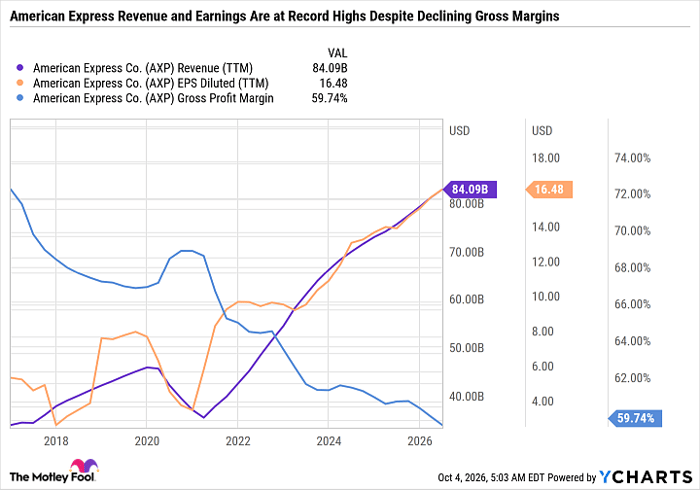
AXP Revenue (TTM) data by YCharts
Aside from falling margins, another reason American Express has been under pressure is concerns about declining consumer spending. American Express's affluent customer base tends to be more resistant to inflationary pressures on expenses like gas and food. But if artificial intelligence (AI) disrupts the high-paying job market in a big way, that could have ripple effects on American Express.
American Express's payout ratio is just 21.5%
The good news is that American Express's fundamentals show no signs of deteriorating. Management is guiding for a 10% increase in fiscal 2026 revenue and even faster earnings growth.
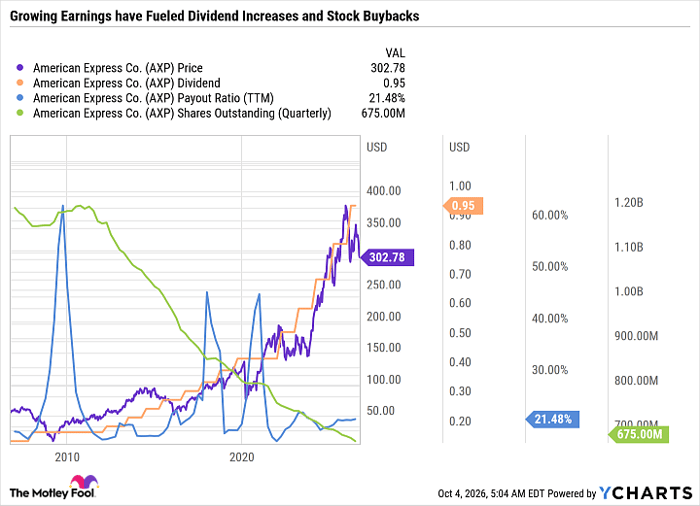
American Express's payout ratio is just 21.5% becasue it consistently grows its earnings and makes affordable dividend raises. For a company of its caliber, a payout ratio between 50% and 75% would be healthy. The payout ratio is the dividend per share divided by earnings per share (EPS), which provides a yardstick for measuring dividend affordability.
AXP data by YCharts
As you can see in the chart, American Express has drastically reduced its share count through buybacks, raised its dividend, and seen its stock price compound significantly over time. Through multiple recessions, American Express's dividend has remained affordable -- even during the financial crisis.
In sum, American Express rewards investors in three ways -- with growing earnings that can justify a rising stock price if the investment thesis remains intact, through stock buybacks that reduce the share count and accelerate EPS growth, and through a growing quarterly dividend that provides a passive income stream for shareholders.
An unassuming passive income powerhouse
American Express may not have a high current yield, but investors who buy the stock can expect their yield on cost to rise over time, driven by American Express's dividend increases. Berkshire Hathaway's American Express position showcases this concept well. As of Dec. 31, 2025, Berkshire's cost basis was just $1.287 billion, its market value was $56.09 billion, and it generated $479 million in dividends for Berkshire Hathaway in 2025 -- a yield on cost of 37.2%.
Given that American Express is a more mature company today than in the 1990s, investors shouldn't expect it to be a 40-bagger as it has been for Berkshire. But its affordable dividend and long-term runway for earnings growth make American Express an excellent buy for investors looking to anchor their portfolios with a high-quality blue chip dividend stock.
Should you buy stock in American Express right now?
Before you buy stock in American Express, consider this:
The Motley Fool Stock Advisor analyst team just identified what they believe are the 10 best stocks for investors to buy now… and American Express wasn’t one of them. The 10 stocks that made the cut could produce monster returns in the coming years.
Consider when Netflix made this list on December 17, 2004... if you invested $1,000 at the time of our recommendation, you’d have $370,440!* Or when Nvidia made this list on April 15, 2005... if you invested $1,000 at the time of our recommendation, you’d have $1,470,022!*
Now, it’s worth noting Stock Advisor’s total average return is 955% — a market-crushing outperformance compared to 215% for the S&P 500. Don't miss the latest top 10 list, available with Stock Advisor, and join an investing community built by individual investors for individual investors.
See the 10 stocks »
*Stock Advisor returns as of October 7, 2026.
American Express is an advertising partner of Motley Fool Money. Daniel Foelber has positions in American Express. The Motley Fool has positions in and recommends American Express, Berkshire Hathaway, Mastercard, and Visa. The Motley Fool has a disclosure policy.
Recommended Articles


