


1 Great Sign for Rivian Investors
Key Points
Rivian deliveries surged in the third quarter, potentially setting the company up for a strong earnings report.
Third quarter deliveries spiked to over 19,000 compared to the second quarter's 12,194 deliveries.
Rivian has also done an excellent job protecting early shareholders from dilutive capital raises.
- 10 stocks we like better than Rivian Automotive ›
This year has been a brutal reality check for electric vehicle (EV) companies and their investors, and Rivian Automotive (NASDAQ: RIVN) is no exception with its stock price down 28% year to date. The broader U.S. EV industry hit a speed bump in late 2025 with rising interest rates combined with a reversal of federal EV tax credits, leaving U.S. EV market share around 6% to 7%, well below its peak of 10%.
All that said, Rivian is still driving forward and its R2 ramp continues to accelerate, and that might be all the company needs to beat estimates for the third quarter when announced later this month. Here's one more strong piece of data from Rivian, and it's just a little more good news.
Missed Nvidia in 2009? This Rare Signal Is Flashing Again. In 2009, a "Double Down" signal flashed for a little-known chipmaker called Nvidia. For the first time in years, that same "Total Conviction" signal is flashing for a company 1/100th the size of Nvidia. Continue »
Deliveries surge
Investors need only glance at Rivian's press release to notice the surge in deliveries during the third quarter. Rivian produced 10,236 vehicles during the first quarter and delivered 10,365. During the second quarter those figures jumped to 12,613 produced and 12,194 delivered. During the third quarter, those figures spiked to 19,751 produced and 19,248 delivered. Now, the company needs to deliver about 20% more vehicles during the fourth quarter to reach its full-year guidance.

Rivian R2. Image source: Rivian.
With that significant of a jump, investors will certainly want to look at the coming change in Rivian's gross margins to better understand how the R2 is contributing, or hindering, its profitability.
While glancing at the EV maker's gross margins, investors will also want to keep in mind exactly how the R2 rollout is trending. The way Rivian approached deliveries of the R2 is wise: offering the highest-margin variant first, followed by the premium version later this year, and finally the most affordable R2 variant in 2027. A 46% increase in deliveries, especially given that it's currently the most profitable variant, suggests a strong start for the company's first mass-market vehicle.
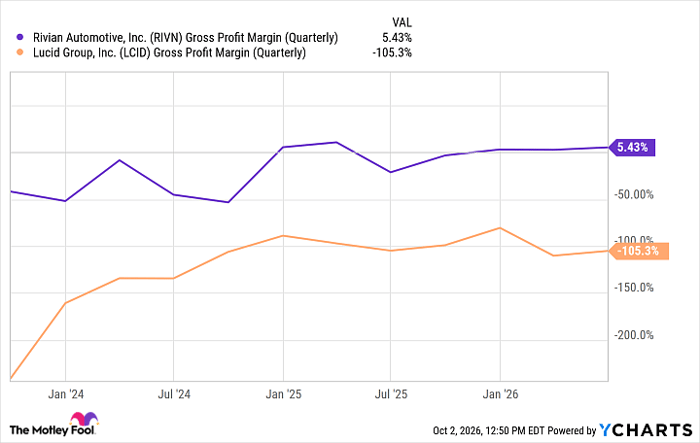
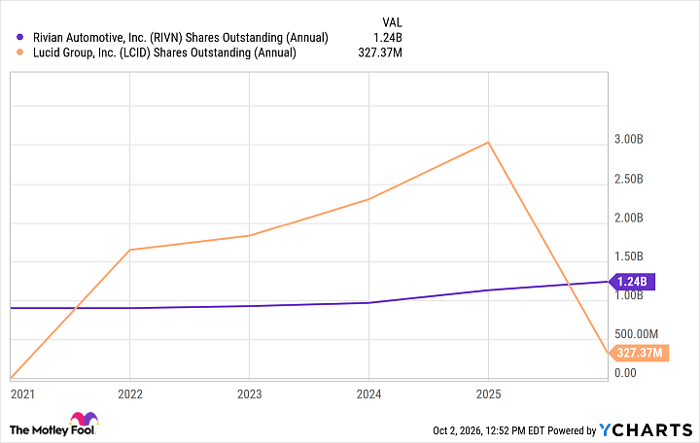
Rivian deliveries topped analysts' estimates and remain critical to the company's young growth story, but just as important is Rivian's consistent growth in gross margins and ability to protect shareholders from dilution -- check out the following two charts to better understand.
RIVN Gross Profit Margin (Quarterly) data by YCharts
Unfortunately, for Lucid, Rivian's rival serves as a great barometer for Rivian's consistent improvement in gross margins (above graph), which reflect its improving production efficiency, smart cost-cutting, and strong demand.
RIVN Shares Outstanding (Annual) data by YCharts
One of the most important graphics for Rivian (above) shows how well the company has protected shareholders from expensive capital raises and shareholder dilution. Rivian has consistently raised non-dilutive capital using loans from Volkswagen in its joint venture, or companies such as Uber Technologies that have injected capital into the young EV maker on the promise of future robotaxi development.
Meanwhile, rival Lucid Group continues to raise capital by offering new shares, although its share count declined after its reverse 1-for-10 stock split. Uber struck a deal with Rivian in March with intentions to invest up to $1.25 billion in Rivian with fully autonomous R2 robotaxis rolling out in 2028. It's actually a bigger deal than many investors realize, and back in March, when the partnership was announced, Rivian acknowledged that reaching profitability next year would be delayed so it could invest even more capital into autonomous driving capabilities.
Market reaction
"The market is reacting to management maintaining full-year guidance," Seth Goldstein, senior equity analyst at Morningstar, told Reuters. "Following the strong third quarter numbers, I think the market was looking for a guidance raise."
Despite the strong delivery figures from Rivian, management only affirmed its 2026 delivery forecast of between 65,000 to 70,000 vehicles, with analysts expecting the company to deliver 66,685 for the full year. The next 12 months for Rivian will be crucial for investors seeking to better understand the full impact of the R2's accelerating production. Keep an eye on gross margins and adjusted EBIT during the third and fourth quarters, but the company is on a solid path forward, and growth should be attainable even with the broader EV market slowdown.
Should you buy stock in Rivian Automotive right now?
Before you buy stock in Rivian Automotive, consider this:
The Motley Fool Stock Advisor analyst team just identified what they believe are the 10 best stocks for investors to buy now… and Rivian Automotive wasn’t one of them. The 10 stocks that made the cut could produce monster returns in the coming years.
Consider when Netflix made this list on December 17, 2004... if you invested $1,000 at the time of our recommendation, you’d have $364,023!* Or when Nvidia made this list on April 15, 2005... if you invested $1,000 at the time of our recommendation, you’d have $1,467,933!*
Now, it’s worth noting Stock Advisor’s total average return is 948% — a market-crushing outperformance compared to 214% for the S&P 500. Don't miss the latest top 10 list, available with Stock Advisor, and join an investing community built by individual investors for individual investors.
See the 10 stocks »
*Stock Advisor returns as of October 6, 2026.
Daniel Miller has no position in any of the stocks mentioned. The Motley Fool recommends Uber Technologies. The Motley Fool has a disclosure policy.
Recommended Articles


