


President Donald Trump's Proposed $5,000 "Trump Dividend" Could Epically Backfire for 2 Key Reasons
Key Points
President Trump recently doubled down on his commitment to pay a $5,000 Trump Dividend to adult U.S. citizens if Republicans retain the U.S. Senate and House on Election Day.
The president’s proposal could initially boost the stock market and economic activity, but would almost certainly throw inflation into overdrive.
The staggering cost of the Trump Dividend would add to the United States’ total debt and likely propel long-duration bond yields to multidecade highs.
- 10 stocks we like better than S&P 500 Index ›
Midterm elections are officially less than one month away. On Nov. 3, Americans from across our great country will head to the polls or mail in their ballots to determine the makeup of Congress over the next two years.
While not every decision made by Congress has a bearing on Wall Street, the fiscal policy enacted by our elected officials does affect corporate America and, in turn, the Dow Jones Industrial Average (DJINDICES:^DJI), S&P 500 (SNPINDEX:^GSPC), and Nasdaq Composite (NASDAQINDEX:^IXIC).
Missed AI’s "Act 1"? Act 2 Could Be 15x Bigger. Most investors think they missed the AI boat because they didn't buy Nvidia in 2005. But according to our analysts, we’re only at the end of "Act 1"—the R&D phase. "Act 2" is the global rollout. Continue »

Image source: Official White House Photo by Joyce N. Boghosian, courtesy of the National Archives.
Entering the midterms, Republicans hold slight majorities in the Senate (53 of 100 seats) and House of Representatives (218 of 435 seats). President Donald Trump has, on two separate occasions, promised to dole out $5,000 "Trump Dividends" to every U.S. adult citizen if the GOP retains both houses of Congress.
There's a laundry list of things we don't yet know about the president's proposal:
- Is it legal?
- How would it be funded?
- Would Congress approve the measure?
- Would the president follow through with the post-election payouts?
Trump: "Because of tariffs, we are taking in hundreds of billions of dollars of profits. It's one of the reasons I can offer, if Republicans win the House and Senate, $5,000 to every adult. We can do it and the Democrats can't, because the Democrats don't have any income." pic.twitter.com/OD8fyc8z40
— Aaron Rupar (@atrupar) September 28, 2026
Hypothetically, if the Trump Dividend were to become a reality, there's a very high probability that it would epically backfire on the U.S. economy and stock market.
A $5,000 Trump Dividend would send inflation to the moon
Handing out $5,000 to every adult citizen in this country would more than likely provide an initial boost to economic activity. Consumers spending this cash or putting it to work on Wall Street can pave the way for new highs for the Dow, S&P 500, and Nasdaq Composite.
But the historical odds are high that this victory would be short-lived.
During the COVID-19 pandemic, the federal government doled out several rounds of fiscal stimulus to qualifying Americans, briefly leading the stock market to new heights. However, fiscal stimulus also rapidly expanded the U.S. money supply, sending the prevailing inflation rate to a four-decade high of 9.1% by June 2022.
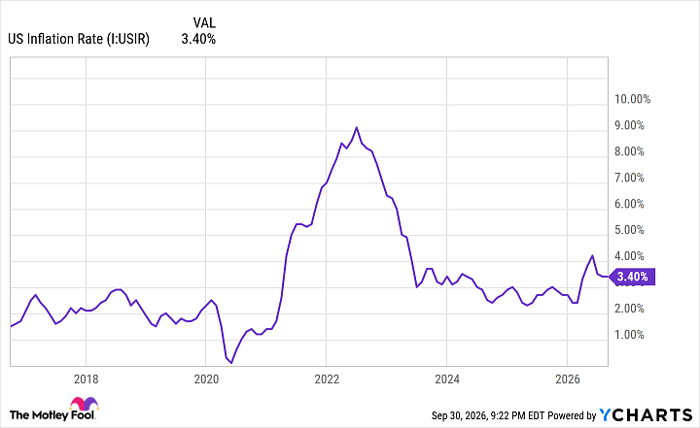
US Inflation Rate data by YCharts
Though putting money directly into the hands of consumers might sound like a smart idea, it's almost always inflationary, and would occur at a time when the Federal Reserve has kicked off a rate-hiking cycle to combat persistently elevated inflation.
In other words, a $5,000 Trump Dividend would kick Trumpflation (inflation that's specifically driven by Trump's policies) into overdrive!

Image source: Getty Images.
Long-duration Treasury bond yields would likely skyrocket
Pushing inflation into a higher gear isn't the only damage Trump's midterm-contingent $5,000 payout would cause. It could also send long-duration bond yields (10-, 20-, and 30-year Treasury bonds) into the stratosphere.
Last week, the 30-year yield reached 5.6%, a level last seen in 2002. Meanwhile, the 10-year Treasury yield, the benchmark for mortgage rates, topped 5.3%, a fresh 24-year high.
Long-duration bond yields have been soaring for a variety of factors, including persistently elevated inflation and, according to Fed Chair Kevin Warsh, the competition for capital among artificial intelligence hyperscalers. But soaring U.S. total debt is also playing a role.
The last time US Treasury yields were this high, total US national debt stood at just $8.9 trillion.
— The Kobeissi Letter (@KobeissiLetter) September 25, 2026
Today, US debt stands at $40.1 trillion. That's +$31.2 trillion more, or over 4.5 TIMES higher.
This means every 1 percentage point in the average cost of servicing the debt now… https://t.co/PXUZmAuKDa pic.twitter.com/xnKNXeMGuR
U.S. total debt leaped above $40 trillion for the first time in history in mid-August. Federal deficits since 2020 have ranged between $1.38 trillion and $3.13 trillion per year. The $5,000 Trump Dividend would cost the federal government more than $1.2 trillion, further adding to America's unsustainable debt pile.
Even though the U.S. continues to make its interest payments and hasn't defaulted on any of its debt obligations, bond traders would likely respond by wanting substantially higher yields to compensate for the risks of rapidly rising total debt.
In other words, the $5,000 Trump Dividend, if enacted, could epically backfire for the U.S. economy and stock market.
Should you buy stock in S&P 500 Index right now?
Before you buy stock in S&P 500 Index, consider this:
The Motley Fool Stock Advisor analyst team just identified what they believe are the 10 best stocks for investors to buy now… and S&P 500 Index wasn’t one of them. The 10 stocks that made the cut could produce monster returns in the coming years.
Consider when Netflix made this list on December 17, 2004... if you invested $1,000 at the time of our recommendation, you’d have $361,650!* Or when Nvidia made this list on April 15, 2005... if you invested $1,000 at the time of our recommendation, you’d have $1,437,517!*
Now, it’s worth noting Stock Advisor’s total average return is 936% — a market-crushing outperformance compared to 213% for the S&P 500. Don't miss the latest top 10 list, available with Stock Advisor, and join an investing community built by individual investors for individual investors.
See the 10 stocks »
*Stock Advisor returns as of October 5, 2026.
Sean Williams has no position in any of the stocks mentioned. The Motley Fool has no position in any of the stocks mentioned. The Motley Fool has a disclosure policy.
Recommended Articles


