


Monster Beverage's Biggest Moat Isn't Its Energy Drink. It's Something Else.
Key Points
The product isn't Monster's moat, but everything around it.
Coca-Cola is an important factor by helping with distribution.
The moat is self-reinforcing, but not permanent.
- 10 stocks we like better than Monster Beverage ›
Monster Beverage (NASDAQ: MNST) sells energy drinks. That sounds like a simple business. The ingredients aren't particularly difficult to find. Competitors can make similar products, and consumers have never had more choices, from Red Bull and Celsius to C4.
Yet Monster Beverage generated $8 billion of revenue in 2025. If the drink is so easy to copy, why is the business so difficult to compete with? The answer is that Monster Beverage's moat isn't what's inside the can. It's everything around it.
Missed Nvidia in 2009? This Rare Signal Is Flashing Again. In 2009, a "Double Down" signal flashed for a little-known chipmaker called Nvidia. For the first time in years, that same "Total Conviction" signal is flashing for a company 1/100th the size of Nvidia. Continue »
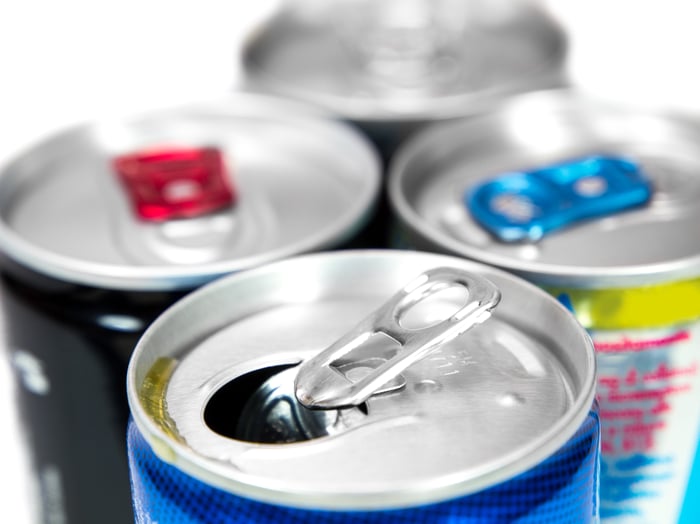
Image source: Getty Images.
It all starts with the brand
Monster Beverage has spent decades building a distinctive brand. Its logo is instantly recognizable. Its packaging stands out, and its marketing is deeply associated with motorsports, gaming, action sports, and music.
That matters. Most people don't walk into a convenience store and conduct a detailed analysis of every energy drink's ingredients before making a purchase. They reach for brands they know.
That creates something valuable for Monster Beverage: habitual purchase. Once people repeatedly choose Monster Beverage, the company doesn't have to win them over from scratch every time they buy an energy drink.
A challenger has to do the opposite. It has to convince people to switch.
Then comes the shelf space
A strong brand is only useful if customers can find it. This is where Monster Beverage's supply chain reach becomes an advantage. Retailers have limited shelf and refrigerator space. They want products that sell.
A brand that consistently generates sales earns more visibility, which can lead to more sales. That creates a simple but powerful loop: brand → sales → shelf space → visibility → more sales. A new energy drink company has to fight its way into that loop.
Coca-Cola makes the moat deeper
There's an important part of Monster Beverage's story that investors shouldn't overlook: Coca-Cola. Monster Beverage has a long-standing strategic relationship with The Coca-Cola Company and its bottling network. That's enormously valuable when Monster Beverage wants to expand worldwide.
Imagine trying to build a global beverage distribution system from scratch. You would need bottlers, warehouses, trucks, retail relationships, and local distribution networks -- all that across dozens of countries.
Fortunately, Monster Beverage doesn't have to build all of that itself. It can use Coca-Cola's vast distribution network to distribute its products, so it can concentrate on what it does best: creating brands and generating consumer demand. That combination is difficult for a challenger to replicate.
Blending scale and innovation
Monster Beverage's moat doesn't stop at distribution.
Its size gives it plenty of opportunities to experiment. Monster Beverage can launch a new flavor, brand, or product and put it through an existing distribution system. Some launches will work. Some won't. But Monster Beverage doesn't need every product to become a blockbuster. Its existing scale gives new products a chance to reach its customers.
That's why the company's portfolio has expanded beyond the original Monster Beverage Energy drink to include brands such as Monster Ultra, Juice Monster, Reign, and Reign Storm. Each successful product can create another reason for consumers to stay within the Monster Beverage ecosystem.
That's the real Monster Beverage flywheel
By putting everything together, we can get a more holistic picture of Monster Beverage's competitive advantages.
A strong brand generates more demand. More demand supports more shelf space. More shelf space increases visibility and sales. More sales generate more cash. More cash funds marketing, innovation, and international expansion. Coca-Cola's distribution network helps Monster Beverage take that system into new markets.
That's a much more powerful moat than a secret formula. It's also why Monster Beverage can continue growing despite its enormous size. In the second quarter of 2026, revenue jumped 20.2% to $2.5 billion, while net income increased 19.6% to $584.5 million.
What does it mean for investors?
None of this means Monster Beverage is untouchable. Celsius and other challengers have shown that consumers are willing to experiment with new brands. Consumer preferences can change, and a product that is fashionable today can become yesterday's news surprisingly quickly.
Monster Beverage, therefore, has to keep investing in its brands and launching products that remain relevant without diluting what made the brand distinctive in the first place.
That's the real test. A moat isn't valuable because it existed yesterday. It's valuable if management can keep widening it tomorrow. If Monster Beverage can further reinforce its competitive advantages, it stands a good chance of sustaining its growth momentum in the foreseeable future.
Should you buy stock in Monster Beverage right now?
Before you buy stock in Monster Beverage, consider this:
The Motley Fool Stock Advisor analyst team just identified what they believe are the 10 best stocks for investors to buy now… and Monster Beverage wasn’t one of them. The 10 stocks that made the cut could produce monster returns in the coming years.
Consider when Netflix made this list on December 17, 2004... if you invested $1,000 at the time of our recommendation, you’d have $361,650!* Or when Nvidia made this list on April 15, 2005... if you invested $1,000 at the time of our recommendation, you’d have $1,437,517!*
Now, it’s worth noting Stock Advisor’s total average return is 936% — a market-crushing outperformance compared to 213% for the S&P 500. Don't miss the latest top 10 list, available with Stock Advisor, and join an investing community built by individual investors for individual investors.
See the 10 stocks »
*Stock Advisor returns as of October 4, 2026.
Lawrence Nga has no position in any of the stocks mentioned. The Motley Fool has positions in and recommends Monster Beverage. The Motley Fool recommends Celsius Holdings. The Motley Fool has a disclosure policy.
Recommended Articles


