


Here's Who Won the Drone Dominance Gauntlet 2 Contest
Key Points
The Pentagon announced its $1.1 billion Drone Dominance Program in February.
During the next two years, 25 or more start-up drone manufacturers will compete for contracts to build attack drones.
Drone Dominance Gauntlet 2 awarded more than $300 million in contracts to at least nine winners.
- 10 stocks we like better than Northrop Grumman ›
Sometimes, the U.S. Department of Defense moves slowly, as when it took 12 years to design and build the first Ford-class aircraft carrier. But sometimes, the Pentagon moves very, very quickly -- and we're seeing a great example of that in the Pentagon's new Drone Dominance Program.
Announced in February as a "$1.1 billion investment in groundbreaking unmanned systems technologies," Drone Dominance aims to enlist dozens of mostly small, mostly new start-up companies to build 350,000 low-cost attack drones for as little as $2,300 each -- and get it all done in less than two years.
Missed Nvidia in 2009? This Rare Signal Is Flashing Again. In 2009, a "Double Down" signal flashed for a little-known chipmaker called Nvidia. For the first time in years, that same "Total Conviction" signal is flashing for a company 1/100th the size of Nvidia. Continue »
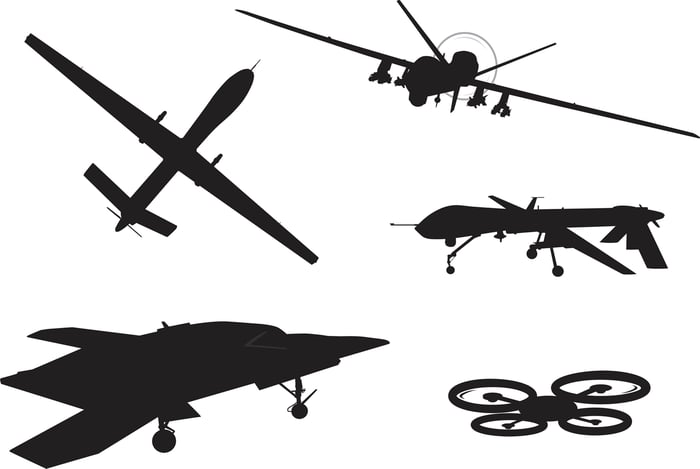
Image source: Getty Images.
Drone Dominance Gauntlet 1
Drone Dominance aims to whittle down the field of defense companies bidding on it through a series of four competition "gauntlets." I discussed the first of these gauntlets, comprising 25 companies competing for just 12 contracts, back in February. Competitors included:
- Anno.ai
- Ascent Aerosystems
- Auterion Government Solutions
- Dzyne Technologies
- Ewing Aerospace
- Farage Precision
- Firestorm Labs
- General Cherry (based in Ukraine)
- Greensight
- Griffon Aerospace
- Halo Aeronautics
- Kratos SRE, a division of Kratos Defense & Security (NASDAQ: KTOS)
- ModalAI
- Napatree Technology
- Neros
- Nokturnal AI
- Paladin Defense Services
- Performance Drone Works
- Responsibly
- Swarm Defense Technologies
- Teal Drones, a subsidiary of Red Cat Holdings (NASDAQ: RCAT), according to data from S&P Global Market Intelligence
- Ukrainian Defense Drones Tech (based in Ukraine)
- Vector Defense
- WS Darley & Co.
- Xtend Reality
Drone Dominance Gauntlet 2
Fast forward seven months, and the second gauntlet of this competition just wrapped up. And what's curious about this one is that 19 companies competed, not just 12. And not even all 12 original Gauntlet 1 winners made it into this competition!
(For ease of reference, I'm italicizing the names of the new entrants in this next list.)
- Ascent Aerosystems Inc.
- Auterion Government Solutions
- Griffon Aerospace
- Grim Tech
- Hyperscale
- ModalAI Inc.
- Mountain Horse Solutions + AG3Labs
- Neros
- ORQA US LLC
- Perennial Autonomy
- Renegade UxS
- Skycutter
- Stellarion
- Swarm Defense
- Teal Drones Inc. (again -- that's Red Cat)
- UDD (Ukrainian Defense Drones) Tech Corp.
- Vector
- Wilcox Cherry Defense LLC
- XTEND Reality Inc.
As you can see, only 10 of the original 25 companies survived the second round. But nine new companies entered the Drone Dominance competition in Gauntlet 2. (The Pentagon confirms that losers in earlier rounds will be entitled to reenter the competition in later rounds.)
Moreover, the Pentagon invited four new companies to partner with the drone-makers as "lethality providers" -- companies manufacturing specialized warheads for drones:
- Bravo Ordnance
- Kela Defense US Inc.
- Kraken Kinetics Inc.
- Northrop Grumman (NYSE: NOC).
What happens next
These four companies (actually five -- Mountain Horse is both a lethality provider and a drone-maker), plus the following nine winners, are now eligible for production contracts:
- Hyperscale
- ModalAI Inc.
- Neros
- ORQA US LLC
- Perennial Autonomy
- Skycutter
- Swarm Defense
- Vector
- XTEND Reality Inc.
What defense investors need to know
Indeed, according to an exclusive report by Tectonic Defense last week, it appears several of these companies have already been, or will soon be, awarded contracts:
- Swarm Defense was awarded a 4,000-drone order worth at least $25 million.
- Skycutter and Vector will both be awarded orders for 5,000 drones.
- Neros will be awarded an order for 14,000 "Deep Strike" and "Close Quarters Battle" drones.
- And Hyperscale, ModalAI, Orqa, Perennial Autonomy, and XTEND will also win awards.
It also seems likely that one or more of the lethality providers will be awarded contracts to arm the total of 60,000 drones ultimately ordered under Gauntlet 2. Multiplied by $5,000 per drone, this implies upward of $300 million in drone sales under Gauntlet 2 -- plus additional funds awarded to the lethality providers.
The bad news is that both publicly traded stocks that originally began this competition in Gauntlet 1 -- Kratos and Red Cat -- now appear to have been knocked out, at least for now. The good news is that the addition of Northrop Grumman as a lethality provider still gives investors at least one way to invest in this $1.1 billion program.
The big money in this Drone Dominance Program is clearly going to the companies building the actual drones. With no publicly traded stocks in the running today, that leaves investors just one hope to be able to own a part of this initiative.
We have to hope that some of these start-ups grow large enough to hold an initial public offering and issue stock.
Should you buy stock in Northrop Grumman right now?
Before you buy stock in Northrop Grumman, consider this:
The Motley Fool Stock Advisor analyst team just identified what they believe are the 10 best stocks for investors to buy now… and Northrop Grumman wasn’t one of them. The 10 stocks that made the cut could produce monster returns in the coming years.
Consider when Netflix made this list on December 17, 2004... if you invested $1,000 at the time of our recommendation, you’d have $365,910!* Or when Nvidia made this list on April 15, 2005... if you invested $1,000 at the time of our recommendation, you’d have $1,418,530!*
Now, it’s worth noting Stock Advisor’s total average return is 930% — a market-crushing outperformance compared to 211% for the S&P 500. Don't miss the latest top 10 list, available with Stock Advisor, and join an investing community built by individual investors for individual investors.
See the 10 stocks »
*Stock Advisor returns as of October 3, 2026.
Rich Smith has no position in any of the stocks mentioned. The Motley Fool has positions in and recommends Kratos Defense & Security Solutions. The Motley Fool has a disclosure policy.
Recommended Articles


