


Palantir Stock Price Forecast: Can PLTR Break $200 and Return to All-Time Highs Amid Rapid AI Business Growth?
TradingKey - Palantir (PLTR) - After experiencing a significant pullback in the first half of 2026, its stock price has rebounded rapidly over the past few months. As of the U.S. market close on September 28, Palantir stood at $187.48, up about 76% from its June low of $106.37. However, it remains about 10.7% below its 52-week high of $207.52 set on November 3, 2025.
As Palantir's commercial AI business continues its rapid expansion, the market is contemplating whether Palantir's stock price can break through $200 and further challenge its previous all-time high.
AI Commercial Business Becomes Palantir's Main Growth Engine
Palantir's latest quarterly results demonstrated once again that AI is rapidly translating into actual orders and revenue.
In the second quarter of 2026, the company's revenue reached $1.935 billion, up 93% year-over-year and 19% quarter-over-quarter; among this, revenue from the US market grew 115% year-over-year to $1.573 billion. Even more noteworthy, US commercial revenue reached $764 million, up 149% year-over-year and 28% quarter-over-quarter, growing significantly faster than its traditional government business. During the same period, US government revenue was $809 million, up 90% year-over-year.
Order metrics were equally strong. Palantir's Total Contract Value (TCV) signed in the second quarter reached $3.373 billion, up 49% year-over-year, with US commercial TCV reaching $2.132 billion, an increase of 153% year-over-year. In addition, US commercial Remaining Deal Value (RDV) reached $6.238 billion, up 124% year-over-year. These figures indicate that enterprise customer demand for Palantir's Artificial Intelligence Platform is expanding, and order growth has begun converting into future revenue.
Palantir's advantage lies not merely in providing AI models, but in integrating data processing and AI models with actual enterprise business workflows. The company's Artificial Intelligence Platform (AIP) helps enterprises connect large language models to their own data and workflows, bringing Palantir closer to the positioning of "AI applications and enterprise software infrastructure."
As enterprises gradually transition from experimenting with AI to large-scale deployment, whether Palantir can continuously expand its commercial customer base and contract size per customer will be a key variable for future revenue growth.
The company has also further raised its full-year guidance. Palantir expects full-year 2026 revenue to increase by 82% year-over-year, with US commercial revenue projected to grow by at least 134% year-over-year; at the same time, the company expects full-year adjusted free cash flow to reach $4.5 billion to $4.7 billion.
High Valuation Remains the Main Risk for PLTR Stock Price
The issue facing Palantir is not a lack of growth, but that its current stock price already prices in fairly optimistic expectations. At its latest price, the company's P/E ratio exceeds 160 times; even using future earnings forecasts, its forward P/E ratio previously reached about 82 times, significantly higher than most large software companies.
This means that Palantir needs not only to maintain rapid revenue growth, but also to continuously improve its profit margins and cash flow. If commercial revenue growth slows, contract signing cycles lengthen, or competition in artificial intelligence software intensifies, its valuation could contract rapidly.
Microsoft (MSFT), Amazon (AMZN), and Google (GOOGL) are integrating generative AI, data management, and AI agents into their own cloud platforms, and enterprises may also choose to deploy AI applications directly on existing cloud infrastructure. Palantir needs to prove that its data governance, deployment efficiency, and industry experience are sufficient to support a premium over major cloud vendors.
At the same time, interest rates are also a potential risk. The value of high-valuation growth stocks comes mainly from future cash flows; when U.S. Treasury yields rise, the market often lowers the valuation multiples it is willing to grant such companies. Therefore, even if Palantir's operational performance does not deteriorate significantly, changes in the macroeconomic environment could still trigger stock price volatility.
Palantir Stock Technical Analysis
Source: TradingView
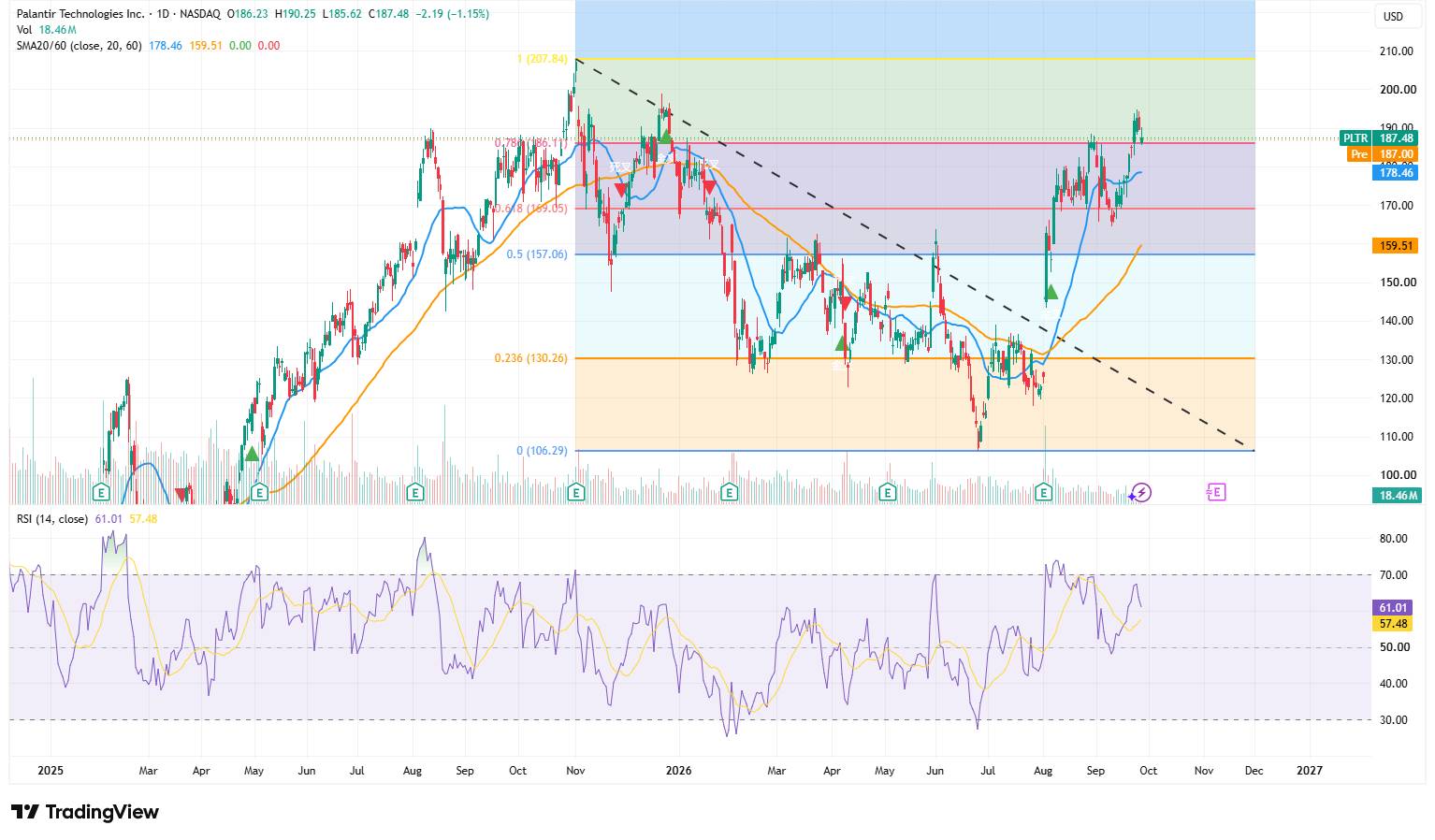
From a technical perspective, Palantir's stock price closed at $187.48 on the 28th, breaking above its previous downward trendline and standing above both the 20-day moving average of $178.46 and the 60-day moving average of $159.51, with short- and medium-term trends strengthening significantly. However, after rising to $190.25, the stock pulled back, indicating that selling pressure remains in the $190–$195 range.
The RSI currently stands at 61.01, above the signal line of 57.48, indicating that bullish momentum retains the upper hand while not yet entering clear overbought territory.
From the perspective of Fibonacci levels, the stock has broken above the 0.786 level of $186.17. If it can hold firm above this level and break through $190–$195 on heavy volume, the next targets will be $200 and the all-time high of $207.84; only a daily close above $207.84 will confirm the opening of a new upside channel.
Immediate downside support lies at $186, followed by the 20-day moving average at $178.46. If the stock fails to hold this moving average, it may retest $169.05; a more crucial medium-term support area lies in the $157–$160 range.
Recommended Articles


