


Should You Really Invest in a Tech ETF in 2026? Here's What History Says.
Key Points
Investors are understandably concerned about overvalued large-cap and tech stocks.
There are some differences between this AI-focused rally and the dot-com boom.
Tech stocks and ETFs have been the best investment over the long term.
- 10 stocks we like better than Vanguard Information Technology ETF ›
Technology stocks just keep moving higher, sparking fears of a bubble amid soaring valuations.
The Nasdaq-100, a leading gauge of large-cap tech stocks, is now up 20% year to date. If it holds, this would mark the fourth straight year that it has returned more than 20%. The Invesco QQQ ETF (NASDAQ: QQQ), which tracks the Nasdaq-100, has an average annualized return of 26% over the past three years.
Missed AI’s "Act 1"? Act 2 Could Be 15x Bigger. Most investors think they missed the AI boat because they didn't buy Nvidia in 2005. But according to our analysts, we’re only at the end of "Act 1"—the R&D phase. "Act 2" is the global rollout. Continue »
This four-year large-cap run has resulted in valuations reaching historically high levels. The Shiller P/E ratio, which tracks S&P 500 stock valuations across a 10-year period, adjusted for inflation, is close to an all-time high at roughly 40, the highest since the dot-com boom and bust in 1999-2000, when it peaked at 44.
Understandably, some investors are shying away from tech stocks amid this tenuous, uncertain environment for large-cap stocks. Here's why you should maintain allocations to technology stocks, particularly through a tech ETF.
Image source: Getty Images.
Tapping into tech
One thing about this market that sometimes gets overlooked is that technology stocks' valuations are not as high as they were during the dot-com boom. The P/E ratio of the Nasdaq-100 is around 28, which is certainly elevated but not as high as it was in 2024, when it reached 35, or in 2000, when it was over 70. It was elevated throughout the dot-com bust, peaking at 79 in 2002 and remaining above 30 until sometime in 2004.
There was a lot of speculation that drove those dot-com-era stocks higher without any real earnings to back them up. There is less of that now, as many high-valuation tech and AI stocks have huge earnings and huge expectations for future earnings.
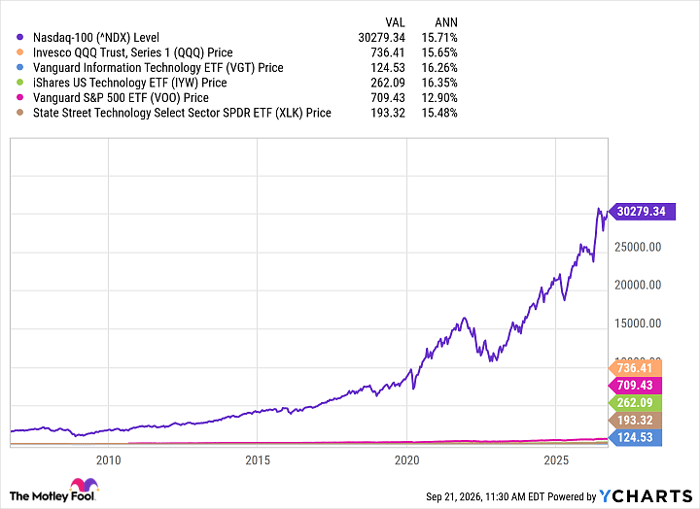
If you are concerned about an overheated tech sector, the best way to tap into it right now is through an ETF, such as the QQQ or the Vanguard Information Technology ETF (NYSEMKT: VGT), to name two of the most popular. That's because these technology-oriented ETFs are more diversified within the sector and, in the case of QQQ, include stocks outside the sector.
^NDX data by YCharts
In uncertain times, this is the best way to maintain a broad allocation to technology stocks in a diversified portfolio, reducing the impact of volatility on individual tech holdings.
Tech stocks have been the best long-term investment
The other thing to know is that tech stocks have been by far the best long-term investment among sectors. Over the past 20 years, the VGT and QQQ have averaged about a 16% annualized return, compared to around 13% for the S&P 500.
And over the past 10 years, the advantage has been starker, with the VGT averaging a 23% annualized return compared to 13% for the S&P 500. So history says that holding on to tech stocks over the long term has never been a bad idea.
Should you buy stock in Vanguard Information Technology ETF right now?
Before you buy stock in Vanguard Information Technology ETF, consider this:
The Motley Fool Stock Advisor analyst team just identified what they believe are the 10 best stocks for investors to buy now… and Vanguard Information Technology ETF wasn’t one of them. The 10 stocks that made the cut could produce monster returns in the coming years.
Consider when Netflix made this list on December 17, 2004... if you invested $1,000 at the time of our recommendation, you’d have $389,154!* Or when Nvidia made this list on April 15, 2005... if you invested $1,000 at the time of our recommendation, you’d have $1,406,303!*
Now, it’s worth noting Stock Advisor’s total average return is 949% — a market-crushing outperformance compared to 214% for the S&P 500. Don't miss the latest top 10 list, available with Stock Advisor, and join an investing community built by individual investors for individual investors.
See the 10 stocks »
*Stock Advisor returns as of September 23, 2026.
Dave Kovaleski has no position in any of the stocks mentioned. The Motley Fool has no position in any of the stocks mentioned. The Motley Fool has a disclosure policy.
Recommended Articles


