


The Under-the-Radar Stock Big Money Is Quietly Buying Up
Key Points
Institutional buying (inflows) of Ford stock in the second quarter alone already tops 2025.
Ford has long had questions regarding its recalls, warranty expense, and quality, but now there is evidence of improvement.
Ford Energy has the capability of adding incremental profits to the bottom line.
- 10 stocks we like better than Ford Motor Company ›
When all is said and done, the global automotive industry might evolve and transform more over the next decade than it has in the past century. Electric vehicles (EVs) are rapidly advancing; vehicles are becoming more software defined, enabling developments like over-the-air updates; automakers are investing heavily in artificial intelligence (AI) and driverless cars, and more services. And of course, subscriptions are adding value to the daily commuter. It's an exciting time in the industry, and margins should rise on the road ahead.
When investing in the automotive industry, names such as Tesla (NASDAQ: TSLA), Rivian (NASDAQ: RIVN), BYD Co., or the Italian juggernaut Ferrari (NYSE: RACE) probably jump to mind, but institutional money is actually pouring into legacy auto Ford Motor Company (NYSE: F). There was nearly $7 billion of institutional buying of Ford stock during the second quarter of 2026 alone, more than during all of 2025. Here's a look at what's likely driving the move into Ford stock.
Missed AI’s "Act 1"? Act 2 Could Be 15x Bigger. Most investors think they missed the AI boat because they didn't buy Nvidia in 2005. But according to our analysts, we’re only at the end of "Act 1"—the R&D phase. "Act 2" is the global rollout. Continue »
Reversing a huge problem
Of course, there are plenty of variables and reasons that could be driving the renewed interest in Ford, but here are two major developments that could be behind it. First, we have to consider that investors and analysts are finally getting raw data that Ford is fixing one of its biggest and most costly problems: vehicle quality. Ford ranked above all competitors in a category it didn't want to win in 2025: manufacturer with most recall campaigns. Ford topped the list with 153 recall campaigns last year, covering nearly 13 million vehicles. Ford had more recall campaigns in the U.S. than any competitor during each of the past five years except in 2024 when Stellantis took the crown briefly.
Not all recalls are created equal, and over-the-air updates can cheaply fix a long list of vehicle issues, but if the vehicle needs physical repairs, it can get costly. Investors will remember Q2 2024 when Ford's total warranty and recall costs surged to $2.3 billion, a $700 million increase over the prior year. It sent pretax profits plunging and crippled Ford's ability to meet Wall Street estimates; the stock initially plunged almost 18%.
Here's the good news! While Ford has for years preached that correcting vehicle quality was a top priority, investors had to rely on the company's word about its internal metrics pointing in a positive direction. That changed when JD Power released its 2026 U.S. Initial Quality Study, which grades brands on "problems per 100 vehicles (PP100)." The lower the score the better. Ford ranked third overall, behind only Porsche and Genesis, and was easily the highest-ranked mass-market brand. The study average reported PP175, while Ford checked in with far fewer problems and a score of PP152. Only three years ago, Ford ranked 23rd in the same study, lending credibility to the idea that Ford is fixing one of its biggest long-term problems.
But wait, there's more
In addition to fixing its vehicle quality woes -- which will take time to filter into the massive number of older Ford vehicles on the road right now -- Wall Street also noticed Ford's newest ambition: Ford Energy. Ford stock soared nearly 50% in May alone before giving back roughly half of those gains since, following the announcement of Ford Energy, which would deliver battery energy storage systems (BESS) to large industrial customers and artificial intelligence (AI) data centers. The latter needs uninterrupted power and a system that helps cut costs by charging when electricity is cheaper and discharging when prices are peaking.
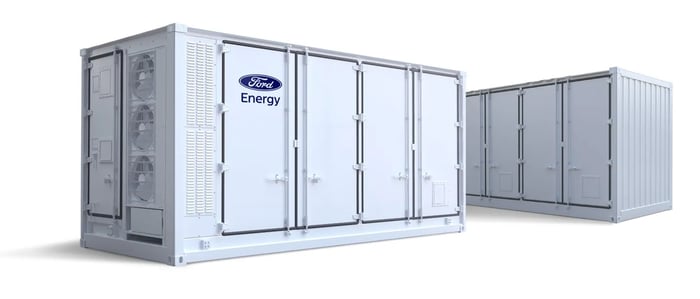
Image source: Ford Motor Company.
Ford is investing roughly $2 billion to repurpose its Glendale, Kentucky manufacturing plant to produce stationary storage systems capable of delivering 20 GWh of battery storage annually. The first deliveries to customers are scheduled for late next year, and Morgan Stanley analysts estimate that at full annual capacity, Ford Energy could generate between $500 million and $600 million in annual operating profits, or earnings before interest and taxes (EBIT).
What it all means
There could be many reasons why Wall Street's interest in Ford has surged, including the company's lucrative 4.1% dividend yield even after its share price rise. Or Wall Street could be optimistic about Ford's plan to refresh roughly 80% of its North America vehicle portfolio by volume by the end of the decade. However, two big reasons likely influencing Wall Street are that Ford is gaining traction by improving vehicle quality and that it is seeking new revenue streams from its EV and battery technology, which could boost margins above the notoriously low-margin narrative that haunts the automotive industry. Whatever it is, Ford is moving in a positive direction, and Wall Street has certainly noticed.
Should you buy stock in Ford Motor Company right now?
Before you buy stock in Ford Motor Company, consider this:
The Motley Fool Stock Advisor analyst team just identified what they believe are the 10 best stocks for investors to buy now… and Ford Motor Company wasn’t one of them. The 10 stocks that made the cut could produce monster returns in the coming years.
Consider when Netflix made this list on December 17, 2004... if you invested $1,000 at the time of our recommendation, you’d have $412,074!* Or when Nvidia made this list on April 15, 2005... if you invested $1,000 at the time of our recommendation, you’d have $1,314,319!*
Now, it’s worth noting Stock Advisor’s total average return is 932% — a market-crushing outperformance compared to 209% for the S&P 500. Don't miss the latest top 10 list, available with Stock Advisor, and join an investing community built by individual investors for individual investors.
See the 10 stocks »
*Stock Advisor returns as of September 17, 2026.
Daniel Miller has positions in Ford Motor Company. The Motley Fool has positions in and recommends Ferrari and Tesla. The Motley Fool recommends BYD Company and Stellantis. The Motley Fool has a disclosure policy.
Recommended Articles


