


3 Reasons Why Nvidia Just Became More Boring, and Wall Street Doesn't Like It
Key Points
Nvidia’s post-earnings price action has slowed as the company has grown in size.
It's returning boatloads of cash to shareholders through buybacks and dividends.
These steps tend to coincide with lower growth, but Nvidia is proving it can do it all.
- 10 stocks we like better than Nvidia ›
Given its integral role in artificial intelligence (AI) and over $5 trillion market cap, Nvidia (NASDAQ: NVDA) certainly has the size and influence to move markets. But Nvidia's quarterly earnings reports aren't producing the fireworks of years past.
In fact, if we look at the last year of Nvidia's releases, the stock has fallen each time -- down 1.8% on May 21 after reporting first-quarter fiscal 2027 earnings, down 5.5% on Feb. 26, down 3.2% on Nov. 20, and a 0.8% decline on Aug. 28.
Will AI create the world's first trillionaire? Our team just released a report on the one little-known company, called an "Indispensable Monopoly" providing the critical technology Nvidia and Intel both need. Continue »
These sell-offs have all come despite Nvidia blowing expectations out of the water and repeatedly raising its guidance, not to mention boosting its dividend by 2,400% in its latest earnings release and authorizing a new $80 billion stock repurchase program.
Here's why Nvidia is becoming boring, and the surprising reason why that's great news for long-term investors.
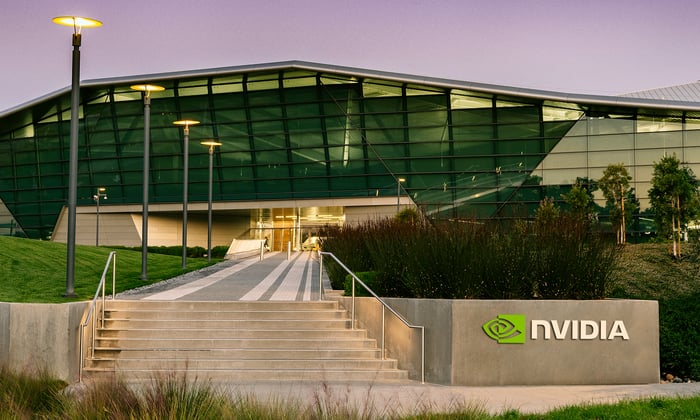
Image source: Getty Images.
1. Nvidia is realizing its potential
If you follow sports, you'll know the hype that goes into highly touted prospects with a seemingly infinite bag of skills that could translate to success on the big stage. But more often than not, expectations exceed reality, and a rare handful of generational talents break through high ceilings to unlock hall-of-fame careers.
Nvidia has become more boring because it is essentially a top draft pick that has won consecutive MVP awards. The winning has become normalized and therefore boring. Only Nvidia isn't an athlete constrained by the physical limitations that come with time. Despite its size, Nvidia still has a multi-decade runway for future growth and market-beating performance.
Nvidia gets a lot of attention for its valuation, but the real story is how profitable it has become.
In its latest quarter, Nvidia generated $81.62 billion in revenue and $53.54 billion in operating income -- good for an operating margin of 65.6%. Nvidia is converting so much revenue into operating income because the vast majority of its costs are tied to chip production. It has very few operating expenses, largely thanks to immense pricing power and insatiable demand from data center customers with ultra-deep pockets.
Nvidia's trailing 12-month net income is now in a virtual tie with Alphabet. And given Nvidia's breakneck growth rate, it will likely eclipse Alphabet and become the most profitable company in the world in the next three months.
2. Buybacks galore
Nvidia CFO Colette Kress has repeatedly stressed how Nvidia prioritizes research and development and organic growth over returning capital to shareholders through buybacks and dividends. But Nvidia is generating so much cash that Kress now forecasts returning 50% of Nvidia's free cash flow (FCF) to shareholders through buybacks and dividends.
Normally, cyclical companies will use cash to pay down debt during favorable periods. But Nvidia's balance sheet is already pristine, with more cash than long-term debt -- ending its most recent quarter with just $7.47 billion in long-term debt compared to $13.24 billion in cash and cash equivalents.
Nvidia has become so profitable on such a massive scale that it has more cash than it knows what to do with. This has been a good problem for a while now, as Nvidia's trailing 12-month stock buyback has surged to $44.5 billion -- the second-most among U.S. companies, behind only Apple. But Nvidia's latest dividend raise takes "boring" to a whole new level.
3. Nvidia has become a dividend growth stock
In March, I correctly predicted that Nvidia would increase its dividend substantially in 2026 based on its massive cash flow and recurring revenue from AI inference demands. Inferencing uses tools like AI Agents to make informed decisions based on what AI models have been trained to do, creating a massive opportunity for cloud computing giants to generate recurring revenue from processing nuggets of data, called tokens. It also has ripple effects for Nvidia, giving it recurring revenue from refresh cycles -- like Apple enjoys with its products -- as hyperscalers upgrade infrastructure to process tokens faster and more efficiently.
Many other tech giants pay stable, growing dividends. Apple, Microsoft, and Broadcom have all raised their dividends for over 15 consecutive years. And even Alphabet and Meta Platforms initiated their first-ever dividends in 2024.
Even with a 2,400% increase in its dividend, Nvidia will still yield around just 0.5% -- not making it a high-yield stock by any means. But because Nvidia is so massive, it will end up paying around $24.3 billion in dividends per year, which is just behind Microsoft as the second-highest annual dividend expense among U.S. companies.
Nvidia's investment thesis is stronger than ever
Normally, a company becomes less exciting as it exits its hypergrowth phase and enters a more mature, steady-growth period that usually includes buybacks and dividends. But Nvidia isn't compromising. Rather, it is still the same hypergrowth company -- just with a massive capital return program because it is about to become the world's most profitable company.
The market is struggling to comprehend what Nvidia is doing. This is backed up by the fact that despite falling after its last four earnings releases, Nvidia was always higher over each of those three-month periods. We simply have never seen a company so massive continue to grow its top and bottom lines this quickly.
And that's why the market has needed a digestion period following Nvidia's earnings and investor presentations. Similarly, Wall Street's gut reaction to buybacks and dividends is to sound the alarm that growth is slowing, even though that isn't the case with Nvidia.
Even if the AI spending cycle cools and Nvidia undergoes a temporary slowdown, the stock would still be too cheap to ignore. Nvidia's revenue rose 20% quarter over quarter and 85% year over year. And yet, it trades at just 33 times trailing 12-month earnings and 24.2 times forward earnings -- which is similar to the S&P 500's 32.2 price-to-earnings (P/E) ratio and 22.5 forward P/E, even though Nvidia is a far higher-quality company than the index.
In sum, Nvidia's massive stock buyback and dividend increase aren't a sign that the company is becoming less innovative, but rather, reflect that Nvidia is so ridiculously profitable that it may as well pull on even more levers to reward shareholders.
Should you buy stock in Nvidia right now?
Before you buy stock in Nvidia, consider this:
The Motley Fool Stock Advisor analyst team just identified what they believe are the 10 best stocks for investors to buy now… and Nvidia wasn’t one of them. The 10 stocks that made the cut could produce monster returns in the coming years.
Consider when Netflix made this list on December 17, 2004... if you invested $1,000 at the time of our recommendation, you’d have $472,852!* Or when Nvidia made this list on April 15, 2005... if you invested $1,000 at the time of our recommendation, you’d have $1,317,207!*
Now, it’s worth noting Stock Advisor’s total average return is 984% — a market-crushing outperformance compared to 210% for the S&P 500. Don't miss the latest top 10 list, available with Stock Advisor, and join an investing community built by individual investors for individual investors.
See the 10 stocks »
*Stock Advisor returns as of May 27, 2026.
Daniel Foelber has positions in Nvidia. The Motley Fool has positions in and recommends Alphabet, Apple, Broadcom, Meta Platforms, Microsoft, and Nvidia. The Motley Fool has a disclosure policy.
Recommended Articles


