


The Latest Social Security COLA Estimates for 2027 Are In -- Next Year's "Raise" Is Tracking to Be the 4th Largest in 36 Years
Key Points
Arguably, no announcement is more anticipated by retired-worker beneficiaries than Social Security's annual cost-of-living adjustment (COLA) reveal.
In 2026, Trump's tariff and trade policy lifted Social Security payouts. Next year, the Iran war may have an even more pronounced impact on payouts.
However, one outsize COLA isn't going to offset more than a decade of purchasing power declines for seniors.
- The $23,760 Social Security bonus most retirees completely overlook ›
Last year was a history-maker in several respects for America's leading retirement program, Social Security. We witnessed the average monthly retired-worker benefit surpass $2,000 for the first time, celebrated the 90th anniversary of the Social Security Act being signed into law, and saw Social Security's cost-of-living adjustment (COLA) meet or exceed 2.5% for a fifth consecutive year (that last happened three decades ago).
Arguably, no announcement is more anticipated by Social Security's more than 54 million retired-worker beneficiaries than the annual COLA reveal -- and based on the latest update, it could be historically large, courtesy of a second consecutive year with a Trump bump.
Will AI create the world's first trillionaire? Our team just released a report on the one little-known company, called an "Indispensable Monopoly" providing the critical technology Nvidia and Intel both need. Continue »

Image source: Getty Images.
What is Social Security's COLA, and why does it matter?
Over time, the price we pay for goods and services rises. If Social Security benefits didn't adjust to account for the effects of inflation (rising prices), beneficiaries would see their purchasing power decline. Social Security's COLA is essentially a near-annual "raise" that attempts to offset the inflationary pressures program recipients have faced.
You'll note the quotation marks around the word raise, and that's purposeful. Social Security's COLA is designed only to keep beneficiaries on par with inflation and isn't like a true raise from an employer, where an individual has an opportunity to outrun inflation.
Since 1975, the Consumer Price Index for Urban Wage Earners and Clerical Workers (CPI-W) has served as the inflation yardstick for Social Security. This inflationary index has north of 200 spending categories, each with its own unique percentage weighting. These weightings are what allow the CPI-W to be whittled down to a single figure each month, providing simple year-over-year comparisons of price changes.
The quirk with Social Security's COLA is that only trailing 12-month CPI-W readings ending in July, August, and September (the third quarter) factor into the calculation. If the average third-quarter CPI-W reading in the present year is higher than in the previous year, inflation has occurred, and beneficiaries are due a raise.
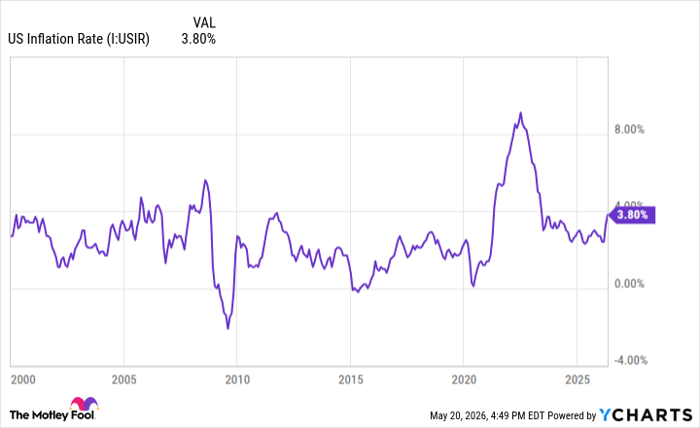
Higher inflation over the last five years has led to above-average Social Security COLAs. US Inflation Rate data by YCharts.
Social Security's 2027 COLA may be historic, thanks to a Trump bump
The 2.8% cost-of-living adjustment Social Security beneficiaries received this year was boosted by President Donald Trump's tariff and trade policy. Adding duties to unfinished imported goods (e.g., steel) increased production costs for some domestic manufacturers, leading to higher inflation and the aforementioned fifth straight year with a COLA at or above 2.5%.
Social Security's 2027 COLA is also on track for a Trump bump, but from an entirely different source.
In late February, the president gave the U.S. military the green light to attack Iran. Shortly after these attacks started, Iran closed the Strait of Hormuz to most commercial vessels, stymying the movement of 20 million barrels of petroleum liquids per day. Iran's response to Trump's actions has resulted in the largest energy supply disruption in history.
Fuel prices have soared in the wake of the Iran war, and it's having a decisive impact on independent Social Security COLA forecasts for 2027.
Following a reported 3.9% increase in the CPI-W in April from the prior-year period, nonpartisan senior advocacy group The Senior Citizens League (TSCL) increased its 2027 COLA prediction from 2.8% to 3.9%. Meanwhile, independent Social Security and Medicare policy analyst Mary Johnson lifted her 2027 COLA forecast to 4.2%. For added context, Johnson's 2027 COLA estimate had sat at 1.7% just a few months earlier.
If Johnson's latest estimate of 4.2% were to prove accurate, it would mark the fourth-largest raise for Social Security recipients in 36 years, topped only by a 5.8% increase in 2009, 5.9% lift in 2022, and 8.7% jump in 2023.
Although it's still a bit early to set anything in stone, Johnson's estimate would increase the average monthly retired-worker benefit by $87.41 (based on an average payout of $2,081.16 in April). As for workers with disabilities and survivor beneficiaries, their average monthly check would climb by $68.66 and $68.27, respectively.

Image source: Getty Images.
A bigger COLA isn't a reason to celebrate
On a nominal-dollar basis, bigger COLAs are a lot of fun. Following a period of anemic cost-of-living adjustments from 2010 through 2021, seeing monthly payouts meaningfully increase has to feel good.
But this is only part of the story. Even if beneficiaries receive the fourth-largest COLA since 1992 next year, many will still be getting the proverbial short end of the stick.
According to a July 2024 analysis from TSCL, the purchasing power of a Social Security dollar plummeted 20% from 2010 to 2024. In other words, what $100 in Social Security income used to be able to buy in 2010 could only purchase $80 worth of the same goods and services by 2024.
One of the primary culprits of this persistent loss of buying power is the CPI-W. It's an index that tracks the inflationary pressures faced by "urban wage earners and clerical workers." These are typically working-age individuals who aren't currently receiving a retired-worker benefit.
Social Security's 2025 Fast Facts & Figures report shows that 87% of traditional Social Security recipients were 62 and older as of December 2024. However, the inflationary tool that's used to determine annual COLAs is tracking the pricing pressures on individuals primarily under the age of 62. The CPI-W doesn't accurately account for the costs that matter most to seniors, such as shelter and medical care services.
Medicare's Part B premium is another problem for retirees. Part B is the segment of traditional Medicare responsible for outpatient services.
In each of the last three years, the Part B premium has jumped by 5.9% (2024), 5.9% (2025), and 9.7% (2026), respectively. Outsize increases in the Part B premium aren't uncommon, and they can partially or fully offset the COLA that beneficiaries receive.
The point being that one historically large cost-of-living adjustment isn't going to reverse more than a decade of purchasing power declines or alter the dynamics that continue to lead to seniors getting the short end of the stick.
The $23,760 Social Security bonus most retirees completely overlook
If you're like most Americans, you're a few years (or more) behind on your retirement savings. But a handful of little-known "Social Security secrets" could help ensure a boost in your retirement income.
One easy trick could pay you as much as $23,760 more... each year! Once you learn how to maximize your Social Security benefits, we think you could retire confidently with the peace of mind we're all after. Join Stock Advisor to learn more about these strategies.
View the "Social Security secrets" »
The Motley Fool has a disclosure policy.
Recommended Articles


