


Will Nvidia Form the $6 Trillion Club on May 20?
Key Points
Nvidia is on track to outperform the S&P 500 and Nasdaq Composite for the fourth consecutive year.
But the stock barely budged after its last earnings report and GTC conference.
Nvidia’s runway for future growth is dependent on the adoption of artificial intelligence (AI) inferencing and physical AI.
- 10 stocks we like better than Nvidia ›
Will AI create the world's first trillionaire? Our team just released a report on the one little-known company, called an "Indispensable Monopoly" providing the critical technology Nvidia and Intel both need. Continue »
Nvidia (NASDAQ: NVDA) is skyrocketing ahead of its highly anticipated first-quarter fiscal 2027 earnings call on May 20. At recent prices, the stock is up about 20% since the semiconductor giant reported its fourth-quarter and full-year fiscal 2026 results. That's even after a 5.7% sell-off from Nvidia's all-time high closing price on May 14 to market close on May 18.
With a market cap of $5.4 trillion, Nvidia would need to gain 11.5% to become the world's first member of the $6 trillion club.
Here's why Nvidia could blow past $6 trillion over the long term, but also why investors shouldn't expect fireworks on May 20.
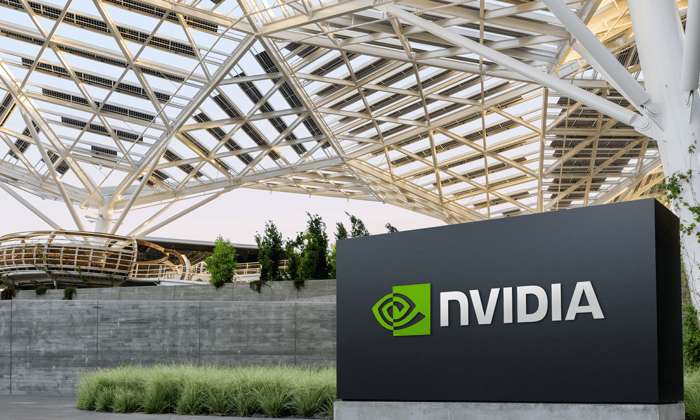
Image source: Nvidia.
The market didn't respond to Nvidia's last earnings report
On Feb. 25, Nvidia delivered blowout earnings for the fiscal year that ended Jan. 25, including a mind-numbing $215.9 billion in revenue and $120.1 billion in net income. Despite being a much larger company now than it was a few years ago, Nvidia continues to generate rapid, high-margin growth as cloud computing behemoths gobble up its artificial intelligence (AI) chips and associated hardware required for data center infrastructure.
On March 16, Nvidia founder and CEO Jensen Huang delivered a keynote at the GTC 2026 conference, forecasting $1 trillion in Blackwell and Rubin chip orders through 2027 -- double his prior guidance. Orders continue to pour in for Nvidia's next-generation Rubin architecture. Rubin includes a rack-scale offering tailor-made for data centers that features a graphics processing unit (GPU), central processing unit (CPU), memory chips, and interconnects -- demonstrating that Nvidia is no longer a pure-play GPU giant.
Despite all these announcements, Nvidia's stock price continued to stagnate. At one point in early March, it was cheaper than the S&P 500 (SNPINDEX: ^GSPC) based on forward earnings, despite having a far faster growth rate and higher margins than the index.
Why Nvidia soared in April and May
Nvidia's recent move is a reminder of why it's never a good idea to time the market. Investors who bought Nvidia in February in the hopes that it would soar if it delivered a strong earnings report and exciting announcements at GTC 2026 were left scratching their heads, wondering why the stock wasn't reacting to this news. But those who bought and held Nvidia because those announcements reinforced its underlying investment thesis as the high-growth bedrock fueling the AI boom have been handsomely rewarded.
Entering earnings season in late March and April, Nvidia's compressed valuation and runway for future growth formed a coiled spring that eventually popped when key Nvidia customers delivered impeccable earnings growth and raised their capital expenditure budgets. These announcements reinforced the durability of the AI spending cycle and helped dispel doubts that hyperscalers would pull back on spending amid AI profitability concerns. However, risks still remain for Nvidia.
Alphabet's Google Cloud and Amazon Web Services are scaling their custom-designed chips, citing major cost and efficiency improvements as an alternative to expensive GPUs. Nvidia's margins are high because it has such a dominant share of the GPU market and immense pricing leverage, since hyperscalers are competing for silicon, specialized industrial machinery, and energy to build and power data centers as quickly as possible.
But hyperscalers like Amazon and Oracle are reporting negative free cash flow as sky-high spending exceeds cash from operations. That puts a lot of pressure on these companies to prove to their investors that spending will pay off. If the return on investment disappoints, the spending cycle could slow, drastically affecting Nvidia's earnings.
Nvidia remains a compounding machine
Nvidia is so massive that it can single-handedly move the major indexes. But ironically, the larger Nvidia has become, the less important its earnings are.
The company is a proven innovator. Moreover, the AI pie is big enough to keep growing rapidly despite competition from Broadcom, Advanced Micro Devices, and now the major cloud computing companies building their own chips. Rather, the main questions are whether Nvidia's core customers have the budgets to continue spending, if U.S. trade restrictions will limit how much Nvidia can tap into key markets like China, and how the company would fare during an economic downturn.
Nvidia's shifting dynamic may disappoint traders who love the theatrics and volatility of a high-profile earnings report. But it's music to the ears of long-term investors who are investing in Nvidia for what it can continue to do years or even decades down the road, rather than the numbers it produces every three months.
Investor excitement could pole-vault Nvidia above the $6 trillion threshold, but whether that level holds depends more on Nvidia's ability to continue capitalizing on AI compute, AI inference, and other physical AI applications like robotics and self-driving cars.
So why am I still bullish?
Yes, that's a lot of "what ifs" -- but Nvidia has a habit of making skeptics look silly.
I think Nvidia remains a generational buying opportunity because both its hardware and software are built to quickly process AI usage requests. This complete package makes it well-positioned to capture increased demand from AI agents. Inferencing could create an ecosystem of enterprises generating recurring revenue from AI, making Nvidia less dependent on one-time chip sales and more resistant to downturns. Its proven data center business, boosted by inference, and the physical AI market's maturation could transform Nvidia from a cyclical semiconductor stock into a cash cow that supports a stable, growing dividend. If that happens, Nvidia could appeal to a wider range of investors, leading to a sustained premium valuation.
Investors could get lucky and make a quick buck if Nvidia rises after reporting earnings. But the stock could also go nowhere, even if it reports great results, for the same reasons that happened last quarter.
The far better approach is to unlock the power of compounding by building an investment thesis on Nvidia and holding the stock through periods of volatility, using earnings reports and investor presentations to challenge your thesis. That way, you can filter out the noise and focus on what the company is doing, rather than letting the volatile stock price guide your investment decisions.
Should you buy stock in Nvidia right now?
Before you buy stock in Nvidia, consider this:
The Motley Fool Stock Advisor analyst team just identified what they believe are the 10 best stocks for investors to buy now… and Nvidia wasn’t one of them. The 10 stocks that made the cut could produce monster returns in the coming years.
Consider when Netflix made this list on December 17, 2004... if you invested $1,000 at the time of our recommendation, you’d have $483,476!* Or when Nvidia made this list on April 15, 2005... if you invested $1,000 at the time of our recommendation, you’d have $1,362,941!*
Now, it’s worth noting Stock Advisor’s total average return is 998% — a market-crushing outperformance compared to 207% for the S&P 500. Don't miss the latest top 10 list, available with Stock Advisor, and join an investing community built by individual investors for individual investors.
See the 10 stocks »
*Stock Advisor returns as of May 19, 2026.
Daniel Foelber has positions in Nvidia and Oracle and has the following options: short July 2026 $200 calls on Oracle and short October 2026 $220 calls on Oracle. The Motley Fool has positions in and recommends Advanced Micro Devices, Alphabet, Amazon, Broadcom, Nvidia, and Oracle. The Motley Fool has a disclosure policy.
Recommended Articles


