

NY Fed Survey of Consumers shows households bracing for higher prices

Source Fxstreet

The New York Fed's September Survey of Consumers revealed that American households expect short-term inflation to rise, while in the long term, they expect prices to cool but remain above the Federal Reserve’s 2% goal.

Inflation expectations for the one-year ahead rose to their highest level since May 2023, from 3.6% to 3.9% in September. For three years, Americans expect a rise in prices from 3.2% to 3.3%, and for five years and beyond, at 3%, unchanged.

Digging into the report, inflation expectations rose due to c. Regarding labour market expectations, they mostly remained positive

About perceptions and expectations about households' financial situation, the New York Fed wrote that “both deteriorated, with larger shares of households reporting a worse financial situation compared to a year ago and expecting a worse financial situation a year from now.”
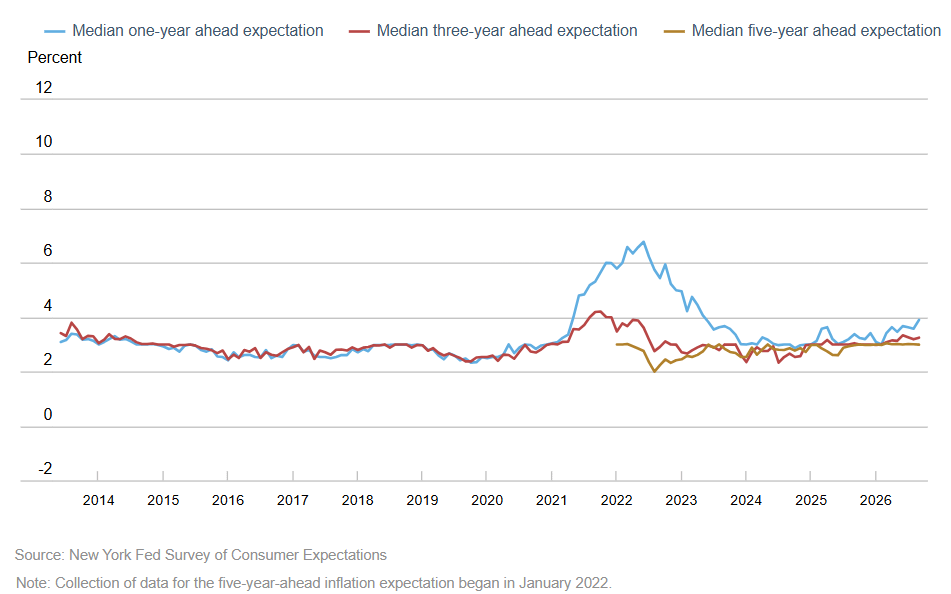
NY Fed Inflation Expectations Chart - Source: NY Fed

Fed FAQs

Monetary policy in the US is shaped by the Federal Reserve (Fed). The Fed has two mandates: to achieve price stability and foster full employment. Its primary tool to achieve these goals is by adjusting interest rates. When prices are rising too quickly and inflation is above the Fed’s 2% target, it raises interest rates, increasing borrowing costs throughout the economy. This results in a stronger US Dollar (USD) as it makes the US a more attractive place for international investors to park their money. When inflation falls below 2% or the Unemployment Rate is too high, the Fed may lower interest rates to encourage borrowing, which weighs on the Greenback.

The Federal Reserve (Fed) holds eight policy meetings a year, where the Federal Open Market Committee (FOMC) assesses economic conditions and makes monetary policy decisions. The FOMC is attended by twelve Fed officials – the seven members of the Board of Governors, the president of the Federal Reserve Bank of New York, and four of the remaining eleven regional Reserve Bank presidents, who serve one-year terms on a rotating basis.

In extreme situations, the Federal Reserve may resort to a policy named Quantitative Easing (QE). QE is the process by which the Fed substantially increases the flow of credit in a stuck financial system. It is a non-standard policy measure used during crises or when inflation is extremely low. It was the Fed’s weapon of choice during the Great Financial Crisis in 2008. It involves the Fed printing more Dollars and using them to buy high grade bonds from financial institutions. QE usually weakens the US Dollar.

Quantitative tightening (QT) is the reverse process of QE, whereby the Federal Reserve stops buying bonds from financial institutions and does not reinvest the principal from the bonds it holds maturing, to purchase new bonds. It is usually positive for the value of the US Dollar.

Disclaimer: For information purposes only. Past performance is not indicative of future results.
placeholder
Hurricane Isaias has shut in a quarter of Gulf oil output — can WTI clear $92 before Thursday's EIA report?WTI trades at $90.80 after rebounding roughly 3% from Wednesday's $87.96 low as Hurricane Isaias — the Atlantic season's first — forces producers to shut in about 25% of US Gulf of Mexico output. Brent holds at $103.41. The first official read on the disruption arrives with the EIA weekly petroleum report on Thursday 15 October — here are the key levels and both scenarios.
Author  Irene Q.
Oct 09, Fri
WTI trades at $90.80 after rebounding roughly 3% from Wednesday's $87.96 low as Hurricane Isaias — the Atlantic season's first — forces producers to shut in about 25% of US Gulf of Mexico output. Brent holds at $103.41. The first official read on the disruption arrives with the EIA weekly petroleum report on Thursday 15 October — here are the key levels and both scenarios.
placeholder
US September CPI preview: inflation set to hit 3.7% — will the Fed hike in December?US September CPI lands Wednesday with headline inflation seen at 3.7% y/y and core at 0.2% m/m. December hike odds sit near 70% — here are the scenarios, the calendar and the key levels.
Author  Irene Q.
Oct 10, Sat
US September CPI lands Wednesday with headline inflation seen at 3.7% y/y and core at 0.2% m/m. December hike odds sit near 70% — here are the scenarios, the calendar and the key levels.
placeholder
Gold posts first weekly gain in three weeks — can $4,200 hold through CPI?Spot gold closed at $4,194.645, up 1.47% — its first weekly gain in three weeks — and COMEX futures settled back above $4,200 at $4,220.30. Here are the drivers, the levels and the scenarios into Wednesday's CPI.
Author  Irene Q.
Oct 10, Sat
Spot gold closed at $4,194.645, up 1.47% — its first weekly gain in three weeks — and COMEX futures settled back above $4,200 at $4,220.30. Here are the drivers, the levels and the scenarios into Wednesday's CPI.
placeholder
WTI declines to near $90.00 despite escalating Middle East conflict, supply risksWest Texas Intermediate (WTI) declines after two days of gains, trading around $90.00 per barrel during Asian hours on Monday.
Author  FXStreet
5 hours ago
West Texas Intermediate (WTI) declines after two days of gains, trading around $90.00 per barrel during Asian hours on Monday.
placeholder
Brent swings $105.63 to $102.33 as Gulf risk meets an 'energy ceasefire' — can $100 hold into CPI?Brent spiked to $105.63 in Asian trade on fresh Middle East supply incidents, then reversed to $102.33 after the US announced a Russia-Ukraine 'energy ceasefire' and 300,000+ tonnes of Russian diesel headed to global markets; WTI fell through $90. Here are the drivers, the levels and the scenarios into Wednesday's US CPI.
Author  Irene Q.
1 hour ago
Brent spiked to $105.63 in Asian trade on fresh Middle East supply incidents, then reversed to $102.33 after the US announced a Russia-Ukraine 'energy ceasefire' and 300,000+ tonnes of Russian diesel headed to global markets; WTI fell through $90. Here are the drivers, the levels and the scenarios into Wednesday's US CPI.
goTop
quote