


Federal Reserve set to raise interest rate after five meetings on hold
- The US Federal Reserve is widely expected to raise the interest rate by 25 basis points.
- The revised Summary of Economic Projections will provide key clues on the monetary policy outlook.
- The US Dollar is set to experience heightened volatility during Fed Chair Warsh’s press conference.
The United States (US) Federal Reserve (Fed) announces its interest rate decision on Wednesday, following another pivotal meeting that could provide key insights into the monetary policy outlook heading into the end of the year.
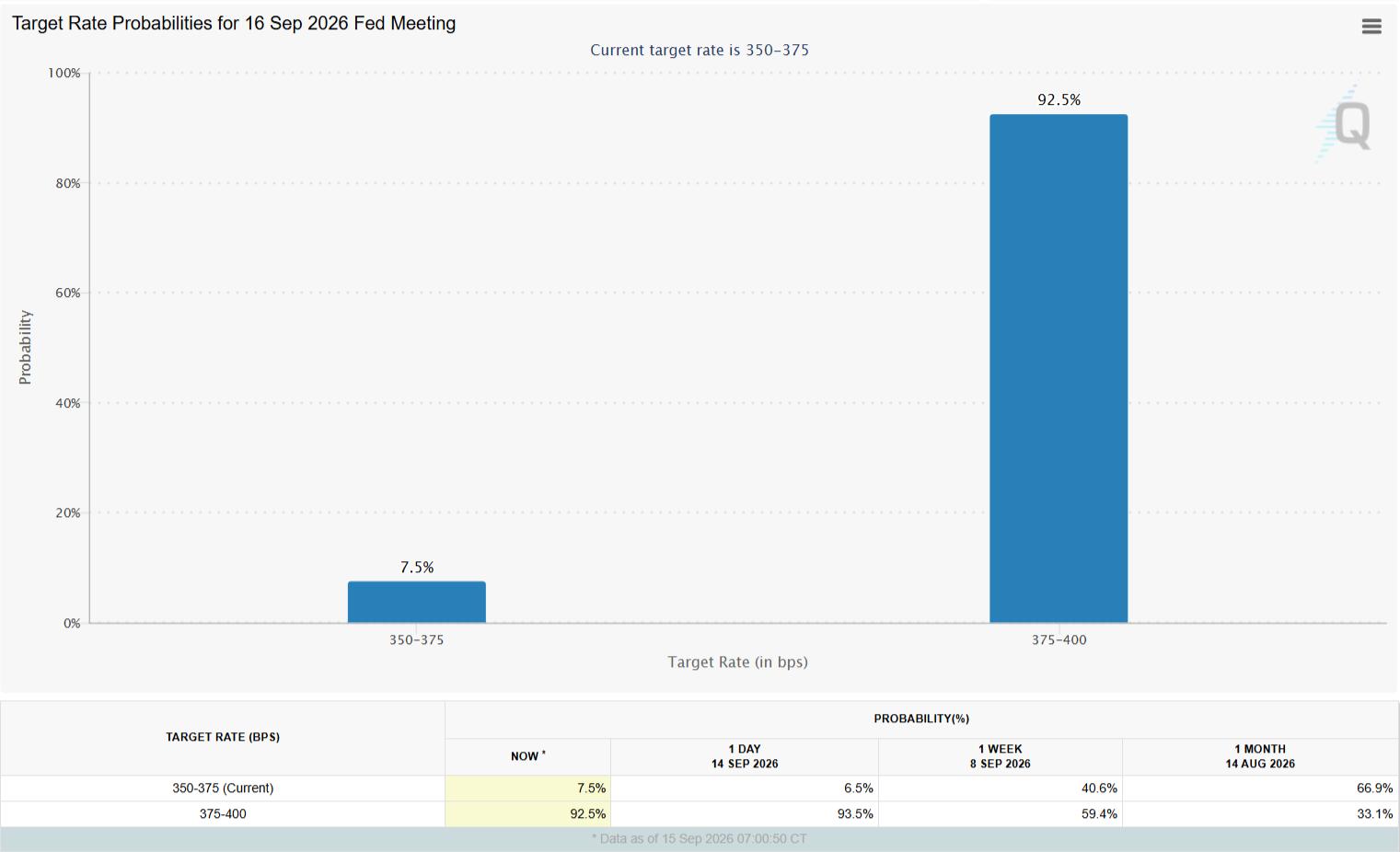
Markets widely expect the Federal Open Market Committee (FOMC) to raise the policy rate by 25 basis points (bps) to the range of 3.75%-4% after opting to leave it unchanged in the previous five consecutive meetings.
This decision is almost fully priced in, with the CME FedWatch Tool pointing to about only a 7.5% chance of another policy hold. Hence, the revised Summary of Economic Projections (SEP) and Fed Chair Kevin Warsh’s comments in the post-meeting press conference could offer important clues on the rate outlook and drive the US Dollar’s (USD) valuation.
Earlier in the month, Fed Governor Christopher Waller said that he would be inclined to support a policy hold if August inflation data were to confirm that inflation pressures were cooling. The US Bureau of Labor Statistics (BLS) reported on Friday that the annual inflation, as measured by the change in the Consumer Price Index (CPI), held steady at 3.4% in August, showing no progress. According to the other details of the report, the core CPI, which excludes volatile food and energy prices, rose by 0.3% on a monthly basis, coming in above the market expectation of 0.2%. These inflation figures, combined with the impressive August labor market report, which recorded an increase of 162K in Nonfarm Payrolls, reaffirmed a monetary policy tightening step in September.
Analysts at MUFG/BTMU note that, following the stronger US inflation data, markets now expect the Fed to “begin their tightening cycle as soon as this week,” with “22bps of hikes priced in for this week’s FOMC meeting compared to around 15bps a week ago.”
They add that “while it is not a done deal that the Fed will begin hiking rates this week, it would be big surprise for the Fed to leave rates on hold after recent communication.” In their view, “a decision to leave rates on hold would also threaten to undermine the Fed’s policy credibility amidst building concerns over upside inflation risks from rising energy prices.” They highlight that “the price of Brent is currently trading at just over 50% higher than pre-conflict levels,” and caution that “there is little optimism that energy supplies from the Middle East will normalize quickly.”
When will the Fed announce its interest rate decision and how could it affect EUR/USD?
The Fed is scheduled to announce its interest rate decision and publish the monetary policy statement, along withe the revised SEP, at 18:00 GMT. This will be followed by Fed Chair Kevin Warsh’s press conference starting at 18:30 GMT.
In June, the dot plot, the component of the SEP that shows policymakers’ interest rate forecasts, highlighted that policymakers’ projections implied only a 25 bps increase in 2026, followed by a 25 bps rate cut in 2027 and another 25 bps cut in 2028.
At this juncture, a decision to leave the interest rate unchanged could be seen as a significant dovish surprise and weigh heavily on the USD and US Treasury bond yields as the initial reaction. Even if the dot plot points to a rate hike at the end of the year or a hawkish tilt in next year’s projections, a policy hold at this meeting could cause the Fed to lose its credibility, suggesting that the US central bank might be under political pressure not to tighten policy ahead of the midterm election. In this scenario, EUR/USD could gather bullish momentum.
In case the Fed raises the interest rate by 25 bps as anticipated, and the dot plot highlights one more increase this year and at least another hike next year, the USD could gather strength in the near term and trigger a sharp decline in EUR/USD. Such an outcome could help convince investors that the Fed will not be influenced by politics and do whatever is necessary to achieve price stability. According to the CME FedWatch Tool, markets currently see about a 75% probability that the Fed will hike rates at least twice by the end of the year, suggesting that there is room on the upside for the USD if one more tightening step in December is confirmed.
Economists at ING note that the data backdrop has softened since the Fed’s last forecast update, pointing to “a weaker than expected 2Q GDP report” and “a softer trend in job creation, notwithstanding the August surprise,” while inflation has shown “some encouraging signs of decelerating, even if the year-on-year rate remains above 2%.” They “continue to argue that weak wage growth, tariff refunds and a stagnant housing market, which will slow shelter inflation, will all contribute towards a convergence on the 2% inflation target next year,” although they flag that “the risk is energy prices.”
Against this backdrop, ING expects only modest changes to the Fed’s projections. “In general though, we expect the Fed to project slightly lower inflation than they had in their June forecast while the GDP and labour metrics are little changed.” On rates, they look for the Fed to maintain a relatively elevated near-term profile, stating: “We expect them to have 4% as their end 2026 and end 2027 Fed funds forecast before it heads to their previous long-run projection for the Fed funds rate of 3.1%.”
Brown Brothers Harriman’s Elias Haddad argues that the upcoming FOMC decision will be pivotal for the USD, with the tone of the meeting likely to matter as much as the rate move itself. BBH outlines a clear “hawkish scenario: a unanimous or near-unanimous vote for a hike, dots that align with markets, and/or Warsh signaling more tightening would lift USD.”
By contrast, the bank cautions that a “dovish scenario: a split vote for a hike, dots below market pricing and/or Warsh framing the hike as insurance against inflation rather than the start of a sustained tightening cycle would weaken USD.” Despite the prospect of further tightening being priced into futures, BBH stresses that “the US economy does not warrant an aggressive tightening cycle. The slowdown in wage growth is disinflationary, and Fed policy is already somewhat restrictive against a nominal neutral rate of around 3.00%.”
Valeria Bednarik, FXStreet Chief Analyst, provides a short-term technical outlook for EUR/USD:
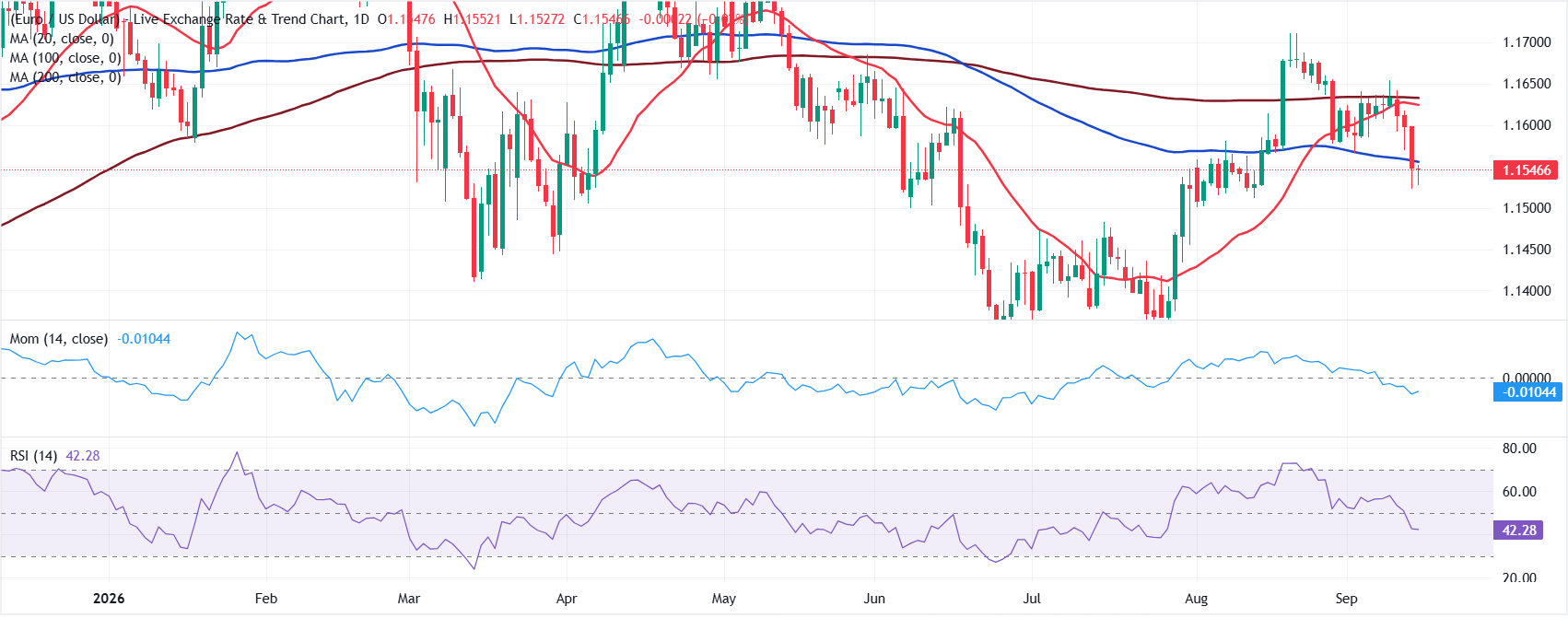
“EUR/USD trades near a fresh one-month low set on Monday at 1.1523, as investors priced in a rate hike. The overall picture is bearish, as the pair trades below all its moving averages on the daily chart after repeatedly failing to overcome the 200-day SMA since late August. The 100-day SMA at around 1.1550 provides immediate resistance ahead of the mentioned 200-day SMA at 1.1630.”
Bednarik adds: “The same chart shows technical indicators consolidating below their midlines, reflecting the ongoing pause ahead of the announcement rather than signaling downward exhaustion. The expected rate hike should push the USD higher, although the EUR/USD slide could be limited, as market players have already priced it in ahead of the announcement. A strong static support area comes at 1.1470, ahead of the 1.1400 threshold. A surprise on-hold decision, on the other hand, could put strong pressure on the Greenback and result in EUR/USD shooting beyond the aforementioned resistance levels and near the 1.1700 mark."
Inflation FAQs
Inflation measures the rise in the price of a representative basket of goods and services. Headline inflation is usually expressed as a percentage change on a month-on-month (MoM) and year-on-year (YoY) basis. Core inflation excludes more volatile elements such as food and fuel which can fluctuate because of geopolitical and seasonal factors. Core inflation is the figure economists focus on and is the level targeted by central banks, which are mandated to keep inflation at a manageable level, usually around 2%.
The Consumer Price Index (CPI) measures the change in prices of a basket of goods and services over a period of time. It is usually expressed as a percentage change on a month-on-month (MoM) and year-on-year (YoY) basis. Core CPI is the figure targeted by central banks as it excludes volatile food and fuel inputs. When Core CPI rises above 2% it usually results in higher interest rates and vice versa when it falls below 2%. Since higher interest rates are positive for a currency, higher inflation usually results in a stronger currency. The opposite is true when inflation falls.
Although it may seem counter-intuitive, high inflation in a country pushes up the value of its currency and vice versa for lower inflation. This is because the central bank will normally raise interest rates to combat the higher inflation, which attract more global capital inflows from investors looking for a lucrative place to park their money.
Formerly, Gold was the asset investors turned to in times of high inflation because it preserved its value, and whilst investors will often still buy Gold for its safe-haven properties in times of extreme market turmoil, this is not the case most of the time. This is because when inflation is high, central banks will put up interest rates to combat it. Higher interest rates are negative for Gold because they increase the opportunity-cost of holding Gold vis-a-vis an interest-bearing asset or placing the money in a cash deposit account. On the flipside, lower inflation tends to be positive for Gold as it brings interest rates down, making the bright metal a more viable investment alternative.
Economic Indicator
FOMC Economic Projections
At four of its eight scheduled annual meetings, the Federal Reserve (Fed) releases a report detailing its projections for inflation, the unemployment rate and economic growth over the next two years and, more importantly, a breakdown of each Federal Open Market Committee (FOMC) member's individual interest rate forecasts.
Read more.Next release: Wed Sep 16, 2026 18:00
Frequency: Irregular
Consensus: -
Previous: -
Source: Federal Reserve
Recommended Articles


