


Direxion Semiconductor Bull ETF Drops 14% as Chip Sector Faces Sharp Selloff
Key Points
The Direxion Daily Semiconductor Bull ETF is performing significantly worse than its non-leveraged counterpart over the past month.
With chip stocks in a funk, that’s not surprising.
But it is a reminder that warning labels on leveraged ETFs need to be acknowledged.
- 10 stocks we like better than Direxion Shares ETF Trust - Direxion Daily Semiconductor Bull 3x ETF ›
One of the most important things new investors can do is assess their risk tolerance. That doesn't mean pigeonholing themselves in the long term, because risk-taking can and does evolve as market participants "stack days," gaining knowledge and experience.
Some investors are content to stick with conservative, low-volatility stocks, while others go for more exhilarating growth. Other market participants simply embrace low-cost, plain vanilla index funds and exchange-traded funds (ETFs) and call it a day. The point is the market serves up dishes for a variety of tastes, and investors are free to change their tastes over time.
Missed Nvidia in 2009? This Rare Signal Is Flashing Again. In 2009, a "Double Down" signal flashed for a little-known chipmaker called Nvidia. For the first time in years, that same "Total Conviction" signal is flashing for a company 1/100th the size of Nvidia. Continue »
For the "go big or go home crowd," there are leveraged, or geared ETFs. That's an expansive, seductive corner of the ETF realm, and it includes the Direxion Daily Semiconductor Bull 3X ETF (NYSEMKT: SOXL).

This semiconductor will get drubbed if chip stocks languish. Image source: Getty Images.
Investors who are new to leveraged ETFs should take a few minutes to understand how these products work. Put simply, they live up to their billing by amplifying the potential upside (and downside) of an index or an individual. So in the case of the Direxion chip ETF, it attempts to deliver 300% of the daily performance of the NYSE Semiconductor Index. Sounds fun, and it can be, but investors need to understand what they're getting into before hitting the "buy" button on leveraged ETFs.
SOXL gives and takes away
Thanks in large part to extended momentum for the artificial intelligence (AI) trade, semiconductor stocks and traditional chip ETFs have become portfolio lynchpins.
For example, Nvidia is the world's largest company by market capitalization. Three chip stocks, including Nvidia, are among the S&P 500's top 10 holdings, and the iShares Semiconductor ETF (NASDAQ: SOXX) has $44.9 billion in assets under management.
Bringing up the SOXX ETF is a good segue into exploring risks associated with leveraged funds, such as the Direxion chip ETF. It tracks the same index as the Direxion product, but for the month ending Sept. 10, the iShares ETF lost 3.6% while its leveraged counterpart slipped 14.3%.
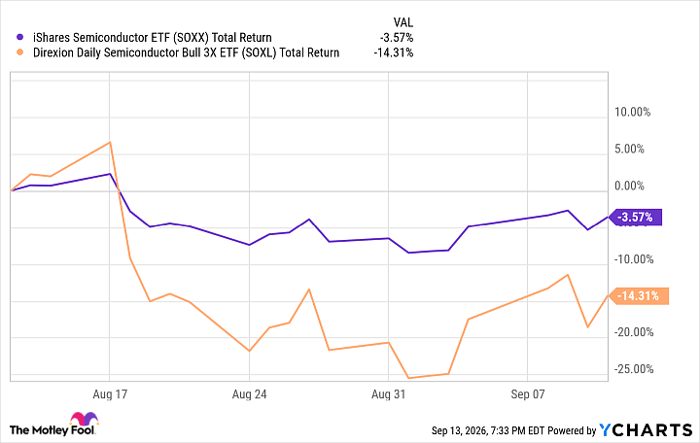
Data by YCharts.
That's the rub with leveraged ETFs. They give, and they take away. Specific to the Direxion ETF, this isn't a fund any investor, risk-tolerant or not, wants to be caught holding when stocks like Nvidia and Micron Technology are having bad days.
But that's exactly what confounded semiconductor stocks over what was a cruel summer. As temperatures rose, the Philadelphia Semiconductor Index (not the gauge followed by the Direxion ETF) dipped 18% this summer. Sure, there are some buying opportunities, but if they don't materialize in earnest, this Direxion ETF won't just trade sideways or post modest declines. It will subject market participants to significant punishment.
Time isn't on your side
In options trading, it's often said that time is the enemy, and that's true with leveraged ETFs such as the Direxion semiconductor fund. There's a reason "daily" is in this fund's name: On any given day, this ETF will behave as expected. So if the NYSE Semiconductor Index rises by 1% tomorrow, the Direxion fund should gain 3%.
Hold this ETF, or another like it, for weeks or months, and the returns realized by an investor will probably differ wildly from the underlying asset.
The reason that's a real specter investors need to consider is that geared ETFs source their leverage through futures and swaps. Still, because a fund like the Direxion semiconductor ETF must stay within its dictated parameters, in this case 300% of the daily performance of the NYSE Semiconductor Index, it resets every day to accomplish that objective.
All that daily resetting is a reminder that even though the going is good for chip stocks, this ETF could veer steeply away from returns that resemble 3 times its underlying index. That's also a reminder that if investors want a buy-and-hold experience in the chip space, it's best to consider a stock like Nvidia or a traditional ETF rather than a short-term thrill ride.
Should you buy stock in Direxion Shares ETF Trust - Direxion Daily Semiconductor Bull 3x ETF right now?
Before you buy stock in Direxion Shares ETF Trust - Direxion Daily Semiconductor Bull 3x ETF, consider this:
The Motley Fool Stock Advisor analyst team just identified what they believe are the 10 best stocks for investors to buy now… and Direxion Shares ETF Trust - Direxion Daily Semiconductor Bull 3x ETF wasn’t one of them. The 10 stocks that made the cut could produce monster returns in the coming years.
Consider when Netflix made this list on December 17, 2004... if you invested $1,000 at the time of our recommendation, you’d have $420,109!* Or when Nvidia made this list on April 15, 2005... if you invested $1,000 at the time of our recommendation, you’d have $1,303,689!*
Now, it’s worth noting Stock Advisor’s total average return is 938% — a market-crushing outperformance compared to 211% for the S&P 500. Don't miss the latest top 10 list, available with Stock Advisor, and join an investing community built by individual investors for individual investors.
See the 10 stocks »
*Stock Advisor returns as of September 16, 2026.
Todd Shriber has no position in any of the stocks mentioned. The Motley Fool has positions in and recommends Micron Technology, Nvidia, and iShares Trust-iShares Semiconductor ETF. The Motley Fool has a disclosure policy.
Recommended Articles


