


Dow Jones Industrial Average futures whiplash as Iran tensions resume
- Crude Oil prices jumped sharply on fading ceasefire hopes, dragging equities lower and pushing Treasury yields higher.
- The Nasdaq led losses as memory chip stocks sold off following Alphabet's AI compression breakthrough.
- Weekly jobless claims edged up to 210K but continuing claims fell to their lowest level since May 2024.
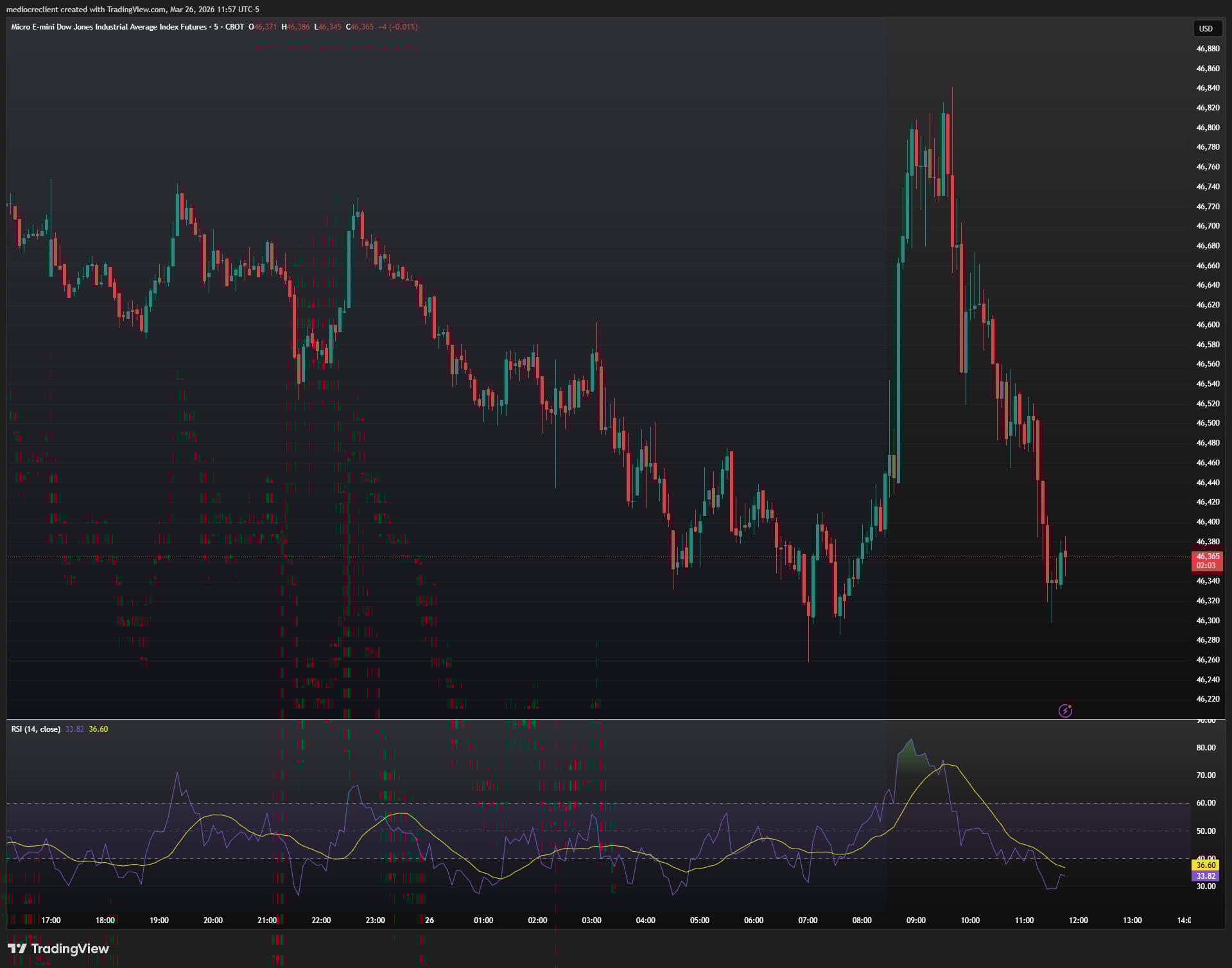
The Dow Jones Industrial Average fell around 230 points, or roughly 0.5%, on Thursday, giving back the previous session's gains as surging Oil prices and collapsing ceasefire optimism crushed risk appetite. The S&P 500 dropped 0.8%, while the tech-heavy Nasdaq Composite shed 1.1%. The selling marked an abrupt reversal from Wednesday's rally, which had been fueled by hopes that a US-brokered peace deal with Iran was within reach. Dow Jones futures slid to 46,200 before a sharp correction into the 46,800 region before immediately paring back into the early session's levels.
Overnight session sets a bearish tone
The risk-off mood was already firmly in place before New York opened. Asian markets sold off overnight after Iran responded negatively to the US's 15-point ceasefire proposal, with state media citing an unnamed senior official who spoke of a counterproposal demanding a complete halt to strikes and recognition of Iranian sovereignty over the Strait of Hormuz. South Korea's Kospi slumped more than 3%, weighed further by heavy selling in tech names like Samsung after Alphabet (GOOG) published research on a more efficient AI memory compression method. China's Shanghai index and Hong Kong's Hang Seng both declined around 1%. European indices followed suit, with the Stoxx 600 trading roughly 0.8% lower ahead of the US open, as Brent Crude climbed through $106 during the European morning session.
Iran tensions escalate as Trump's deadline looms
Thursday marked 48 hours until the expiration of President Donald Trump's five-day pause on strikes against Iranian power and energy infrastructure, and the diplomatic picture deteriorated further throughout the session. Trump posted on Truth Social that Iranian negotiators were "very different" and "strange," warning that Tehran had better "get serious soon, before it is too late." Separately, CNN reported that the commander of Iran's Islamic Revolutionary Guard Corps (IRGC) Navy — a key figure behind the near-total blockade of the Strait of Hormuz — had been killed, citing Israel's defense minister. Gulf states piled on with a joint statement condemning Iran's strikes from Iraqi territory on their energy infrastructure, describing them as "criminal" and signaling a readiness to defend themselves. Two people were also killed in Abu Dhabi after debris fell from an intercepted ballistic missile. Tobin Marcus, head of US policy and politics at Wolfe Research, noted that markets appeared to be pricing in the possibility that Iran's public rejection of talks was a bluff, but cautioned that "the ambiguity can't last much longer" with Trump's deadline fast approaching.
Oil surges as yields spike
Brent Crude futures jumped around 5% to above $107 per barrel, while West Texas Intermediate climbed more than 4% to near $95. The move pushed Treasury yields sharply higher, with the 10-year reaching close to 4.4% and longer-dated 20-year and 30-year yields approaching 5%. The rise in yields hit rate-sensitive sectors hard and added pressure to already struggling tech names. Trump attempted to calm nerves, telling reporters he thought the surge in Oil and the broader market pressure were "not as bad as he expected," predicting prices would "come back down to where it was and probably lower." Despite the reassurances, the damage was done — equities stayed pinned near session lows through the close.
Memory chips hammered as Alphabet's AI breakthrough rattles demand outlook
The technology sector faced a second headwind beyond geopolitics. Alphabet's Google Research earlier this week unveiled TurboQuant, a compression algorithm that reportedly reduces the memory required to run large language models by up to six times with zero accuracy loss. While still a research-stage development, the announcement triggered a swift reassessment of memory demand. Micron (MU) fell sharply, while Lam Research (LRCX) and Applied Materials (AMAT) both sank around 4%. The selling extended to international names, with Samsung and SK Hynix dropping 5% and 6% respectively in Seoul. Among the mega-caps, Tesla (TSLA), Microsoft (MSFT), Amazon (AMZN), and Meta (META) all fell between 1.5% and 3%, caught in the crossfire of rising yields and deteriorating risk sentiment. Nvidia (NVDA) struggled to stay afloat despite bullish commentary from CEO Jensen Huang at the ongoing GTC 2026 conference. On the upside, Equitable Holdings (EQH) and Corbridge (CRBG) both gained around 2% after announcing an all-stock merger valued at $22 billion.
Jobless claims steady as labor market holds firm
On the economic data front, the US Department of Labor reported that initial jobless claims rose to 210K for the week ending March 21, up from 205K the prior week and in line with consensus expectations. Continuing claims, a proxy for the total number of people receiving unemployment benefits, fell by 32K to 1.82 million for the week ending March 14 — the lowest reading since late May 2024. The data paints a picture of a labor market that is cooling but not cracking, with layoffs contained even as hiring momentum has slowed. The Federal Reserve (Fed) held rates steady at 3.50%-3.75% at its March 18 meeting, with the updated dot plot projecting only one cut for the remainder of 2026. The CME FedWatch Tool now shows an 89% probability that rates will remain unchanged through the Fed's June meeting, with markets assigning better than even odds that the current rate stays in place through year-end. Fed Governor Lisa Cook and Fed Vice Chair Philip Jefferson are both scheduled to speak later on Thursday.
Dow Jones E-mini Futures 5-minute chart
Dow Jones FAQs
The Dow Jones Industrial Average, one of the oldest stock market indices in the world, is compiled of the 30 most traded stocks in the US. The index is price-weighted rather than weighted by capitalization. It is calculated by summing the prices of the constituent stocks and dividing them by a factor, currently 0.152. The index was founded by Charles Dow, who also founded the Wall Street Journal. In later years it has been criticized for not being broadly representative enough because it only tracks 30 conglomerates, unlike broader indices such as the S&P 500.
Many different factors drive the Dow Jones Industrial Average (DJIA). The aggregate performance of the component companies revealed in quarterly company earnings reports is the main one. US and global macroeconomic data also contributes as it impacts on investor sentiment. The level of interest rates, set by the Federal Reserve (Fed), also influences the DJIA as it affects the cost of credit, on which many corporations are heavily reliant. Therefore, inflation can be a major driver as well as other metrics which impact the Fed decisions.
Dow Theory is a method for identifying the primary trend of the stock market developed by Charles Dow. A key step is to compare the direction of the Dow Jones Industrial Average (DJIA) and the Dow Jones Transportation Average (DJTA) and only follow trends where both are moving in the same direction. Volume is a confirmatory criteria. The theory uses elements of peak and trough analysis. Dow’s theory posits three trend phases: accumulation, when smart money starts buying or selling; public participation, when the wider public joins in; and distribution, when the smart money exits.
There are a number of ways to trade the DJIA. One is to use ETFs which allow investors to trade the DJIA as a single security, rather than having to buy shares in all 30 constituent companies. A leading example is the SPDR Dow Jones Industrial Average ETF (DIA). DJIA futures contracts enable traders to speculate on the future value of the index and Options provide the right, but not the obligation, to buy or sell the index at a predetermined price in the future. Mutual funds enable investors to buy a share of a diversified portfolio of DJIA stocks thus providing exposure to the overall index.
Recommended Articles


