


Could Buying Eli Lilly Today Set You Up for Life?
Key Points
Eli Lilly's GLP-1 drugs Mounjaro and Zepbound are industry leaders.
Mounjaro and Zepbound are driving the company’s impressive revenue growth.
Investors are well aware of the company's strengths and perhaps ignoring the pharmaceutical industry's normal ebbs and flows.
- 10 stocks we like better than Eli Lilly ›
If you are interested in buying Eli Lilly (NYSE: LLY) today, it is most likely because of the success of the company's GLP-1 drugs. The sales performance of Mounjaro and Zepbound is nothing short of impressive. However, long-term investors need to step back and look at the bigger picture before buying in the hope that Eli Lilly will set them up for life.
Eli Lilly's GLP-1 drugs are driving the story
Sales of Mounjaro rose 99% in 2025. Zepbound's sales rose an even more impressive 175%. Eli Lilly only breaks out one other individual drug based on sales, and the gain was just 8% for the year. In other words, almost all of Eli Lilly's 45% sales gain in 2025 came from Mounjaro and Zepbound. In fact, the two drugs accounted for 56% of the company's top line last year.
Will AI create the world's first trillionaire? Our team just released a report on the one little-known company, called an "Indispensable Monopoly" providing the critical technology Nvidia and Intel both need. Continue »
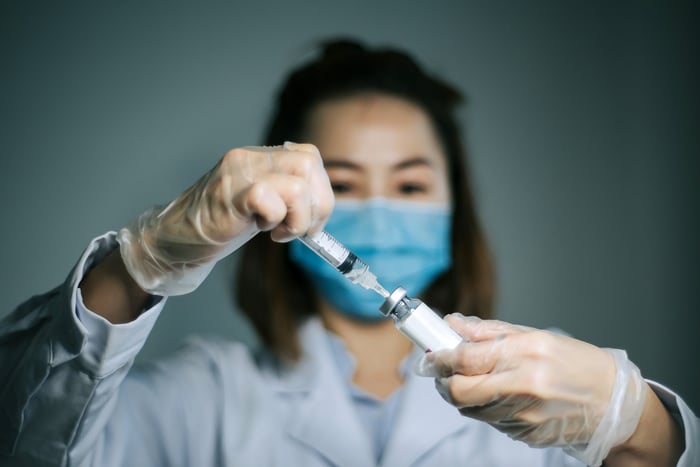
Image source: Getty Images.
GLP-1 weight loss drugs are an exciting new class of pharmaceuticals. So Eli Lilly's success is notable, since it is basically the industry's dominant player in the GLP-1 niche. That's good news, but with a price-to-earnings ratio of roughly 40x, Eli Lilly is a very expensive stock. For comparison, the S&P 500 index (SNPINDEX: ^GSPC) has a P/E ratio of 28x and the average pharma stock's P/E is just over 9x.
It looks very much like investors have fully priced in Eli Lilly's GLP-1 success. If the drug maker loses its industry-leading position for any reason, investors might drop the stock, quickly compressing its valuation. The problem is that Eli Lilly is, indeed, destined to see its GLP-1 business fade.
Eli Lilly is preparing today for a different tomorrow
Wall Street tends to extend current trends too far into the future. That is likely what is happening with Eli Lilly's GLP-1 success, given the lofty valuation the stock is trading at. Luckily, Eli Lilly isn't taking GLP-1 sales for granted; it is using the windfall to invest in new drugs, both internally and via acquisition.
That is good news, but it isn't clear that Eli Lilly will be able to develop new drugs in a timely manner in a highly complex, tightly regulated, and competitive industry. This is the big problem.
By design, Eli Lilly has a limited window during which it can sell Mounjaro and Zepbound exclusively. When patent protections expire, generic competition will come in, and the revenue from these drugs will fall dramatically. At the same time, other healthcare companies, including Novo Nordisk (NYSE: NVO) and Pfizer (NYSE: PFE), are developing their own GLP-1 drugs.
For example, Novo Nordisk just introduced a pill form of its GLP-1 drugs, beating Eli Lilly to market with this advance. Pfizer, meanwhile, is working on a longer-acting GLP-1 drug that would require less frequent dosing. That could give Pfizer's drug an edge on existing GLP-1 drugs if approved. Eli Lilly is the industry leader right now, but that doesn't guarantee it will remain so forever.
Eli Lilly is doing everything right, and long-term investors should still be worried
The truth is that there's nothing wrong with Eli Lilly as a business. It is hitting on all cylinders today and using its current success to prepare for the future. As an investor, that is exactly what you want to see a drug company do. However, Wall Street has afforded the stock such a large premium that Eli Lilly isn't likely to be a great long-term investment if you buy it today, as it looks priced for perfection. But that perfection is virtually impossible given the normal dynamics of the drug industry.
If you are looking at Eli Lilly, don't focus on its GLP-1 success. As iconic value investor Benjamin Graham explained, overpaying for a great business can turn it into a bad investment. Right now, Eli Lilly's valuation is troublingly high.
Should you buy stock in Eli Lilly right now?
Before you buy stock in Eli Lilly, consider this:
The Motley Fool Stock Advisor analyst team just identified what they believe are the 10 best stocks for investors to buy now… and Eli Lilly wasn’t one of them. The 10 stocks that made the cut could produce monster returns in the coming years.
Consider when Netflix made this list on December 17, 2004... if you invested $1,000 at the time of our recommendation, you’d have $497,659!* Or when Nvidia made this list on April 15, 2005... if you invested $1,000 at the time of our recommendation, you’d have $1,095,404!*
Now, it’s worth noting Stock Advisor’s total average return is 912% — a market-crushing outperformance compared to 185% for the S&P 500. Don't miss the latest top 10 list, available with Stock Advisor, and join an investing community built by individual investors for individual investors.
See the 10 stocks »
*Stock Advisor returns as of March 26, 2026.
Reuben Gregg Brewer has no position in any of the stocks mentioned. The Motley Fool has positions in and recommends Pfizer. The Motley Fool recommends Novo Nordisk. The Motley Fool has a disclosure policy.
Recommended Articles


