


Is Mitrade Right for You? A Complete Guide on How to Start Trading CFDs in 5 Steps
Ever felt like the world of online trading was a locked door, accessible only to veteran investors? Many platforms are cluttered with complex charts and jargon that scare off beginners.
Mitrade changes that. It is a platform designed to strip away the noise, giving you a clean window into global markets. Whether you want to trade surging tech stocks, volatile forex pairs, or the latest crypto trends, Mitrade makes the process intuitive.
This guide will walk you through exactly how to trade in Mitrade, turning intricate financial mechanisms into simple, actionable decisions.
Key Takeaways
Mitrade lets you trade CFDs on forex, gold, silver, indices, shares, and crypto
With CFD trading, you are just betting on price movements without actually owning the asset
Mitrade provides competitive spreads and negative balance protection, and doesn’t charge commission on most products
What is Mitrade? The Platform at a Glance
Mitrade is an online CFD trading platform built to be clean and simple, whether you are a complete newbie or have some experience. You can trade directly in your web browser, on its slick mobile app, or via a desktop app.
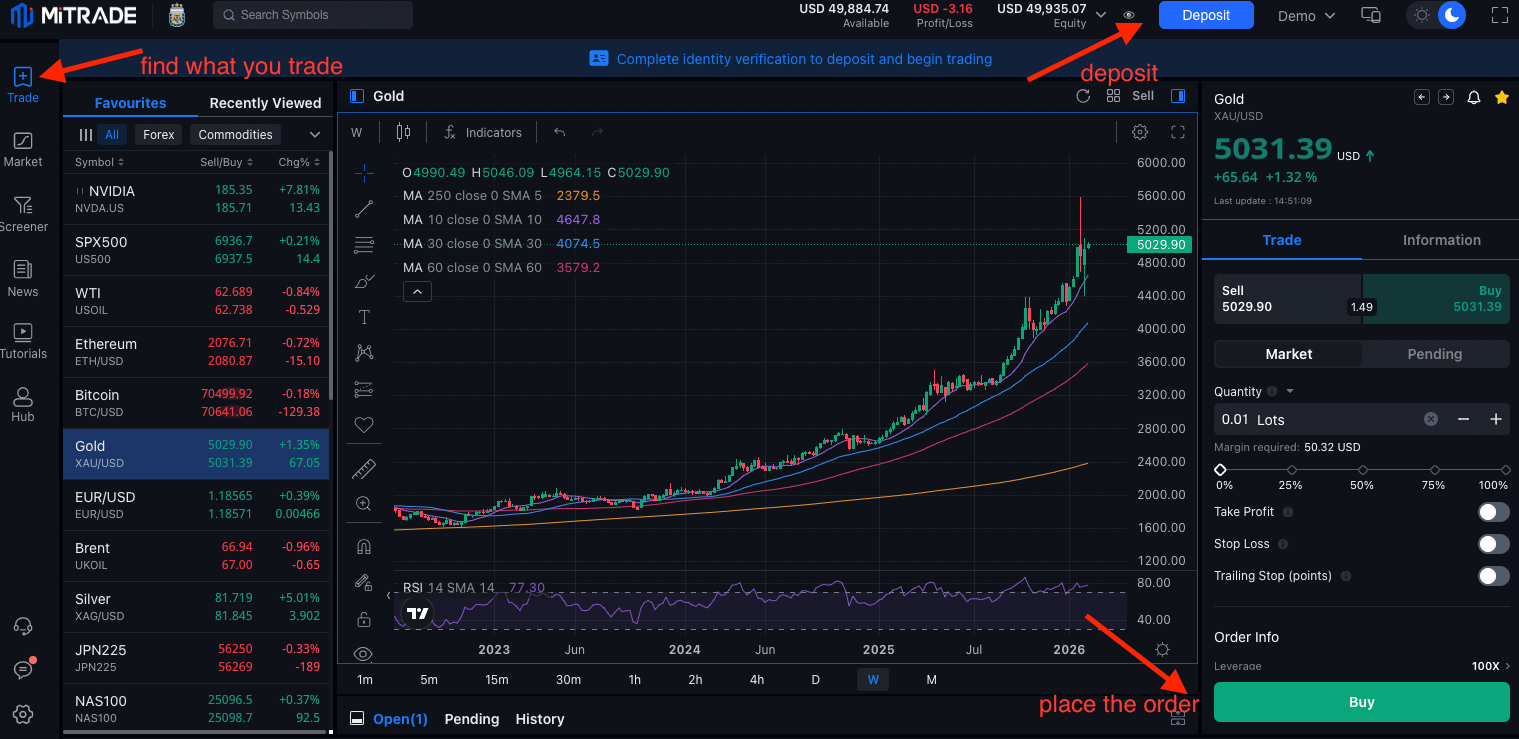
The interface is intuitive, clean, and modern. It includes a watchlist, open trades, account information, and a chart area. The platform also offers real-time pricing, built-in risk management tools, and educational resources to help you understand market behavior.
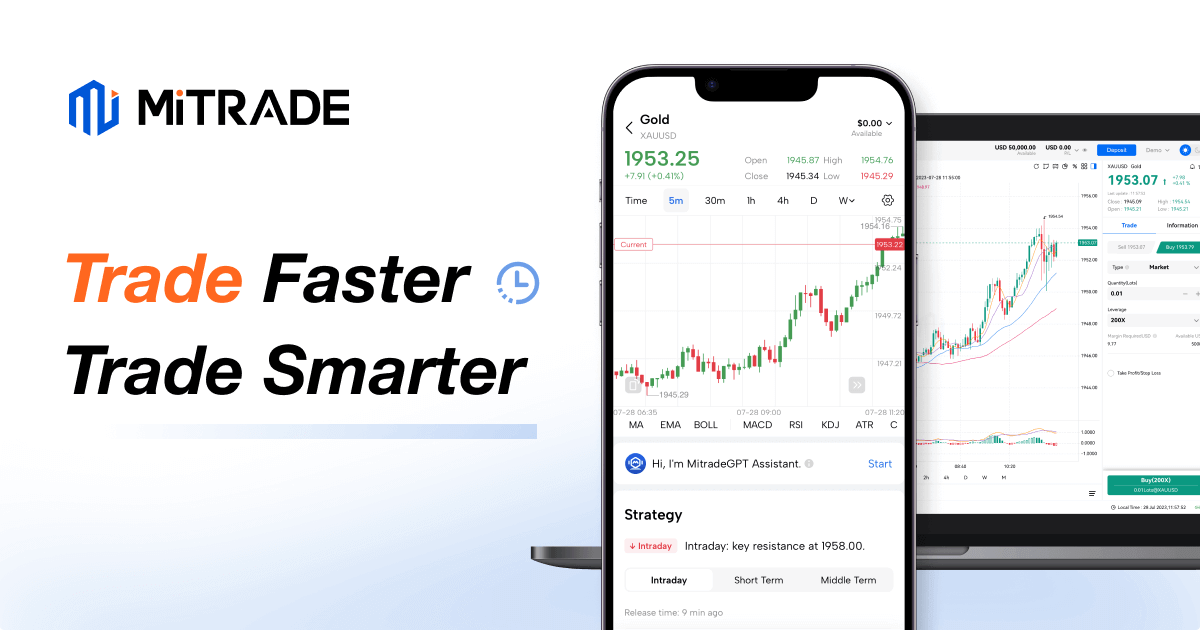
Key highlights of Mitrade:
Low Entry: Minimum deposit is just AUD 50.
Leverage: Up to 1:200 on forex (varies by asset and regulation).
Competitive Spreads: E.g., ~0.6 pips on EUR/USD, ~0.10–0.20 on Gold.
Safety First: Regulated by ASIC (Australia), CIMA (Cayman), and FSC (Mauritius).
Protection: Includes Negative Balance Protection (you cannot lose more than you deposit).
How Does CFD Trading Work?
Contract for Difference or CFD enables you to catch price swings. You never own the gold or the Apple share; you are just trading on its price movement.
If you think the price will rise, you Buy (Go Long). If you think it will fall, you Sell (Go Short). Your profit or loss is the difference between where you entered and exited the trade.
Here’s the big thing: leverage. This lets you control a much larger position with a smaller amount of your own cash (your “margin”). It’s a powerful tool that magnifies both gains and losses, so risk management is key.
On Mitrade, CFD trading is easy. The platform clearly shows your margin, leverage, and risk controls before you enter a trade. This makes it easier to understand what you are getting into.
Let’s say gold is at $4,450/ounce. You are convinced it will jump to $4,500, so you initiate a “buy” order with $500 and use 1:100 leverage. That gives you $50,000 worth of buying power, enough to control about 11.2 ounces of gold. If the asset climbs to $4,500, you pocket $560 (11.2 x $50). But if it falls $50 instead, you lose the same amount.
How to Use Mitrade: Your 5-Step Quick Start Guide
Mitrade is built to be simple, so getting started is simple. Here are the 5 steps to go from zero to your first trade.
Step 1: Sign Up & Verify
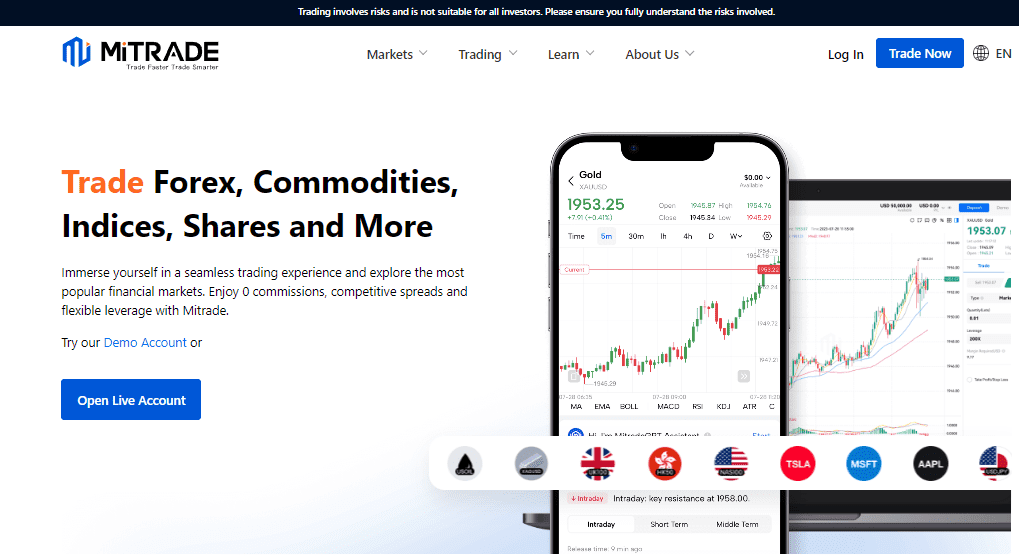
Head to the Mitrade website or download the app. Hit “Trade Now” at the far right-hand corner and proceed to “Sign Up.” Select log in if you already have an existing account. If not, fill in your info, and indicate whether you want a real or demo account (a good choice to start with). If ready to go live, you will need to upload a photo ID and proof of address for verification purposes.
*Start with a risk-free demo & 100USD welcome bonus.
Step 2: Fund Your Account (or Use Demo)
Minimum deposit is AUD 50. You can fund instantly with PayID (super popular in Australia), Visa/Mastercard, bank transfer, Skrill, or Neteller. The demo account gives you $50,000 virtual AUD right away. No verification needed, so you can practice as long as you want.
To deposit, (only on live account), open Mitrade's intuitive interface and follow the prompts.
Step 3: Explore the Platform
Log in, and you will see the main screen: watchlist, open trades, account balance, and charts. Tap the search icon and type “XAUUSD” for gold, “EURUSD” for forex, “NAS100” for Nasdaq, “Tesla” for shares, “Bitcoin”, etc. You can also click on one of the instruments to open the chart and see all the tools.
Step 4: Place Your First Trade
On the chart screen, select“Trade.” Choose “Buy” (if you think the price will rise) or “Sell” (if
you think it will fall). Set your trade amount (e.g., 0.01 lot for a small position). Adjust leverage if needed, and add a stop-loss and take-profit. Press“Confirm,” and the trade opens instantly. You will see it in your “Positions” tab with live profit/loss.
Step 5: Manage & Close Trades
Tap any open position to see details. Close it manually or set a trailing stop to lock in profits as it moves your way. You can also place pending orders (limit or stop) to enter automatically at a better price. Withdraw profits the same way you deposited — PayID is instant in Australia.
*Start with a risk-free demo & 100USD welcome bonus.
What Products Can Be Traded on Mitrade?
Mitrade keeps the list focused but very usable
Forex: multiple currency pairs (EUR/USD, GBP/USD, AUD/USD, USD/JPY, etc).
Commodities: Gold (XAU/USD), Silver (XAG/USD), Crude Oil, Copper, Coffee, Sugar, Natural Gas, and more.
Indices: US30, NAS100, GER40, UK100, AUS200, HK50, ES35, etc.
Shares: 150+ CFDs on US, Australian, European, and Hong Kong stocks (Apple, Tesla, BHP, CBA, etc.).
Cryptocurrencies: Bitcoin, Ethereum, Ripple, Litecoin, and other major crypto CFDs.
What Fees Are Involved in Buying and Selling CFDs?
You incur very low fees trading CFDs on Mitrade. Here are the fees to keep watch:
Spreads: This is the difference between the buy (ask) and sell (bid) price and is the main cost on the platform. Mitrade’s spreads are among the lowest in the industry. For instance, you “pay” about 0.6-0.8 pips EUR/USD or 0.10-0.20 USD gold when entering a trade.
Swap fees: If you hold a CFD position overnight, you attract a small interest-based fee or credit. It can be positive or negative depending on the direction of your position.
No commission: Mitrade doesn’t charge separate commission fees on standard CFD trades.
Deposit and withdrawal: These are free unless your bank charges some fees. Be mindful of foreign currency conversion charges as well.
Inactivity fees: You are charged a small amount if your account remains dormant for a long time, say 12 months. Always check the latest schedule of fees on the website.
Mitrade is very transparent — what you see in the trade ticket (spread + estimated swap) is basically what you pay. There are no hidden charges.
What Are the Risks of CFD Trading?
Every form of investing has its positive and negative sides, and CFD trading is no different. The very features that make it a flexible tool also require a mindful and educated approach.
Leverage, for example, is a double-edged sword. Sure, it enables you to gain meaningful market exposure with a smaller initial deposit and multiply possible gains. However, you can still make substantial losses in case the market moves against you.
And volatility? It’s constant as markets are always on the move. News events, economic data, and global sentiment can cause assets like Gold or major indices to experience swift price changes in short periods. This creates trading opportunities but also underscores the need for a plan.
It’s important to enter the markets with clear eyes. Regulatory warnings state that a significant majority of retail traders lose money on CFDs. This statistic isn’t meant to scare you away, but a reality check. So to succeed, avoid guessing every twist and turn in the market and stick to solid risk management.
Want to build a more resilient approach? Try these:
Practice on demo for at least 2–4 weeks or more to attain emotional discipline.
Risk only 1–2% of your account per trade.
Always set a stop-loss.
Trade only with money you can afford to lose.
Mitrade believes in empowering your journey with the correct safeguards. That’s why it offers negative balance protection. This means your risk is limited to the funds in your account, so you can never lose more than your deposit and owe it money. The platform includes an unlimited demo account to give you a risk-free start. You have space to learn, make mistakes, and build confidence in a completely simulated environment.
Is Trading CFDs on Mitrade Right for You?
Before you sign up with Mitrade, ask yourself a few things first
Do you really get the risks, and are you ready to handle them responsibly?
Are you a beginner or an intermediate trader wanting simplicity? The interface is perfect for anyone who doesn’t need overly complex institutional tools.
Want access to multiple markets from a single platform? Here, you can trade CFDs on indices, forex, and commodities.
Are you willing to practice? Mitrade demo account offers an ideal, zero-risk training ground.
If you answered Yes, Mitrade is an excellent entry point. It removes the barriers of complex institutional software and lets you focus on the market itself.
Mitrade makes CFD trading straightforward, fast, and beginner-friendly — with tight spreads, instant PayID funding, low costs, and full ASIC protection. Whether you are starting with gold, forex, shares, or crypto, the platform gives you everything you need without overwhelming you.
Start small: open the free demo, practise your strategy, and only trade real money when you feel confident.


* The content presented above, whether from a third party or not, is considered as general advice only. This article should not be construed as containing investment advice, investment recommendations, an offer of or solicitation for any transactions in financial instruments.


