

Oil Prices Plunged 20% in May, Under the Fog of U.S.-Iran Tensions, Where Are Oil Prices Heading?

Source Tradingkey

TradingKey - As the conflict between the U.S. and Iran continues into its third month, the global oil market is caught in a situation where sharp volatility and uncertainty are intertwined.

In May, international oil prices saw their largest monthly decline in six years, with Brent crude's July contract falling nearly 20% and West Texas Intermediate (WTI) July contract dropping nearly 17%, both recording their worst monthly performance since the pandemic outbreak in March 2020.
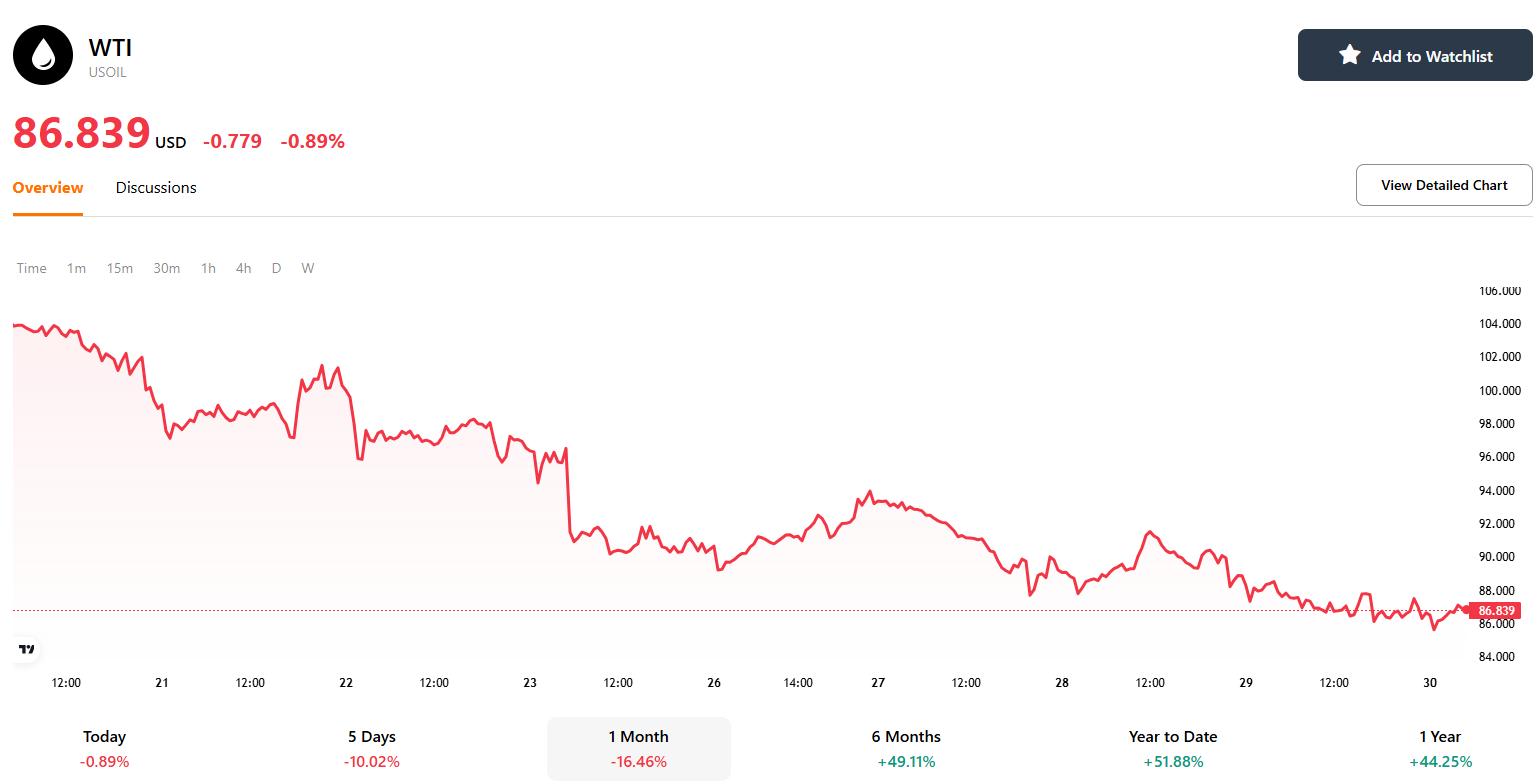
usoil-3d5270167446446d94969b7b9c638dcf

The market generally attributed this plunge to expectations of an imminent ceasefire agreement between the U.S. and Iran. Although traders are betting that a ceasefire will ease supply disruptions in the Persian Gulf, the negotiation process remains volatile. The latest reports indicate that President Trump has postponed a final decision on the Iran-related deal.

Reportedly, U.S. and Iranian negotiators have reached a consensus on a preliminary framework agreement, which still requires approval from the top leaders of both nations. Iran insists on the immediate lifting of sanctions, the release of $12 billion in frozen assets, and the establishment of a $300 billion reconstruction fund; meanwhile, the U.S. maintains that sanctions relief should be linked to Iran's compliance progress.

The two sides remain divided on core issues such as the nuclear program and passage rights through the Strait of Hormuz. Iranian Foreign Ministry spokesperson Baghaei explicitly stated that they will not accept any demands containing "must" language, adding that the navigation mechanism for the Strait of Hormuz should be jointly determined by Iran and Oman.

President Trump claimed on social media that Iran must abandon its nuclear program, destroy its enriched uranium, and open the Strait of Hormuz, announcing that the U.S. Navy would lift its blockade of the strait; however, Iran quickly refuted his remarks as "half-truths," stating that the text of the agreement does not involve the destruction of nuclear materials or toll-free passage through the strait.

Currently, Trump has not made a final decision on the agreement, and administration officials stated that the President will only accept a proposal that meets his "red line" requirements.

Even if a ceasefire agreement is eventually reached, it will be difficult for the oil market to quickly return to its pre-war state. Analysts pointed out that the conflict has caused structural changes to the global energy landscape, and geopolitical risk premiums will persist over the long term.

Ben McMillan, Chief Investment Officer at IDX Advisors, believes that oil prices are unlikely to drop back to pre-war levels of $60 per barrel. Even in the best-case scenario, it would take three to six months for oil supplies to recover, while geopolitical risk premiums will act as a long-term "tax" reflected in oil prices.

During the conflict, Very Large Crude Carriers (VLCCs) that originally passed through the Strait of Hormuz were diverted elsewhere globally, and redeploying these vessels will take two to three months.

Furthermore, energy infrastructure in the Gulf region has suffered sustained damage, with repairs to Qatar's Ras Laffan LNG plant expected to take three to five years. Shipping companies' confidence in the security of the Persian Gulf will also take time to recover, and vessels will only return to this critical waterway when they see clear economic incentives and signals of lasting peace.

The market is currently caught in a tug-of-war between two extreme expectations: on one hand, the optimistic assumption that crude flows will gradually recover following a ceasefire agreement; on the other, concerns that an escalation of the conflict will lead to further supply tightening.

Daily news developments are shifting the probabilities of these two outcomes, triggering sharp volatility in oil prices. Stephen Innes, managing partner at SPI Asset Management, noted that the market has become exhausted by repeated ceasefire rumors, missile attacks, draft agreements, and denials, with any piece of news capable of sparking a market reversal.

Meanwhile, the pressure on global crude inventory depletion triggered by supply disruptions in the Middle East continues to climb.

Helima Croft, Head of Commodity Strategy at RBC Capital Markets, noted in her latest report that based on the average depletion rate over the past six weeks, inventory coverage—measured as the ratio of onshore crude stocks to refinery throughput—is expected to drop to the 30-40 day range by October. This would be the lowest level since RBC began building the relevant dataset in 2016.

Once this critical threshold is breached, the crude market will face the dual challenges of logistical bottlenecks and feedstock shortages, which could even threaten the normal operations of the refining industry.

Croft specifically emphasized that the current price trend has significantly diverged from supply fundamentals. Despite the sharp drop in oil prices in May, global inventories are being depleted at an unprecedented rate. She warned that if there is no substantive breakthrough in the U.S.-Iran situation, the June-August period this year will serve as a critical pressure test window for the crude market.

In the long term, this conflict could permanently alter the risk pricing mechanism of the oil market. The prolonged closure of the Strait of Hormuz, the destruction of energy infrastructure, and the escalation of geopolitical tensions will lead to higher crude transportation costs, increased demand for alternative routes, and heightened security requirements for tankers. The risk premium formed by these collective factors will continue to influence oil price trends for years to come, and even once the conflict concludes, the market may find it difficult to return to the low-risk environment of the past.

Disclaimer: For information purposes only. Past performance is not indicative of future results.
placeholder
Bitcoin CME gaps at $35,000, $27,000 and $21,000, which one gets filled first?Prioritize filling the $27,000 gap and even try higher.
Author  FXStreet
Aug 22, 2023
Prioritize filling the $27,000 gap and even try higher.
placeholder
Pinduoduo Earnings Incoming: Morgan Stanley Sees Long-Term Profit Potential​Insights – On November 21, Chinese e-commerce giant Pinduoduo (PDD) will release its Q3 2024 earnings.
Author  Mitrade
Nov 20, 2024
​Insights – On November 21, Chinese e-commerce giant Pinduoduo (PDD) will release its Q3 2024 earnings.
placeholder
Bitcoin briefly loses 2025 gains as crypto plunges over the weekend.Bitcoin experienced a sharp decline this weekend, briefly erasing its 2025 gains and dipping below its year-opening value of $93,507. The cryptocurrency fell to a low of $93,029 on Sunday, representing a 25% drop from its all-time high in October. Although it has rebounded slightly to around $94,209, the pressures on the market remain significant. The downturn occurred despite the reopening of the U.S. government on Thursday, which many had hoped would provide essential support for crypto markets. This year initially appeared promising for cryptocurrencies, particularly after the inauguration of President Donald Trump, who has established the most pro-crypto administration thus far. However, ongoing political tensions—including Trump's tariff strategies and the recent government shutdown, lasting a historic 43 days—have contributed to several rapid price pullbacks for Bitcoin throughout the year. Market dynamics are also being influenced by Bitcoin whales—investors holding large amounts of Bitcoin—who have been offloading portions of their assets, consequently stalling price rallies even as positive regulatory developments emerge. Despite these sell-offs, analysts from Glassnode argue that this behavior aligns with typical patterns seen among long-term investors during the concluding stages of bull markets, suggesting it is not indicative of a mass exodus. Notably, Bitcoin is not alone in its struggles, as Ethereum and Solana have also recorded declines of 7.95% and 28.3%, respectively, since the start of the year, while numerous altcoins have faced even steeper losses. Looking ahead, questions linger regarding the viability of the four-year cycle thesis, particularly given the increasing institutional support and regulatory frameworks now in place in the crypto landscape. Matt Hougan, chief investment officer at Bitwise, remains optimistic, suggesting a potential Bitcoin resurgence in 2026 driven by the “debasement trade” thesis and a broader trend toward increased adoption of stablecoins, tokenization, and decentralized finance. Hougan emphasized the soundness of the underlying fundamentals, pointing to a positive outlook for the sector in the longer term.
Author  Mitrade
Nov 17, 2025
Bitcoin experienced a sharp decline this weekend, briefly erasing its 2025 gains and dipping below its year-opening value of $93,507. The cryptocurrency fell to a low of $93,029 on Sunday, representing a 25% drop from its all-time high in October. Although it has rebounded slightly to around $94,209, the pressures on the market remain significant. The downturn occurred despite the reopening of the U.S. government on Thursday, which many had hoped would provide essential support for crypto markets. This year initially appeared promising for cryptocurrencies, particularly after the inauguration of President Donald Trump, who has established the most pro-crypto administration thus far. However, ongoing political tensions—including Trump's tariff strategies and the recent government shutdown, lasting a historic 43 days—have contributed to several rapid price pullbacks for Bitcoin throughout the year. Market dynamics are also being influenced by Bitcoin whales—investors holding large amounts of Bitcoin—who have been offloading portions of their assets, consequently stalling price rallies even as positive regulatory developments emerge. Despite these sell-offs, analysts from Glassnode argue that this behavior aligns with typical patterns seen among long-term investors during the concluding stages of bull markets, suggesting it is not indicative of a mass exodus. Notably, Bitcoin is not alone in its struggles, as Ethereum and Solana have also recorded declines of 7.95% and 28.3%, respectively, since the start of the year, while numerous altcoins have faced even steeper losses. Looking ahead, questions linger regarding the viability of the four-year cycle thesis, particularly given the increasing institutional support and regulatory frameworks now in place in the crypto landscape. Matt Hougan, chief investment officer at Bitwise, remains optimistic, suggesting a potential Bitcoin resurgence in 2026 driven by the “debasement trade” thesis and a broader trend toward increased adoption of stablecoins, tokenization, and decentralized finance. Hougan emphasized the soundness of the underlying fundamentals, pointing to a positive outlook for the sector in the longer term.
placeholder
Markets in 2026: Will gold, Bitcoin, and the U.S. dollar make history again? — These are how leading institutions thinkAfter a turbulent 2025, what lies ahead for commodities, forex, and cryptocurrency markets in 2026?
Author  Insights
Dec 25, 2025
After a turbulent 2025, what lies ahead for commodities, forex, and cryptocurrency markets in 2026?
placeholder
Gold flatlines near $4,450 on US-Iran uncertainties, US PCE inflation data loomsGold price (XAU/USD) trades on a flat note around $4,455 during the early Asian session on Thursday. The precious metal steadies as US-Iran peace negotiations face uncertainties.
Author  FXStreet
May 28, Thu
Gold price (XAU/USD) trades on a flat note around $4,455 during the early Asian session on Thursday. The precious metal steadies as US-Iran peace negotiations face uncertainties.
goTop
quote