


USD/JPY Price Forecast: 20-day EMA provides cushion near 157.55
- USD/JPY bounces back to near 158.23 as the Japanese Yen comes under pressure.
- Japan’s Takaichi vows to cap new debt issuance around 40 trillion yen.
- 10-year US Treasury Yields continue to lend strength to the US Dollar.
The Japanese Yen (JPY) gives back its early gains and turns slightly negative against the US Dollar (USD) during the early European trading session on Thursday. As of writing, the USD/JPY pair is up 0.13% to near 158.23.
Japanese Yen Price Today
The table below shows the percentage change of Japanese Yen (JPY) against listed major currencies today. Japanese Yen was the weakest against the Swiss Franc.
| USD | EUR | GBP | JPY | CAD | AUD | NZD | CHF | |
|---|---|---|---|---|---|---|---|---|
| USD | 0.02% | 0.10% | 0.08% | 0.09% | 0.31% | 0.06% | -0.02% | |
| EUR | -0.02% | 0.08% | 0.09% | 0.06% | 0.22% | 0.05% | -0.03% | |
| GBP | -0.10% | -0.08% | 0.00% | 0.02% | 0.14% | -0.03% | -0.09% | |
| JPY | -0.08% | -0.09% | 0.00% | -0.01% | 0.15% | -0.07% | -0.09% | |
| CAD | -0.09% | -0.06% | -0.02% | 0.01% | 0.16% | -0.03% | -0.07% | |
| AUD | -0.31% | -0.22% | -0.14% | -0.15% | -0.16% | -0.16% | -0.21% | |
| NZD | -0.06% | -0.05% | 0.03% | 0.07% | 0.03% | 0.16% | -0.02% | |
| CHF | 0.02% | 0.03% | 0.09% | 0.09% | 0.07% | 0.21% | 0.02% |
The heat map shows percentage changes of major currencies against each other. The base currency is picked from the left column, while the quote currency is picked from the top row. For example, if you pick the Japanese Yen from the left column and move along the horizontal line to the US Dollar, the percentage change displayed in the box will represent JPY (base)/USD (quote).
The Asia-Pacific currency falls back even as Japan’s Current Account data for August has come in stronger than expected. The Current Account data shows that the surplus increased to 4,062 billion yen in August, beating 3,194 billion yen estimates, and the prior release of 2,988 billion.
Meanwhile, Japan Prime Minister (PM) Sanae Takaichi has pushed back hopes of a reflationary policy, the combination of fiscal and monetary measures to prompt economic growth, a scenario that might support the Bank of Japan (BoJ) to remain on the monetary tightening path. Takaichi also vowed to cap new debt issuance around 40 trillion yen ($253 billion), Reuters reported.
On the US Dollar front, the currency remains firm due to surging bond yields. At press time, the US Dollar Index (DXY), which gauges the Greenback’s value against six major currencies, traders marginally higher to near 102.28. The DXY is close to its fresh annual high of 102.54 posted on Monday. 10-year US Treasury Yields are up 0.6% to near 5.32%.
The selling pressure in US bonds remain intact as Federal Reserve (Fed) officials continue to warn upside inflation risks in the wake of energy shock and Artificial Intelligence (AI)-led strong demand.
USD/JPY Technical Analysis
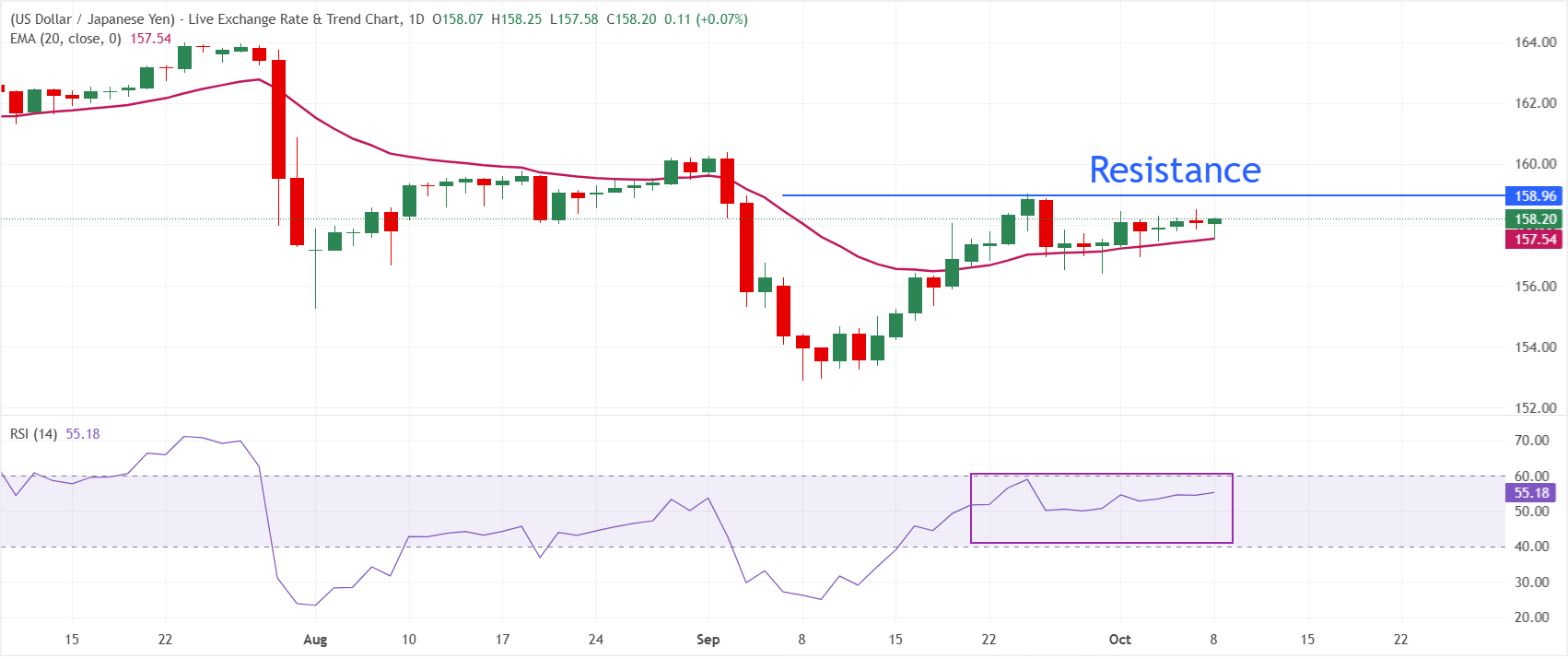
In the daily chart, USD/JPY trades at 158.19. The pair holds above the 20-day exponential moving average (EMA) at 157.54, which suggests a constructive near-term tone while reinforcing a bullish bias as price extends away from its recent corrective lows. The Relative Strength Index (RSI) at 55.15 stays in positive territory without reaching overbought levels, hinting that upside pressure is present but not yet stretched.
On the downside, immediate support is seen at the 20-day EMA at 157.54, with the current 158.19 area acting as a nearby pivot where buyers have recently defended the advance. As long as USD/JPY remains above 157.54 on a daily closing basis, the technical backdrop favors further gains, while a decisive move below this EMA would expose a deeper pullback within the broader uptrend. On the upside, the September 24 high at 159.04 is the key hurdle for the pair.
(The technical analysis of this story was written with the help of an AI tool. Know more.)
Japanese Yen FAQs
The Japanese Yen (JPY) is one of the world’s most traded currencies. Its value is broadly determined by the performance of the Japanese economy, but more specifically by the Bank of Japan’s policy, the differential between Japanese and US bond yields, or risk sentiment among traders, among other factors.
One of the Bank of Japan’s mandates is currency control, so its moves are key for the Yen. The BoJ has directly intervened in currency markets sometimes, generally to lower the value of the Yen, although it refrains from doing it often due to political concerns of its main trading partners. The BoJ ultra-loose monetary policy between 2013 and 2024 caused the Yen to depreciate against its main currency peers due to an increasing policy divergence between the Bank of Japan and other main central banks. More recently, the gradually unwinding of this ultra-loose policy has given some support to the Yen.
Over the last decade, the BoJ’s stance of sticking to ultra-loose monetary policy has led to a widening policy divergence with other central banks, particularly with the US Federal Reserve. This supported a widening of the differential between the 10-year US and Japanese bonds, which favored the US Dollar against the Japanese Yen. The BoJ decision in 2024 to gradually abandon the ultra-loose policy, coupled with interest-rate cuts in other major central banks, is narrowing this differential.
The Japanese Yen is often seen as a safe-haven investment. This means that in times of market stress, investors are more likely to put their money in the Japanese currency due to its supposed reliability and stability. Turbulent times are likely to strengthen the Yen’s value against other currencies seen as more risky to invest in.
Recommended Articles


