


Australian Dollar steady near three-year highs as RBA minutes reinforce hawkish tone
- RBA minutes stress upside inflation risks after the February rate hike to 3.85%, with Q4 wage data and January employment figures due later this week.
- A golden cross on the daily chart and bullish momentum above 0.7000 support keep the pair positioned for a potential retest of the 0.7160 year-to-date high.
The Reserve Bank of Australia (RBA) released minutes from its February meeting on Tuesday, providing further detail on the board's unanimous decision to raise the cash rate by 25 basis points to 3.85%, the first hike in over two years. The minutes showed policymakers judged that without further tightening, inflation would remain above the 2% to 3% target band for an extended period, with trimmed mean Consumer Price Index (CPI) printing at 3.4% in Q4 and the Melbourne Institute's consumer inflation expectations jumping to 5.0% in February. Governor Michele Bullock has reiterated the board's willingness to raise rates again if inflation proves persistent.
On the US side, still-tricky economic data continues to reinforce expectations that the Federal Reserve (Fed) will hold rates at 3.50% to 3.75% through at least mid-2026. The Federal Open Market Committee (FOMC) minutes are due Wednesday, alongside Australian Q4 Wage Price Index data, followed by Australian employment figures on Thursday, making this a high-impact week for the pair.
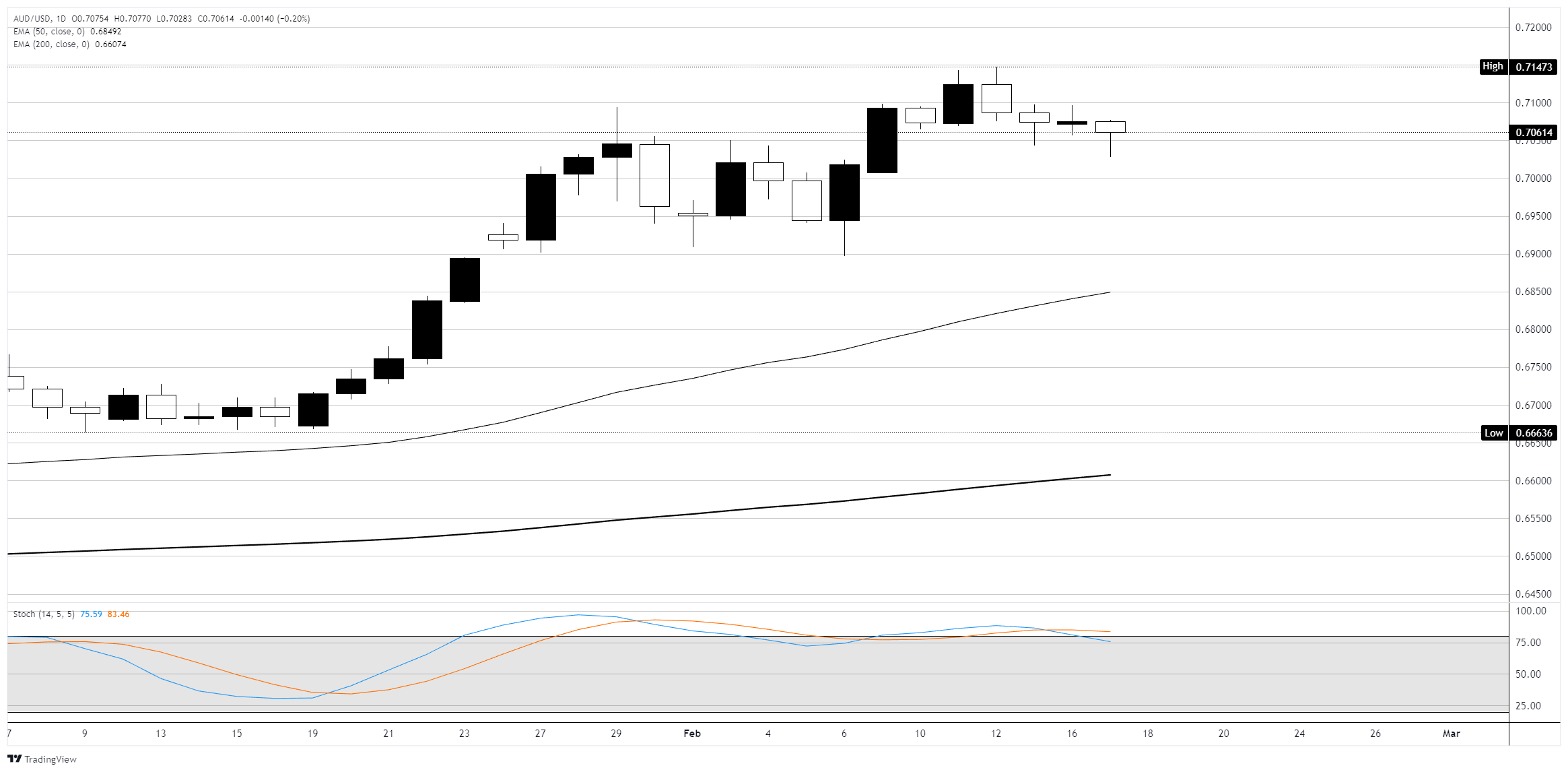
On the daily chart, AUD/USD is trading near 0.7050 on Tuesday after pulling back from the year-to-date high of 0.7160 posted on February 12. The pair recently formed a golden cross as the 50-day Exponential Moving Average (EMA) crossed above the 200-day EMA, confirming the broader bullish trend that has driven price from the April 2025 low near 0.5905. The 55-day Simple Moving Average (SMA) at 0.6783 and the 100-day SMA continue to rise, providing layered dynamic support below current price action.
The 14-day Relative Strength Index (RSI) reads near 65, signaling firm bullish momentum without overbought conditions. On the 4H timeframe, a triple-top pattern is forming near the 0.7140 to 0.7160 resistance zone, with the 50-period EMA at 0.7085 acting as near-term dynamic resistance on the pullback. Support sits at the psychological 0.7000 level, which aligns with the September 2024 swing high at 0.6940 that now serves as a key role-reversal zone. A sustained hold above 0.7000 keeps bullish structure valid, with a break above 0.7160 opening targets toward the 0.7200 psychological level; failure to hold 0.6940 would suggest a deeper correction toward the 55-day SMA near 0.6783.
AUD/USD daily chart
Australian Dollar FAQs
One of the most significant factors for the Australian Dollar (AUD) is the level of interest rates set by the Reserve Bank of Australia (RBA). Because Australia is a resource-rich country another key driver is the price of its biggest export, Iron Ore. The health of the Chinese economy, its largest trading partner, is a factor, as well as inflation in Australia, its growth rate and Trade Balance. Market sentiment – whether investors are taking on more risky assets (risk-on) or seeking safe-havens (risk-off) – is also a factor, with risk-on positive for AUD.
The Reserve Bank of Australia (RBA) influences the Australian Dollar (AUD) by setting the level of interest rates that Australian banks can lend to each other. This influences the level of interest rates in the economy as a whole. The main goal of the RBA is to maintain a stable inflation rate of 2-3% by adjusting interest rates up or down. Relatively high interest rates compared to other major central banks support the AUD, and the opposite for relatively low. The RBA can also use quantitative easing and tightening to influence credit conditions, with the former AUD-negative and the latter AUD-positive.
China is Australia’s largest trading partner so the health of the Chinese economy is a major influence on the value of the Australian Dollar (AUD). When the Chinese economy is doing well it purchases more raw materials, goods and services from Australia, lifting demand for the AUD, and pushing up its value. The opposite is the case when the Chinese economy is not growing as fast as expected. Positive or negative surprises in Chinese growth data, therefore, often have a direct impact on the Australian Dollar and its pairs.
Iron Ore is Australia’s largest export, accounting for $118 billion a year according to data from 2021, with China as its primary destination. The price of Iron Ore, therefore, can be a driver of the Australian Dollar. Generally, if the price of Iron Ore rises, AUD also goes up, as aggregate demand for the currency increases. The opposite is the case if the price of Iron Ore falls. Higher Iron Ore prices also tend to result in a greater likelihood of a positive Trade Balance for Australia, which is also positive of the AUD.
The Trade Balance, which is the difference between what a country earns from its exports versus what it pays for its imports, is another factor that can influence the value of the Australian Dollar. If Australia produces highly sought after exports, then its currency will gain in value purely from the surplus demand created from foreign buyers seeking to purchase its exports versus what it spends to purchase imports. Therefore, a positive net Trade Balance strengthens the AUD, with the opposite effect if the Trade Balance is negative.
Recommended Articles


