


Should You Buy Bitcoin Now or Buy Tesla Which Holds Bitcoin?

 Trending Articles
- Gold slumps below $4,800 on renewed Strait of Hormuz tensions
- How Will the U.S.-Iran Situation Evolve? What Is Behind the Nasdaq’s Record High?
- Silver Price Forecasts: XAG/USD approaches $78.00 boosted by Iran peace hopes
- Nasdaq Index Rises for 10 Straight Days, Why Has Tesla Barely Risen?
- WTI drifts higher to near $89.00 amid Lebanon-Israel ceasefire strains
- AUD/USD climbs above 0.7170 as truce hopes lift risk appetite
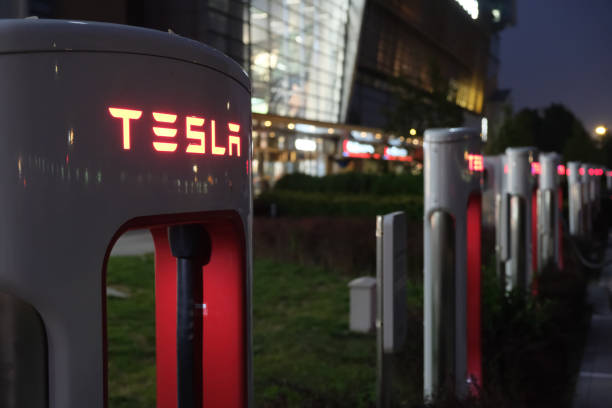
TradingKey - In 2026, Bitcoin (BTC) suffered a Waterloo-style sell-off, with prices quickly retreating to around $60,000 from a period high of nearly $98,000 at the start of the year. Bitcoin is once again faced with a familiar question: Is it truly "digital gold," or a highly volatile risk asset? Should we invest in Bitcoin itself or in companies that hold Bitcoin?
According to data from BITCOINTREASURIES.NET, Tesla (TSLA) holds 11,542 Bitcoins, ranking 13th on the list of Bitcoin holders and making it the only company among the "Magnificent Seven" US tech giants to appear on the list.
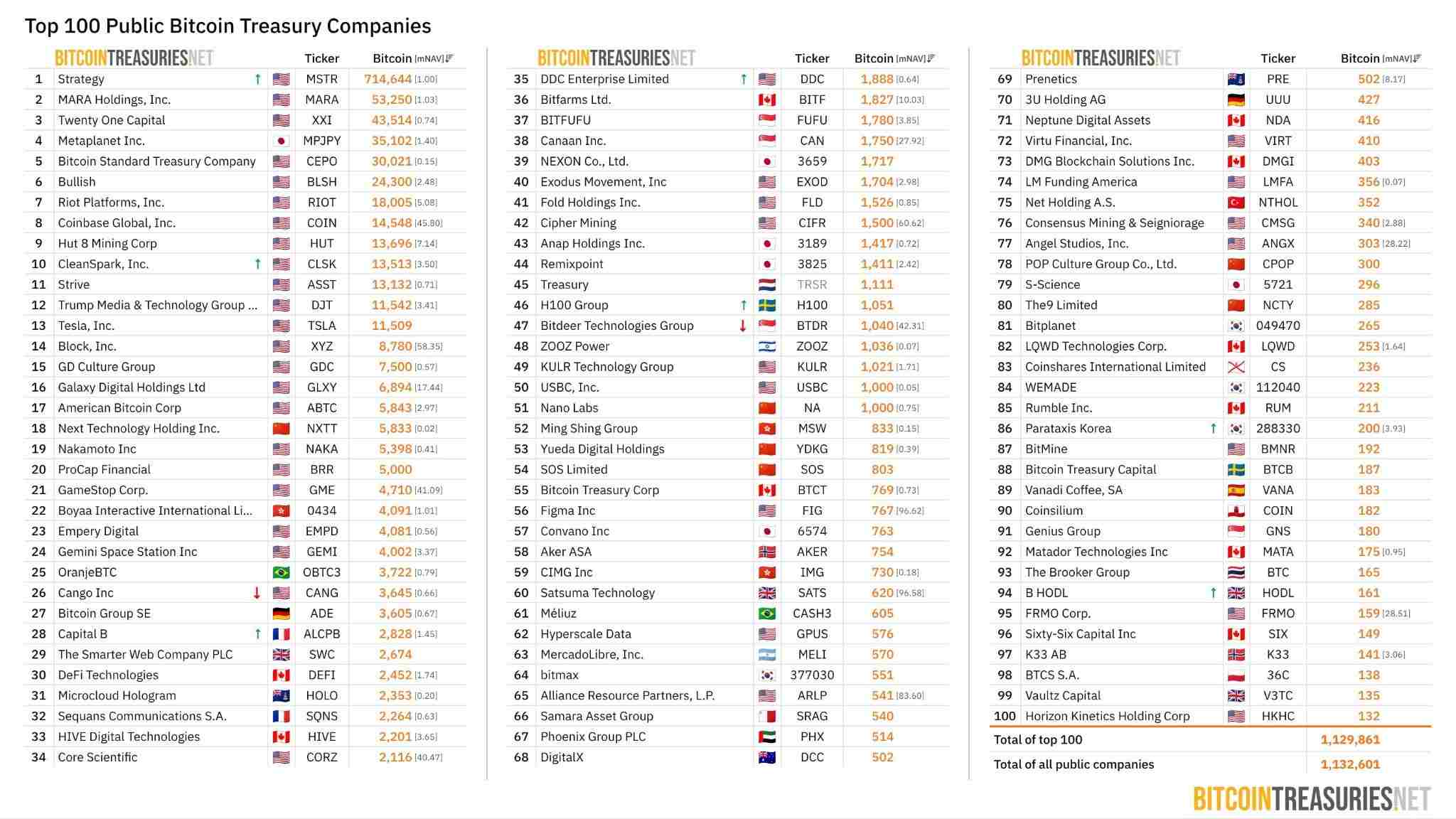
[Top 100 Bitcoin Holdings, Source: https://bitcointreasuries.net]
If one is bullish on the long-term value of Bitcoin, should they buy Bitcoin directly or gain indirect exposure by purchasing Tesla, which holds Bitcoin assets?
We will address this decisive question from three dimensions: logical essence, risk differences, and market cycles.
Direct Purchase vs. Indirect Holding of Bitcoin: What is the underlying logic for each?
Buying Bitcoin directly means investors are fully exposed to the price fluctuations of the digital asset itself. Compared to any proxy instrument, Bitcoin's most prominent feature is its lack of cash flow, corporate operations, and influence from management decisions. Its price primarily reflects dynamic changes in global liquidity, risk appetite, and supply-demand relationships, making its logic relatively simple and pure.
When you buy Bitcoin, you are essentially betting on the global macro liquidity environment, the risk appetite of marginal capital for digital asset exposure, and whether the long-term narrative of "digital gold" or an alternative asset can persist.
Tesla is entirely different. Even though it is widely known that its balance sheet includes Bitcoin, Tesla is first and foremost a manufacturing company and a high-growth tech enterprise. Its stock price is influenced not only by Bitcoin's price but also by multiple factors including EV sales, changes in gross margins, the pace of capital expenditure, progress in autonomous driving commercialization, industry competition, and market sentiment.
Therefore, when investors buy Tesla, they are not buying Bitcoin risk but rather a comprehensive risk exposure formed by multiple overlapping factors. In certain cycles, these combined factors may yield higher elastic returns; however, during downturns, this mixed risk can easily amplify losses.
In simple terms, buying Bitcoin is a "single-factor risk exposure," while buying Tesla is a "composite risk exposure."
How do economic cycles affect both?
Many investors hesitate because weak macroeconomic data is often interpreted as "increasing the probability of rate cuts and strengthening the logic for rising stock prices." In reality, however, this equation is far from straightforward.
For Bitcoin, improved liquidity may indeed raise the valuation of risk assets, but when weak data is driven by declining demand, slowing corporate expansion, or a marginal deterioration in the labor market, such news does not necessarily translate into a catalyst for growth.
The situation for Tesla is even more complex. As a high-beta stock, its valuation indeed shows high upward elasticity during easing cycles, but this elasticity can just as quickly reverse when risk appetite wanes or earnings expectations are downgraded. This means that when macro data is weak and risk assets are generally under pressure, even if rate-cut expectations increase, Tesla's stock price may still face greater downward pressure due to corporate fundamentals and market sentiment.
Intuitively, if economic weakness progresses to the stage of corporate profit downgrades, then the drop in discount rates cannot compensate for the negative effects of reduced future cash flows and valuation corrections.
Is risk tolerance the watershed for decision-making?
If an investor has a low tolerance for price drawdowns and seeks relatively clear risk exposure, buying Bitcoin directly may be more logical. Bitcoin's path is clear, and risk factors are primarily concentrated at the macro and market sentiment levels, allowing investors to make relatively distinct risk management decisions based on price action.
Conversely, if an investor believes in the long-term value of Bitcoin while also being willing to endure the valuation pullbacks and fundamental volatility associated with a growth stock like Tesla, then Tesla may offer higher return elasticity during periods of improving macro conditions. However, this elasticity is only achievable by assuming higher uncertainty.
In the current phase of macro cycles and market structural adjustments, investors must distinguish what they are truly betting on and ensure this bet aligns with their risk tolerance, investment horizon, and portfolio objectives. Choosing Bitcoin means placing a direct bet on macro liquidity and market appetite; choosing Tesla means a dual bet on growth potential and market sentiment.
No one can accurately predict when the market will pivot, but understanding the underlying risk logic of these two assets will make your decisions more robust and closer to long-term value.
Read more
* The content presented above, whether from a third party or not, is considered as general advice only. This article should not be construed as containing investment advice, investment recommendations, an offer of or solicitation for any transactions in financial instruments.


