


USD/MXN (USDMXN) Is up 0.54% on Oct 1: What Signals Does the Macro Data Send?
USD/MXN (USDMXN) is up 0.54% at Oct 1 03:20(ET), now at $18.1595, with a 7-day up of 2.50%.
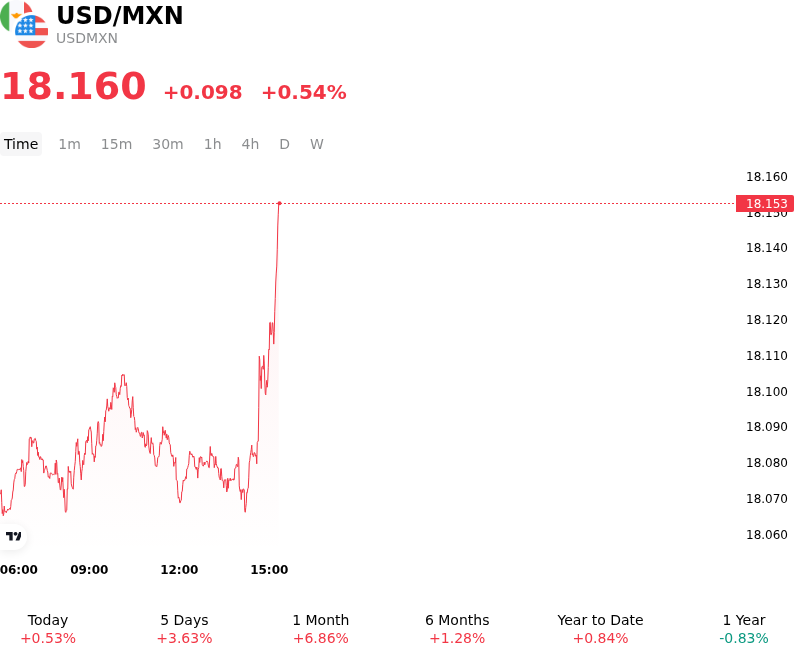
What is driving USD/MXN (USDMXN)’s stock price up today?
The upward movement in USDMXN is primarily driven by the ongoing compression of the U.S.-Mexico interest rate differential and the subsequent unwinding of Mexican peso carry trade positions. Following the Federal Reserve's recent monetary policy tightening alongside Banco de México's decision to hold its benchmark rate steady at 6.50%, the yield advantage that historically anchored long peso trades has narrowed significantly. Banxico's policy decoupling and shift toward a more flexible stance signaled to international investors that local interest rates will not adjust mechanically to higher U.S. borrowing costs, eroding the risk-adjusted carry premium for holding Mexican assets.
Institutional positioning has adjusted rapidly to this altered interest-rate landscape. Macro funds and systematic market participants have engaged in sustained profit-taking and liquidations of stretched long MXN positions, leading to capital outflows from Mexican local debt instruments. Concurrently, resilient U.S. economic indicators and elevated U.S. Treasury yields have bolstered broad-based demand for the dollar, rendering high-yielding emerging market currencies comparatively less attractive.
Broader risk sentiment across emerging markets has further exacerbated pressure on the peso. Heightened geopolitical uncertainty, energy price fluctuations, and evolving market expectations regarding global monetary policy have encouraged defensive portfolio rebalancing toward liquid dollar assets. While Mexican local bonds still provide absolute yield, the structural shift in policy spreads and institutional capital flows indicates that the pair's advance is backed by broader macro re-pricing rather than transitory volatility.
Technical Analysis of USD/MXN (USDMXN)
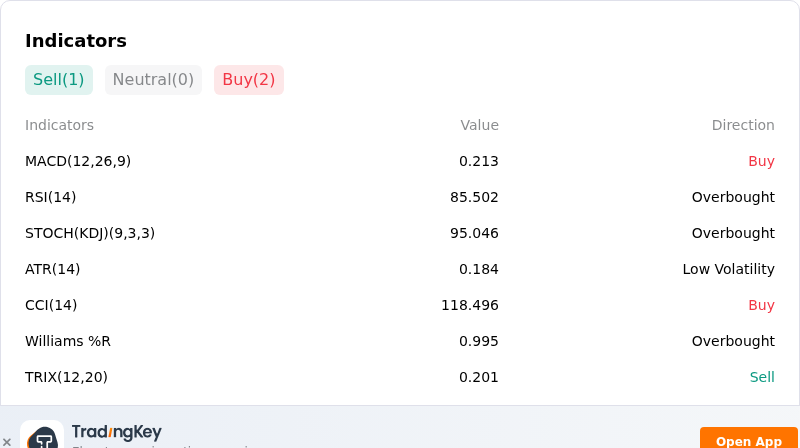
Technically, USD/MXN (USDMXN) shows a MACD (12,26,9) value of 0.213, indicating a buy signal. The RSI at 85.502 suggests overbought condition and the Williams %R at 0.995 suggests overbought condition. Please monitor closely.
More details about USD/MXN (USDMXN)
Recent Events and Risks:
- Narrowing U.S.-Mexico Yield Spread and Carry Unwind: The compression of the U.S.-Mexico policy rate differential to 250 basis points—resulting from Federal Reserve rate hikes alongside Banxico keeping its benchmark rate unchanged at 6.50%—has substantially eroded the peso's carry trade appeal, sparking liquidations of long-MXN speculative positions.
- Banxico Policy Decoupling and Domestic Macro Moderation: Banco de México's explicit guidance that it will not mechanically track Fed tightening, combined with softer Mexican macroeconomic indicators and moderating core inflation, restricts the central bank's ability to defensively support the peso against persistent U.S. monetary repricing.
- Elevated U.S. Treasury Yields and Broad Dollar Resurgence: Robust U.S. economic activity and persistent Fed hawkishness have held benchmark U.S. Treasury yields above 5.00%, fueling capital repatriation toward U.S. dollar assets and driving USD/MXN above critical psychological resistance at 18.00.
- USMCA Trade Vulnerability and Risk-Off Sentiment: Sensitivity to cross-border trade friction, potential tariff threats under the USMCA framework, and broader global risk aversion disproportionately pressure the high-beta Mexican peso, triggering sharp downside intraday volatility for MXN.
Recommended Articles


