




Worried About a Market Crash? This Dividend Stock Outperformed as the S&P 500 Sank in Both 2008 and 2022
Key Points
Amgen has proven that it can manage market downturns fairly well.
The company is also an excellent dividend stock.
The drugmaker is a top pick for investors worried about a potential market crash.
- 10 stocks we like better than Amgen ›
Broader equities have been resilient this year despite macroeconomic concerns, including elevated inflation, rising energy and oil prices, and other factors. However, there is always the possibility that these issues will persist and eventually drag equities into bear-market territory. We can't be certain that this will happen, but it's always good to be prepared. And one way to do so is to invest in stocks that can perform relatively well even amid broader economic problems. Let's consider one example: Amgen (NASDAQ: AMGN). This drugmaker has proven that it can navigate market crashes better than most.
Image source: The Motley Fool.
Missed Nvidia in 2009? This Rare Signal Is Flashing Again. In 2009, a "Double Down" signal flashed for a little-known chipmaker called Nvidia. For the first time in years, that same "Total Conviction" signal is flashing for a company 1/100th the size of Nvidia. Continue »
Consider the Great Recession, which lasted from December 2007 to June 2009. It was arguably the worst U.S. recession in the 21st century, and it led to a sustained market crash that bottomed out in March 2009. The S&P 500 lost significant value over this period, but Amgen held up pretty well. The stock was still in the red over the entire recession, but it performed much better than broader equities -- and if we look only at 2008, when most of the damage to the S&P 500 occurred, Amgen gained value that year.
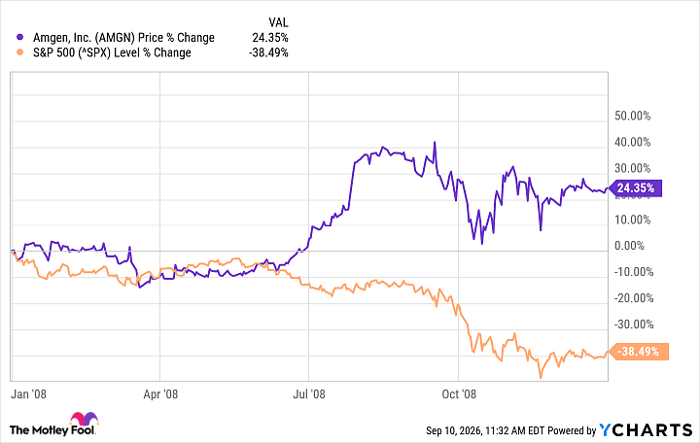
AMGN data by YCharts
Now, turning to 2022, when broader equities experienced a bear market amid geopolitical tensions and economic challenges (such as inflation and rising interest rates), Amgen was once again a standout. The stock gained significant value that year.
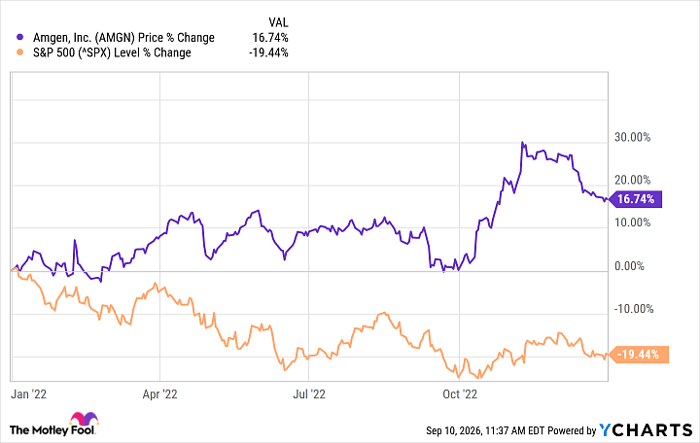
AMGN data by YCharts
Why Amgen stock is a buy
Now, Amgen won't perform well during every single market crash. The company's shares dropped significantly in 2020, as the pandemic started wreaking havoc on the economy. However, Amgen has several qualities that make it a resilient business that is capable of posting solid financial results even when the economy isn't doing well. First, the company markets lifesaving drugs that nobody wants to stop taking, no matter what is happening to the stock market. Patients also often don't have to foot most of the bill when it comes to prescription drugs. Health insurance companies pick up much of the tab.
Second, Amgen has a deep portfolio of medicines that allows it to overcome patent cliffs. It is doing that right now. Over the past two years, Amgen has lost patent exclusivity in the U.S. and in Europe for denosumab, a medicine that treats several bone-related conditions. This wasn't a product that just barely contributed to the company's financial results. In 2024, denosumab, sold under brands such as Prolia and Xgeva, accounted for nearly 20% of Amgen's total revenue. Despite that, Amgen is still posting revenue growth after denosumab's patent cliff. In the second quarter, Amgen's total revenue grew 10% year over year to $10.1 billion. And 22 of the company's products posted at least double-digit sales growth.
Third, Amgen has a rich pipeline with multiple attractive candidates. One of them, MariTide, is an investigational long-acting weight-loss medicine being tested for obesity and several obesity-related conditions. With the anti-obesity market growing fast, this could become a meaningful growth driver for Amgen down the road. The company's shares recently fell by about 10% in one day after Novartis' (NYSE: NVS) Pelacarsen failed to prove effective in reducing the risk of cardiovascular events in patients with elevated lipoprotein(a). Amgen is also developing a drug, olpasiran, that seeks to help patients with high levels of Lp(a), but Novartis' recent setback was a warning sign for many investors.
That said, Amgen's phase 3 studies for olpasiran are still ongoing, and at any rate, the company's pipeline is fairly deep, and even a clinical setback for this product won't be a death sentence. Lastly, Amgen is an excellent dividend stock. It has increased its payouts every year since initiating them in 2011 and offers a dividend yield of 2.6%, much higher than the S&P 500's average of 1.1%. Dividends can help smooth out losses during market downturns while also boosting long-term returns when reinvested. That's another great reason Amgen is an excellent stock to buy to prepare for a market crash.
Should you buy stock in Amgen right now?
Before you buy stock in Amgen, consider this:
The Motley Fool Stock Advisor analyst team just identified what they believe are the 10 best stocks for investors to buy now… and Amgen wasn’t one of them. The 10 stocks that made the cut could produce monster returns in the coming years.
Consider when Netflix made this list on December 17, 2004... if you invested $1,000 at the time of our recommendation, you’d have $420,109!* Or when Nvidia made this list on April 15, 2005... if you invested $1,000 at the time of our recommendation, you’d have $1,303,689!*
Now, it’s worth noting Stock Advisor’s total average return is 938% — a market-crushing outperformance compared to 211% for the S&P 500. Don't miss the latest top 10 list, available with Stock Advisor, and join an investing community built by individual investors for individual investors.
See the 10 stocks »
*Stock Advisor returns as of September 16, 2026.
Prosper Junior Bakiny has no position in any of the stocks mentioned. The Motley Fool has positions in and recommends Amgen. The Motley Fool has a disclosure policy.
Recommended Articles


