




Alphabet May Have Just Gotten Its Biggest Competitor Yet. And It's Not OpenAI or Anthropic.
Key Points
Alphabet's moat extends beyond Germini.
SpaceX is going big into AI.
The real AI battle goes beyond AI models.
- 10 stocks we like better than Alphabet ›
For years, investors could easily identify Alphabet's (NASDAQ: GOOGL) biggest artificial intelligence (AI) competitors. OpenAI had ChatGPT. Anthropic had Claude. Microsoft had Copilot. Nvidia supplied the chips powering the industry.
But the AI race is changing. Alphabet may now have a far more ambitious competitor: SpaceX.
Missed AI’s "Act 1"? Act 2 Could Be 15x Bigger. Most investors think they missed the AI boat because they didn't buy Nvidia in 2005. But according to our analysts, we’re only at the end of "Act 1"—the R&D phase. "Act 2" is the global rollout. Continue »
That sounds strange at first. One company runs the world's largest search engine and some of the biggest consumer and cloud platforms. The other launches rockets and operates a satellite internet network.
But SpaceX's acquisition of xAI changed the equation. While that doesn't make SpaceX and Alphabet equal today, it could make the former one of the most interesting companies for Alphabet investors to watch.
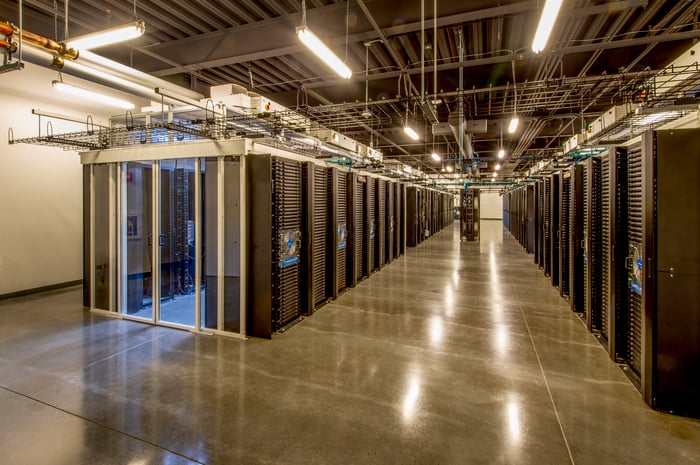
Image source: Getty Images.
Alphabet's biggest AI advantage isn't Gemini.
Investors often reduce Alphabet's AI story to one question: Can Gemini beat ChatGPT or Claude? I think that's too narrow. Alphabet's real advantage comes from everything surrounding Gemini.
The company designs its own TPU chips, operates enormous data centers, runs Google Cloud, and distributes AI through Search, YouTube, Android, Chrome, Workspace, and other products used by billions of people.
Alphabet calls this its full-stack approach to AI. And it matters because the company controls multiple layers of the system rather than depending on outside suppliers. That gives Alphabet an extraordinary combination of infrastructure and distribution.
For years, that has been one of the strongest reasons to believe Alphabet can win in AI. But SpaceX is now attempting something surprisingly similar, just in a completely different form.
SpaceX is becoming an AI company.
The acquisition of xAI is the obvious starting point.
SpaceX now owns Grok, giving it a frontier AI model and an AI research organization. But the more important part of the strategy is what SpaceX can build around that model.
It is developing a large-scale AI compute infrastructure and eventually extending that infrastructure into space. It has recently expanded compute capacity to 1.4 Gigawatts (GW), up from 0.4 GW a year ago, with more to come.
SpaceX is also pushing deeper into chips . SpaceX and Tesla announced an initial $16.8 billion investment in Terafab, an advanced semiconductor facility in Texas designed to produce chips for applications including SpaceX's future AI computing needs.
That is significant. SpaceX isn't simply developing an AI model and renting someone else's infrastructure. It is increasingly trying to control the infrastructure underneath it. And that's where the comparison with Alphabet becomes interesting.
The real AI battle may be beyond AI models.
This is the part I think investors should focus on. The AI race won't ultimately depend on which chatbot wins. It will likely center around who controls the infrastructure and distribution that AI runs through.
To this end, Alphabet already has an extraordinary position. Its latest results show just how quickly that ecosystem is developing: Google Cloud revenue grew 82% year over year, Gemini reached 950 million monthly active users, and Alphabet continues to integrate AI across Search, YouTube, Cloud, and its consumer products.
Comparatively, SpaceX is nowhere near that level of commercial AI distribution.
Still, it is worth mentioning that SpaceX doesn't need to copy Google. It is building something fundamentally different. Imagine an ecosystem in which SpaceX controls the AI models, the computing infrastructure, the chips, the connectivity network, and eventually even the platforms carrying that computing capacity into orbit.
That's not another chatbot competitor. It's another technology stack altogether.
Why Alphabet's investors should care?
Alphabet's moat is partly due to vertical integration. SpaceX is now pursuing vertical integration of its own.
That creates an interesting long-term possibility. If AI becomes increasingly constrained by electricity, land, data-center capacity, and access to computing power, then SpaceX's combination of launch economics, satellite manufacturing, connectivity, and AI infrastructure could become unusually valuable.
And if orbital computing eventually becomes economically viable, SpaceX could possess an infrastructure advantage that Alphabet simply cannot replicate without partnering with someone else.
That's a very big if, of course. Moreover, Alphabet's terrestrial infrastructure remains much more credible. Google has decades of experience in AI research, cloud computing, data centers, and software. SpaceX still has to prove that its broader AI vision can translate into attractive returns.
But that's precisely why investors should watch this development in coming years.
Should you buy stock in Alphabet right now?
Before you buy stock in Alphabet, consider this:
The Motley Fool Stock Advisor analyst team just identified what they believe are the 10 best stocks for investors to buy now… and Alphabet wasn’t one of them. The 10 stocks that made the cut could produce monster returns in the coming years.
Consider when Netflix made this list on December 17, 2004... if you invested $1,000 at the time of our recommendation, you’d have $417,413!* Or when Nvidia made this list on April 15, 2005... if you invested $1,000 at the time of our recommendation, you’d have $1,341,294!*
Now, it’s worth noting Stock Advisor’s total average return is 950% — a market-crushing outperformance compared to 212% for the S&P 500. Don't miss the latest top 10 list, available with Stock Advisor, and join an investing community built by individual investors for individual investors.
See the 10 stocks »
*Stock Advisor returns as of September 15, 2026.
Lawrence Nga has no position in any of the stocks mentioned. The Motley Fool has positions in and recommends Alphabet. The Motley Fool has a disclosure policy.
Recommended Articles


