




SpaceX Trades at 98 Times Sales. Here's What Amazon's Multiple Looked Like at the Same Stage.
Key Points
SpaceX had revenue similar to Amazon's in 2009.
Amazon's price-to-sales ratio is well below SpaceX's current trading level.
If Amazon traded at 98 times sales in 2009, its stock would have gone nowhere for two decades.
- 10 stocks we like better than Space Exploration Technologies ›
Many investors are ignoring a flashing warning sign when analyzing Space Exploration Technologies (NASDAQ: SPCX). The rocket flight and artificial intelligence (AI) company helmed by Elon Musk now trades at a market cap of $2.1 trillion and a price-to-sales ratio (P/S) of 98.
Some growth investors are making comparisons to Amazon (NASDAQ: AMZN) during the dot-com bubble. Shares of Amazon looked expensive at the peak, but if you held through the decades, they eventually delivered great performance for investors who bought in at those levels.
Missed Nvidia in 2009? This Rare Signal Is Flashing Again. In 2009, a "Double Down" signal flashed for a little-known chipmaker called Nvidia. For the first time in years, that same "Total Conviction" signal is flashing for a company 1/100th the size of Nvidia. Continue »
This is not an apples-to-apples comparison. Today, SpaceX generates $23 billion in trailing revenue. What did Amazon trade at with a similar revenue size? When you learn the answer, it will make you think twice about buying SpaceX stock today.
Revenue and margin comparisons
SpaceX generated $23 billion in revenue over the last 12 months and had a gross profit margin of 52% (net profitability was negative). Revenue grew 92% last quarter to $7.8 billion.
Amazon generated close to $23 billion in revenue back in 2009, when it posted annual sales of $24.5 billion. At the time, Amazon was primarily an e-commerce platform and had a lower gross margin than SpaceX does today, with a consolidated margin of 22.6% in the year. However, it was more profitable than SpaceX, generating $1.1 billion in operating earnings back in 2009.

Image source: Getty Images.
Valuations are incomparable
Given the immense growth ahead for Amazon, you might think that investors would have given it an ultra-premium multiple to its sales. This is certainly what would have happened in 2026. However, that is not the case, especially as the world was nervous coming out of the financial crisis and stock market crash in 2008 and early 2009.
In 2009, Amazon had a P/S ratio between 1.5 and 2.5, compared to 98 for SpaceX today. If it were valued at close to SpaceX's current valuation, it would have a market cap of close to $2.4 trillion (98 times its trailing revenue of $24.5 billion). Today, Amazon has a market cap of $2.77 trillion. When you factor in close to two decades of shareholder dilution, the stock price would likely be lower in 2026 compared to 2009, in a hypothetical scenario where an investor bought in 2009 at a P/S ratio of 98.
That is even including two decades of growth at Amazon Web Services (AWS), and Amazon coming to dominate retail spending in North America. Price matters in investing.
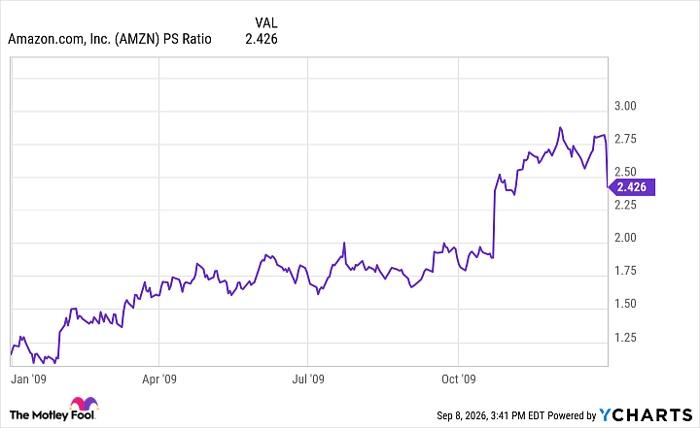
AMZN PS Ratio data by YCharts
Does this mean you should sell SpaceX stock?
Elon Musk is ultra-bullish about SpaceX's growth prospects. He thinks revenue can explode higher to $1 trillion by 2030 due to its heavy investments in AI data centers. Revenue is already growing quickly, and the company is planning to spend tens of billions, if not hundreds of billions, on AI capital expenditures.
To be fair to SpaceX, it is growing faster today and has a better gross margin than Amazon did in 2009. However, I would expect reselling AI data center compute to come with lower margins than its highly profitable Starlink satellite internet service, which dominates the income statement today.
Investors should be concerned that even if Musk is right about reaching $1 trillion in revenue by 2030 (which is highly unlikely; no company in history has ever generated $1 trillion in sales), the stock might not be worth much more than it is today. Amazon generates nearly $1 trillion in revenue and is valued at just above SpaceX's current market cap.
And if SpaceX's P/S ratio compresses down to Amazon's level in 2009? Watch out below.
Should you buy stock in Space Exploration Technologies right now?
Before you buy stock in Space Exploration Technologies, consider this:
The Motley Fool Stock Advisor analyst team just identified what they believe are the 10 best stocks for investors to buy now… and Space Exploration Technologies wasn’t one of them. The 10 stocks that made the cut could produce monster returns in the coming years.
Consider when Netflix made this list on December 17, 2004... if you invested $1,000 at the time of our recommendation, you’d have $410,024!* Or when Nvidia made this list on April 15, 2005... if you invested $1,000 at the time of our recommendation, you’d have $1,372,815!*
Now, it’s worth noting Stock Advisor’s total average return is 950% — a market-crushing outperformance compared to 211% for the S&P 500. Don't miss the latest top 10 list, available with Stock Advisor, and join an investing community built by individual investors for individual investors.
See the 10 stocks »
*Stock Advisor returns as of September 10, 2026.
Brett Schafer has no position in any of the stocks mentioned. The Motley Fool has positions in and recommends Amazon. The Motley Fool has a disclosure policy.
Recommended Articles


