




Nvidia Has $96 Billion in Quarterly Revenue. Here's Why the Stock Is Still a Buy.
Key Points
Despite generating substantial revenue and trading at a $5 trillion-plus market cap, the stock looks cheap.
Amazon will deploy 2 million GPUs over the next two years, while Nvidia's non-hyperscaler business is growing rapidly.
The stock is trading at 15 times next year's consensus earnings estimate, even as analysts' current revenue estimate doesn't line up with management's guidance.
- 10 stocks we like better than Nvidia ›
Nvidia (NASDAQ: NVDA) has seen revenue go parabolic during the artificial intelligence (AI) boom, climbing more than 11-fold since 2022 to $303 billion on a trailing-12-month basis. In fiscal Q2, which ended July 26, it posted $96 billion in revenue, up 106% year over year. That's rare growth at this scale -- but the bigger takeaway isn't what's already in the books. It's what management says comes next.
The company is guiding for roughly 70% revenue growth in fiscal 2028, and its next major chipset platform, Vera Rubin, is already shipping. Here's why this $5.4 trillion market-cap stock still looks like a no-brainer buy.
Missed Nvidia in 2009? This Rare Signal Is Flashing Again. In 2009, a "Double Down" signal flashed for a little-known chipmaker called Nvidia. For the first time in years, that same "Total Conviction" signal is flashing for a company 1/100th the size of Nvidia. Continue »
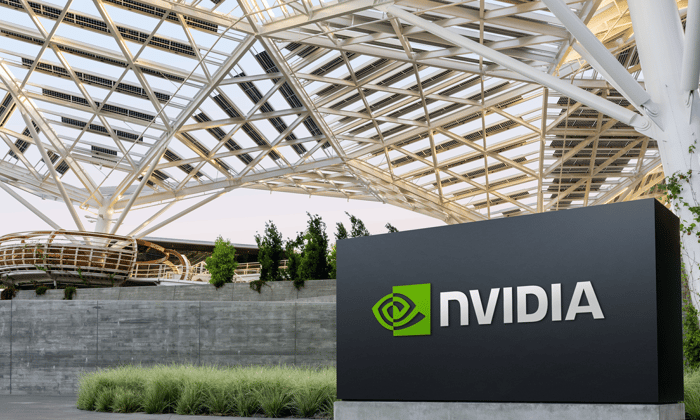
Image source: Nvidia.
Nvidia's opportunity goes well beyond the hyperscalers
Demand from hyperscalers like Amazon, Alphabet, and Microsoft continues to drive a big portion of Nvidia's data center business. Last quarter, hyperscalers generated nearly $49 billion in revenue -- about half of Nvidia's total revenue. On top of that, Amazon Web Services said it plans to deploy an additional 2 million GPUs through fiscal 2029, which reinforces long-term demand visibility.
But Nvidia revealed even stronger growth outside these core customers. Revenue from neocloud (specialized AI clouds), industrial, and enterprise customers rose 138% year over year to $40 billion, outpacing hyperscaler growth. That matters because hyperscalers are increasingly touting the capabilities of their in-house chips, potentially presenting a risk to Nvidia over time.
Nvidia's push to diversify its customer base is working. The $40 billion in non-hyperscaler revenue includes sovereign government buyers, regional cloud providers, and AI start-ups. Many of these customers don't want to design chips themselves; they want a proven, end-to-end platform that includes compute, networking, and software, and it's clearly opening up a massive opportunity for Nvidia to extend its leadership.
Wall Street is still underestimating Nvidia's growth
Nvidia stock trades at about 15 times next year's earnings estimate, which is a bargain for the leading AI chip supplier growing this quickly.
A big driver of next year's growth will be Nvidia's new Vera Rubin computing platform, which began shipping in early August. It is ramping up quickly and is expected to total 20% of Nvidia's data center revenue in fiscal Q3.
Even with its gross margin under pressure from higher memory prices, the setup for investors looks very attractive. Analysts currently project $411 billion in revenue for fiscal 2027, followed by a 65% jump to $678 billion in fiscal 2028.
However, Nvidia's guidance implies about $700 billion in revenue next year. This means Nvidia's fiscal 2027 earnings may also come in ahead of Wall Street estimates, implying the stock is even cheaper than its 15x forward (one-year) earnings multiple.
The risk is that data center spending may not rise in a straight line, with constraints like power availability and potential regulation that could slow the build-out and demand for Nvidia's chips. But Nvidia still looks like a business that can be meaningfully larger years from now -- and that's why the stock remains compelling.
Should you buy stock in Nvidia right now?
Before you buy stock in Nvidia, consider this:
The Motley Fool Stock Advisor analyst team just identified what they believe are the 10 best stocks for investors to buy now… and Nvidia wasn’t one of them. The 10 stocks that made the cut could produce monster returns in the coming years.
Consider when Netflix made this list on December 17, 2004... if you invested $1,000 at the time of our recommendation, you’d have $410,024!* Or when Nvidia made this list on April 15, 2005... if you invested $1,000 at the time of our recommendation, you’d have $1,372,815!*
Now, it’s worth noting Stock Advisor’s total average return is 950% — a market-crushing outperformance compared to 211% for the S&P 500. Don't miss the latest top 10 list, available with Stock Advisor, and join an investing community built by individual investors for individual investors.
See the 10 stocks »
*Stock Advisor returns as of September 10, 2026.
John Ballard has positions in Amazon and Nvidia. The Motley Fool has positions in and recommends Alphabet, Amazon, Microsoft, and Nvidia. The Motley Fool has a disclosure policy.
Recommended Articles


