




3 High-Yield Energy Stocks to Buy in September for Steady Income
Key Points
Enbridge's oil and gas pipelines effectively serve as a tollbooth for the energy sector, regardless of the price of either commodity.
Energy Transfer is capitalizing on the same idea as Enbridge, but with a different organizational structure that allows for slightly higher yields.
Brookfield offers investors access to reliable revenue-generating businesses with above-average income growth potential.
- 10 stocks we like better than Enbridge ›
Are you looking for some new income-producing holdings? The recent rise in interest rates presents new options that many investors weren't considering before. The fact of the matter is, however, energy stocks remain some of the market's highest-yielding prospects. They also offer income growth that bonds just can't.
Here's a closer look at three of the energy sector's highest-yielding names that you can count on for steady income.
Missed Nvidia in 2009? This Rare Signal Is Flashing Again. In 2009, a "Double Down" signal flashed for a little-known chipmaker called Nvidia. For the first time in years, that same "Total Conviction" signal is flashing for a company 1/100th the size of Nvidia. Continue »
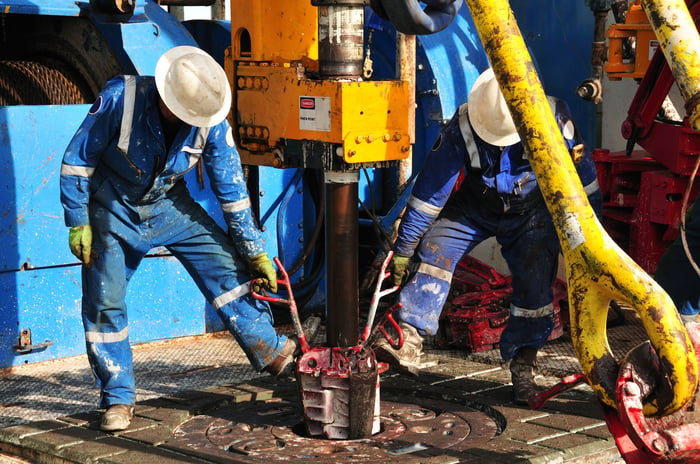
Image source: Getty Images.
Enbridge
Enbridge (NYSE: ENB) isn't exactly a household name, but there's a good chance your household regularly benefits from the service it provides. This company's 18,000 miles' worth of pipelines handle 30% of all the crude oil produced within North America and 40% of the crude oil imported into the U.S. Meanwhile, it owns and operates nearly 19,000 miles of natural gas pipelines, moving 20% of the gas consumed within the United States.
It's an ideal business model for supporting ongoing dividend payments, too. Whereas more familiar energy names like integrated explorers/drillers/refiners Chevron and ExxonMobil see their profits rise and fall in step with the price of oil and natural gas, pipeline operators like Enbridge charge for volume-based usage of their infrastructure. That means they make a predictable amount of money regardless of the value of the commodity being pumped through their pipelines. Enbridge just needs consumption of both to remain steady, which it is.
Perhaps the chief bullish argument for owning a stake in Enbridge, however, isn't its forward-looking dividend yield of 5.6%. While that's certainly solid, the top selling point here is the fact that Enbridge has now raised its per-share dividend payment for 31 consecutive years, with no end to the streak in sight.
Energy Transfer
At first blush, Energy Transfer (NYSE: ET) looks a lot like Enbridge, and there are plenty of similarities to be sure. It owns a massive network of oil and gas pipelines within the United States as well, handling millions of barrels of crude oil and billions of cubic feet of natural gas every single day. It did $85.5 billion worth of business last fiscal year, predictably turning $9 billion of that into net income.
From that, $1.325 worth of per-share cash payments were passed along to shareholders, translating into a yield of nearly 6.2% that's since improved to a forward-looking yield of 6.3%. Not bad, especially given that the company's now raised its quarterly payout for 19 consecutive quarters. Not years. Quarters. The last time it didn't do so was in the midst of the COVID-19 pandemic, when everything was disrupted. As was the case with Enbridge, there's no end in sight for this growth streak, either.
There is one important detail to consider before diving into Energy Transfer, though. That is, it's not organized as a conventional corporation. It's structured as a master limited partnership, which is a tax-efficient way of passing a portion of its profits along to shareholders, but one that comes with infrequently used tax forms and a few extra steps when filing your taxes.
It's certainly nothing a well-qualified tax professional can't handle, or, for that matter, a taxpayer familiar with these forms. Their usually higher yields may not necessarily be worth the additional hassle, however, if you can find a comparably yielding alternative.
Brookfield Infrastructure Partners
Last but not least, add Brookfield Infrastructure Partners (NYSE: BIP) (NYSE: BIPC) to your list of energy stocks to buy this month if you're looking for steady income.
Just as the name suggests, like Energy Transfer, Brookfield Infrastructure Partners is a partnership, although there's an easier-to-own version for investors who don't want the additional tax-filing headache. While the ticker BIP may be the more net-profitable option for anyone who doesn't mind the additional tax forms and tax-filing work, BIPC represents the same company, but in a more conventional corporate structure that pays conventionally taxed dividends reported on an ordinary 1099. That being said, know that Brookfield intends to fold BIP into BIPC in the near future, simplifying its taxability as well as newcomers' choice between the two.
The ultimate underlying bullish argument is still the same either way, though. That's what Brookfield Infrastructure Partners is. Simply put, this company holds whole or partial stakes in a portfolio of several privately owned power utility providers, oil and gas pipeline networks, data center infrastructure, and a bunch of revenue-bearing railroad assets. These holdings collectively produced over $700 million worth of operational cash flow last quarter alone, allowing shareholders to plug into income streams that simply aren't accessible any other way.
Perhaps the top reason income-minded investors might want to consider stepping into a position in BIPC, however, is the long-term performance goals that management is aiming for, and will very likely reach. Brookfield Infrastructure Partners says it's looking for operational fund-flow growth of at least 10% per year, leading to annual distribution (partnerships' equivalent to dividends) growth of between 5% and 9% that will only consume between 60% and 70% of its profit equivalents.
The thing is, with a reasonably targeted rate of return of between 12% and 15% on new infrastructure investments, the company could easily do what it says it's hoping to do.
Newcomers will be plugging into a forward-looking yield of 4.9%, by the way. You can find higher-yielding names within the energy sector. But you may not find higher-yielding prospects with as much long-term payment growth as this one promises.
Should you buy stock in Enbridge right now?
Before you buy stock in Enbridge, consider this:
The Motley Fool Stock Advisor analyst team just identified what they believe are the 10 best stocks for investors to buy now… and Enbridge wasn’t one of them. The 10 stocks that made the cut could produce monster returns in the coming years.
Consider when Netflix made this list on December 17, 2004... if you invested $1,000 at the time of our recommendation, you’d have $410,024!* Or when Nvidia made this list on April 15, 2005... if you invested $1,000 at the time of our recommendation, you’d have $1,372,815!*
Now, it’s worth noting Stock Advisor’s total average return is 950% — a market-crushing outperformance compared to 211% for the S&P 500. Don't miss the latest top 10 list, available with Stock Advisor, and join an investing community built by individual investors for individual investors.
See the 10 stocks »
*Stock Advisor returns as of September 10, 2026.
James Brumley has no position in any of the stocks mentioned. The Motley Fool has positions in and recommends Chevron and Enbridge. The Motley Fool recommends Brookfield Infrastructure Partners. The Motley Fool has a disclosure policy.
Recommended Articles


