




Here's Why USA Rare Earth Is a Buy Before Its Next Earnings Report
Key Points
USA Rare Earth is trying to make rare-earth magnets on American soil.
It plans to acquire a mine in Brazil that could add significant revenue.
- 10 stocks we like better than USA Rare Earth ›
USA Rare Earth (NASDAQ: USAR) is quickly becoming one of America's most strategically important mining companies, at least if the economy, technology, and national security count for anything.
Why all the attention? Two words: rare earths. Indeed, rare-earth metals, as their name suggests, are a class of elements that are tough to find in economically useful deposits. They are essential to everything from smartphones and electric vehicles (EVs) to fighter jets and guided missiles, and China controls most of the world's capacity to process them.
Missed Nvidia in 2009? This Rare Signal Is Flashing Again. In 2009, a "Double Down" signal flashed for a little-known chipmaker called Nvidia. For the first time in years, that same "Total Conviction" signal is flashing for a company 1/100th the size of Nvidia. Continue »
USA Rare Earth is one of only a handful of American companies that control a rare-earth deposit on American soil. Its goal is to extract rare-earth elements from a deposit in Texas, process and separate them domestically, and turn them into permanent magnets for American companies out of its factory in Oklahoma.
For some time, this has been at the heart of USA Rare Earth's growth thesis; none of it is new. What is new, however, is its pending acquisition of Serra Verde, which could turn USA Rare Earth from a would-be miner with an uncertain start date into the owner of an operating rare-earth mine. That deal will likely close before its next earnings report -- expected in early November -- and could set the stage for a huge rally.
Here's what investors should know.
Image source: Getty Images.
From cash burn to cash flow
For nearly all of its existence, USA Rare Earth has been all map and no territory. True, it owns Round Top Deposit, one of the largest known U.S. sources for heavy rare earths. But Round Top isn't an operational mine, and it won't become one for at least another two years.
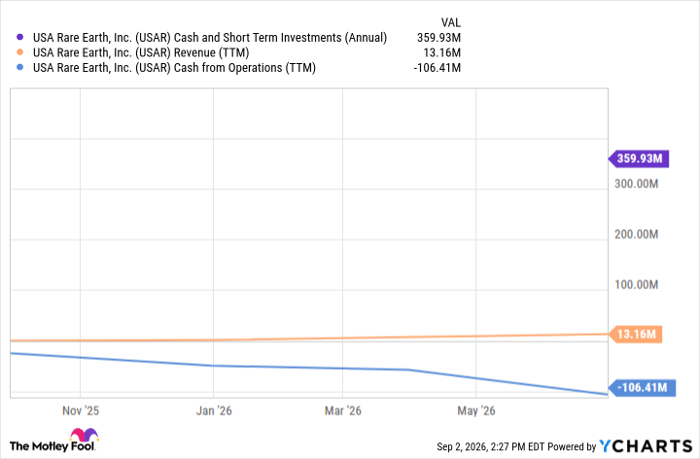
With no functioning mine yet, and only about $13 million in trailing-12-month revenue, USA Rare Earth's annual cash burn of roughly $100 million has been a flashing warning light for investors.
Data by YCharts
This is where the Serra Verde acquisition could prove to be the best move USA Rare Earth can make. The Brazilian rare-earth mine is expected to generate between $550 million and $650 million in annualized run rate earnings before interest, taxes, depreciation, and amortization (EBITDA) by the end of 2027. Not only would that help offset USA Rare Earth's cash burn, but move it closer to positive cash flow.
Oh, but it gets better. Serra Verde has already secured a buyer for 100% of its Phase 1 production. That buyer is US SIIE, a government-backed special-purpose company established specifically to buy Serra Verde's rare-earth products. The 15-year agreement includes price floors and take-or-pay protections, which are supported by $750 million in U.S. government funding.
In simple terms, Serra Verde now has a customer obligated to buy its output at protected prices. For a mining company, it doesn't get much safer than that, at least on the demand side.
Once the acquisition closes -- shareholders have already approved it -- the protections on Serra Verde would extend to USA Rare Earth. In essence, USA Rare Earth would have an operating mine to help generate cash flow for its other projects, such as its Top Deposit and magnet factories.
At its next earnings report, USA Rare Earth could very likely, I think, announce the closing of this acquisition. Investors who buy USA Rare Earth beforehand may be glad they did.
Should you buy stock in USA Rare Earth right now?
Before you buy stock in USA Rare Earth, consider this:
The Motley Fool Stock Advisor analyst team just identified what they believe are the 10 best stocks for investors to buy now… and USA Rare Earth wasn’t one of them. The 10 stocks that made the cut could produce monster returns in the coming years.
Consider when Netflix made this list on December 17, 2004... if you invested $1,000 at the time of our recommendation, you’d have $421,997!* Or when Nvidia made this list on April 15, 2005... if you invested $1,000 at the time of our recommendation, you’d have $1,413,876!*
Now, it’s worth noting Stock Advisor’s total average return is 978% — a market-crushing outperformance compared to 213% for the S&P 500. Don't miss the latest top 10 list, available with Stock Advisor, and join an investing community built by individual investors for individual investors.
See the 10 stocks »
*Stock Advisor returns as of September 5, 2026.
Steven Porrello has no position in any of the stocks mentioned. The Motley Fool has no position in any of the stocks mentioned. The Motley Fool has a disclosure policy.
Recommended Articles


