




Mortgage Rates Just Hit a 1-Year High. Here’s What That Means for Lowe’s and Home Depot Investors.
Key Points
Mortgage rates move in a correlated fashion to the yield on the 10-year U.S. Treasury note.
Bond yields have an inverse correlation with bond prices.
Home Depot and Lowe's provide materials, tools, and appliances for homebuilding, home renovation, and repair work, making both businesses heavily tied to the state of the housing market.
- 10 stocks we like better than Home Depot ›
Mortgage rates recently hit a one-year high, with the 30-year fixed-rate mortgage rate now at 6.71%.
The global sell-off in Treasury bonds is driving the increase because, as bond prices fall, bond yields rise. Mortgage rates are directly correlated to moves in the yield on the 10-year U.S. Treasury note.
Missed Nvidia in 2009? This Rare Signal Is Flashing Again. In 2009, a "Double Down" signal flashed for a little-known chipmaker called Nvidia. For the first time in years, that same "Total Conviction" signal is flashing for a company 1/100th the size of Nvidia. Continue »
Bond yields have surged recently, as inflation remains persistently high, the Iran war continues on, and as investors grow more nervous about mounting U.S. debt, which recently topped $40 trillion.
Bond yields directly impact all stocks, but some sectors are more impacted than others. Two examples are Lowe's and Home Depot (NYSE:HD).

Image source: Getty Images.
Directly tied to the housing market
While Lowe's and Home Depot don't issue mortgages, they do sell materials, tools, and appliances used by consumers, builders, and other professionals who work on and inside homes and other structures. So, the health of the housing market can certainly impact their businesses.
In fact, on its recent earnings call for the second quarter of 2026, Lowe's was forced to lower its full-year outlook. The company now expects sales of $92 billion versus a prior range of $92 billion to $94 billion.
The company also lowered its operating margin guidance to 11.2% versus a prior range of 11.2% to 11.4%, and similarly lowered its adjusted operating margin guidance to 11.6% from a previous range of 11.6% to 11.8%.
Diluted earnings per share are now forecasted at $11.75, versus a prior range of $11.75 to $12.25.
"Across retail home improvement, macro pressure like interest rates, inflation and gas prices continue to influence DIY (do it yourself) demand," Lowe's CFO Brandon Sink said on the company's most recent earnings call.
Home Depot reaffirmed its full-year outlook in its second-quarter earnings report, but management also noted pressure in the housing market, stemming from high interest rates and high housing costs.
Specifically, CFO Richard McPhail said that housing turnover has been at historic lows for the past four years.
This is likely due to a combination of affordability issues and people who managed to purchase homes at historically low interest rates during the pandemic not wanting to relinquish those rates.
Marginally higher interest rates won't affect the company too much, but that's because Home Depot has been dealing with these conditions for years now.
Interestingly, in the second quarter, Home Depot managed to grow revenue by 5.7% year over year, while earnings increased by 4.6%.
Home Depot has maintained momentum by focusing on contractors and smaller repair projects for more price-conscious customers.
Lower rates would lift both stocks
With mortgage rates soaring, it's more difficult for players like Lowe's and Home Depot to do business because building materials cost more, and the high price of housing reduces homebuilding and home improvement projects.
The good news for value investors is that both stocks trade at forward earnings multiples below their typical levels over the past two years.
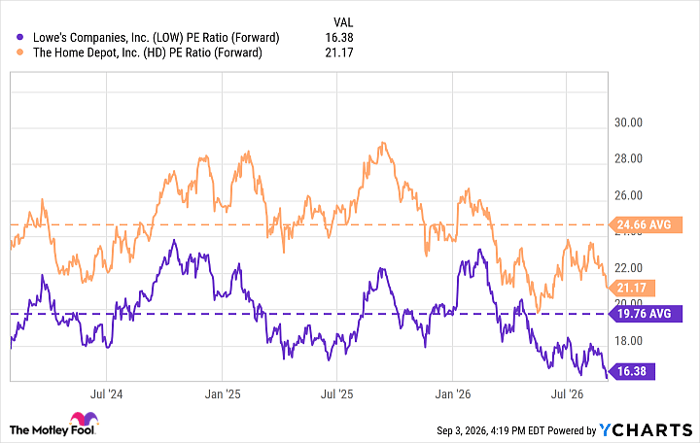
LOW PE Ratio (Forward) data by YCharts
So, if and when interest rates do decline, that should lift both stocks. Now, predicting the future trajectory of the bond market and mortgage rates is no easy task, but things can also change quickly.
Look how many times the outlook for interest rates has changed this year. Both Lowe's and Home Depot are stocks that can benefit from lower rates, whenever they might materialize.
They both also have solid dividend yields. Lowe's has a trailing 12-month yield of nearly 2.4%, while Home Depot is roughly 2.9%.
Should you buy stock in Home Depot right now?
Before you buy stock in Home Depot, consider this:
The Motley Fool Stock Advisor analyst team just identified what they believe are the 10 best stocks for investors to buy now… and Home Depot wasn’t one of them. The 10 stocks that made the cut could produce monster returns in the coming years.
Consider when Netflix made this list on December 17, 2004... if you invested $1,000 at the time of our recommendation, you’d have $446,157!* Or when Nvidia made this list on April 15, 2005... if you invested $1,000 at the time of our recommendation, you’d have $1,377,357!*
Now, it’s worth noting Stock Advisor’s total average return is 983% — a market-crushing outperformance compared to 212% for the S&P 500. Don't miss the latest top 10 list, available with Stock Advisor, and join an investing community built by individual investors for individual investors.
See the 10 stocks »
*Stock Advisor returns as of September 3, 2026.
Bram Berkowitz has no position in any of the stocks mentioned. The Motley Fool has positions in and recommends Home Depot. The Motley Fool recommends Lowe's Companies. The Motley Fool has a disclosure policy.
Recommended Articles


