




Are the Bond Markets and the Equity Markets Coming Into Agreement About an AI Bubble?
Key Points
Oracle's credit default swap pricing signals bond market skepticism.
Oracle and Microsoft face a higher risk due to OpenAI exposure, while Alphabet appears less affected.
Market discernment may curb unrealistic AI investments, supporting better risk pricing.
- 10 stocks we like better than Alphabet ›
The bond markets and equity markets appear to be taking different views on the sustainability of artificial intelligence. There are clear signs of stress in credit default swap (CDS) pricing -- the cost to insure against default -- for companies like Oracle (NYSE: ORCL). Yet, in general, stock markets have continued to invest in AI companies. Which side is right, and is AI in a bubble?
Widening bond market skepticism
Oracle's CDS pricing spiked in November. While bond markets can get jittery from time to time, they have remained at elevated levels. Currently, they're at almost four times the levels they were in September. This is a clear sign that the bond market is concerned about Oracle's debt.
Will AI create the world's first trillionaire? Our team just released a report on the one little-known company, called an "Indispensable Monopoly" providing the critical technology Nvidia and Intel both need. Continue »

Image source: Getty Images.
The concerns center on the ballooning cost of building out data center infrastructure to support AI growth, and specifically on Oracle's $300 billion deal with OpenAI. The latter is widely reported to have internal projections of burning through over $100 billion in cash before it starts generating cash in 2030. That's reportedly the company's view, but the markets are having some doubts over it.
Does it matter?
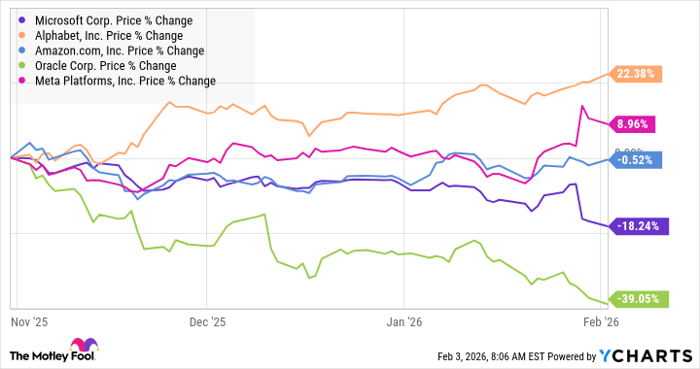
The CDS pricing blowout is concerning, but on closer inspection, the bad news appears to be limited in scope. On that, the equity market appears to agree. Below is a look at share price charts of leading hyperscalers.
It's no accident that Oracle and Microsoft have underperformed, as Microsoft recently disclosed that 45% of its backlog is due to OpenAI. Meanwhile, the outperformer, Alphabet (NASDAQ: GOOG) (NASDAQ: GOOGL), has minimal exposure to OpenAI.
MSFT data by YCharts.
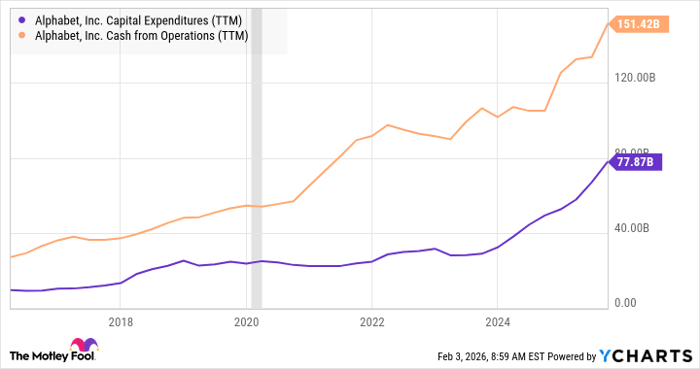
Alphabet is also in a much better financial position to support its AI-related capital spending.
GOOG Capital Expenditures (TTM) data by YCharts.
Is AI in a bubble?
As ever, the answer to whether AI is a bubble is nuanced. History suggests that companies overreach during technological revolutions, and capital will inevitably flow to ultimately unproductive sources, driven by a "me too" mentality. That's just how human beings and cycles work.
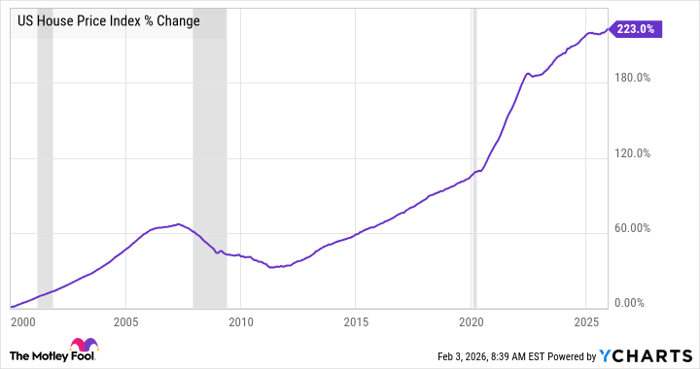
However, it's very difficult to predict when this will happen. For example, U.S. housing prices peaked in July 2006, about two years before the financial crisis of 2008-2009, and are now significantly higher. No one knew when the peak would come, and selling your house during the crash didn't turn out to be a great long-term decision.
US House Price Index data by YCharts.
If the bond and equity markets are becoming more discerning about the quality of the AI-exposed companies they invest in, with Alphabet the highest-quality company, it's likely to rein in some of the less realistic plans. That would be a good thing and make AI growth more sustainable over the long term, as markets need the effective pricing of risk to function properly.
Should you buy stock in Alphabet right now?
Before you buy stock in Alphabet, consider this:
The Motley Fool Stock Advisor analyst team just identified what they believe are the 10 best stocks for investors to buy now… and Alphabet wasn’t one of them. The 10 stocks that made the cut could produce monster returns in the coming years.
Consider when Netflix made this list on December 17, 2004... if you invested $1,000 at the time of our recommendation, you’d have $436,126!* Or when Nvidia made this list on April 15, 2005... if you invested $1,000 at the time of our recommendation, you’d have $1,053,659!*
Now, it’s worth noting Stock Advisor’s total average return is 885% — a market-crushing outperformance compared to 192% for the S&P 500. Don't miss the latest top 10 list, available with Stock Advisor, and join an investing community built by individual investors for individual investors.
See the 10 stocks »
*Stock Advisor returns as of February 6, 2026.
Lee Samaha has no position in any of the stocks mentioned. The Motley Fool has positions in and recommends Alphabet, Amazon, Meta Platforms, Microsoft, and Oracle. The Motley Fool has a disclosure policy.
Recommended Articles


