




1 Important Number Nvidia Investors Should Watch on Feb. 25 -- and Nobody Is Talking About It
Key Points
Nvidia is the world's top supplier of the most important data center chips for artificial intelligence (AI) development.
The company is drawing an increasing amount of its revenue from a small number of customers, creating a significant risk.
Investors seem to be taking a cautious approach to the stock right now, but that might change after Feb. 25.
- 10 stocks we like better than Nvidia ›
Over the last few years, artificial intelligence (AI) companies have been major drivers of overall stock market returns thanks to their incredible revenue and earnings growth. Nvidia (NASDAQ: NVDA) has led the charge with an 11-fold increase in its stock since the start of 2023 alone.
Nvidia continues to experience astronomical demand for its industry-leading graphics processing units (GPUs) for data centers, which are the primary chips used in AI development. On Feb. 25, investors will get a fresh sales update when the company reports its operating results for its fiscal 2026 fourth quarter (ended Jan. 25).
Will AI create the world's first trillionaire? Our team just released a report on the one little-known company, called an "Indispensable Monopoly" providing the critical technology Nvidia and Intel both need. Continue »
The report could dictate the direction of its stock, which is currently trading 10% below its all-time high. While most investors will rightly focus on the company's revenue and earnings, I think there is another key number to watch when Feb. 25 rolls around, and it often gets overlooked.
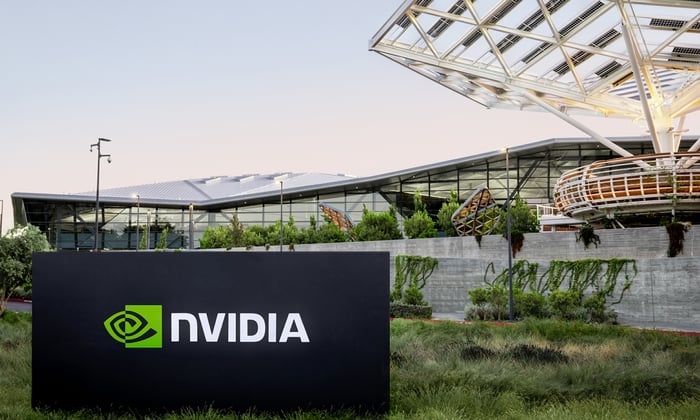
Image source: Nvidia.
All eyes will be on Nvidia's GPU sales
The company's upcoming fourth-quarter operating results will cap off its strongest year ever, with total fiscal 2026 revenue expected to come in at $213 billion, according to management's latest guidance. Almost 90% of that revenue will have come from the data center segment alone, where the company counts its AI GPU sales.
Nvidia's current generation of GPUs are based on its Blackwell and Blackwell Ultra architectures, which produce up to 50 times better performance than the company's original Hopper-based AI GPUs like the H100. Demand continues to outstrip supply for the Blackwell platform, but investors have turned their attention to the next generation, called Rubin, which Nvidia unveiled last year.
The company says the Rubin architecture is so powerful that developers will be able to train AI models with 75% fewer GPUs, which will reduce inference costs (the amount it costs for models to ingest prompts and generate responses) by as much as 90%. Rubin GPUs are currently in production and will start being shipped to customers in the second half of this calendar year, with customers like Amazon, Microsoft, and Alphabet among the first in line to receive them.
The Feb. 25 report will probably feature a fresh update on Rubin's commercialization, and since it is likely to fuel substantial growth for the company in fiscal 2027, this is where investors will rightly focus a lot of their attention.
The very important number to watch on Feb. 25
The AI revolution has hit a few speed bumps over the last couple of weeks. Microsoft, for example, is experiencing relatively low adoption for its Copilot AI assistant in some crucial areas. For example, companies have collectively added Copilot to less than 4% of their enterprise 365 licenses (Word, Excel, Outlook, and more), which is a key reason the stock tumbled after its latest earnings report.
There are also concerns that leading start-up OpenAI won't be able to fulfill its financial commitments. For example, it has placed $281 billion worth of orders for data center capacity with Microsoft Azure, and another $300 billion with Oracle Cloud Infrastructure.
However, the start-up has annualized revenue of just $20 billion, so unless it experiences substantial growth or raises a truckload of cash from investors, it won't have the money to meet its obligations.
That brings me to a very important number to watch in Nvidia's upcoming report: customer concentration. During the company's fiscal 2026 third quarter (ended Oct. 26), 61% of its total $57 billion in revenue came from just four mystery customers.
|
Customer |
Proportion Of Nvidia's Q3 Revenue |
|---|---|
|
Customer A |
22% |
|
Customer B |
15% |
|
Customer C |
13% |
|
Customer D |
11% |
Data source: Nvidia.
Its customer concentration has grown significantly. During the year-ago quarter, its largest customer accounted for just 12% of its total revenue, and only three customers represented over 10% of total revenue.
This creates a substantial risk for the company. Let's assume Microsoft is Customer A (which is impossible to know, but plausible nonetheless), and it has to cut back on its AI data center spending because a major customer like OpenAI can't fulfill its financial commitments. That will trigger a substantial drop in revenue for Nvidia, which it probably won't be able to replace.
Nvidia stock looks cheap, but investors are clearly cautious
As I mentioned earlier, the stock is currently down 10% from its record high and is trading at a price-to-earnings ratio (P/E) of just 45.9, which is a steep discount to its 10-year average of 61.5. This implies investors are treading with caution right now, but the company's Feb. 25 report could turn sentiment around, especially if it eases concerns in areas like customer concentration.
History suggests that this will be the probable outcome because Nvidia stock tends to perform well after management releases its quarterly earnings reports, since CEO Jensen Huang often paints a very bullish picture of the company's long-term future. Therefore, while it's as important as ever for investors to remain vigilant, it's hard to ignore the stock at the current price. Five years from now, I think it's likely to be trading higher than it is today.
Should you buy stock in Nvidia right now?
Before you buy stock in Nvidia, consider this:
The Motley Fool Stock Advisor analyst team just identified what they believe are the 10 best stocks for investors to buy now… and Nvidia wasn’t one of them. The 10 stocks that made the cut could produce monster returns in the coming years.
Consider when Netflix made this list on December 17, 2004... if you invested $1,000 at the time of our recommendation, you’d have $432,297!* Or when Nvidia made this list on April 15, 2005... if you invested $1,000 at the time of our recommendation, you’d have $1,067,820!*
Now, it’s worth noting Stock Advisor’s total average return is 894% — a market-crushing outperformance compared to 194% for the S&P 500. Don't miss the latest top 10 list, available with Stock Advisor, and join an investing community built by individual investors for individual investors.
See the 10 stocks »
*Stock Advisor returns as of February 5, 2026.
Anthony Di Pizio has no position in any of the stocks mentioned. The Motley Fool has positions in and recommends Alphabet, Amazon, Microsoft, and Nvidia. The Motley Fool has a disclosure policy.
Recommended Articles


