




After Silver's Fast Rise and Even Faster Crash, What's Next?
Key Points
Silver prices have seen extreme volatility over the last month, nearly doubling before crashing in short order.
Silver may have no fundamentals, but there's an extremely straightforward way to analyze its outlook.
A series of revolutionary trends is converging to push it higher in 2026 and beyond.
- 10 stocks we like better than iShares Silver Trust ›
Silver prices surged 60% in the first four weeks of 2026 before crashing last week in the white metal's worst trading day since 1980. Tuesday was another hectic day, with silver jumping 10% to close at $88 per ounce. Investors could be forgiven for being confused. Given these lightning price changes, many are wondering what silver does next.
Unlike stocks, silver has no fundamentals to judge. It typically rises during times of economic uncertainty as a "safe haven" asset. So with consumer confidence recently hitting a 10-year low in January 2026, economic anxiety certainly explains some of silver's rise. Of course, it's impossible to know whether economic uncertainty will continue in the months ahead. But there's a straightforward way to determine if silver is effectively overvalued and due for a sell-off -- or poised for still more gains.
Where to invest $1,000 right now? Our analyst team just revealed what they believe are the 10 best stocks to buy right now. Continue »
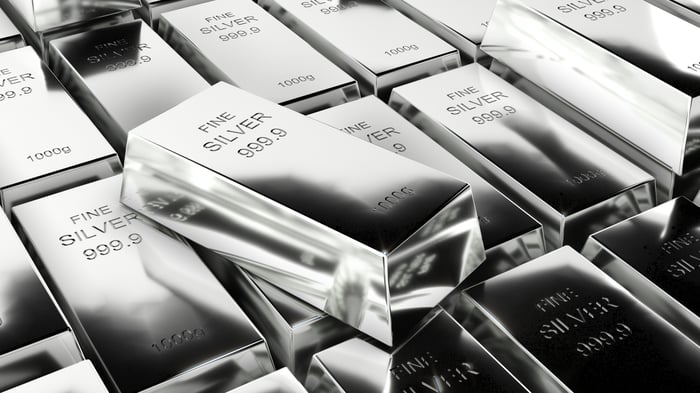
Image source: Getty Images.
A straightforward way to assess silver
Silver pays no dividend. It has no earnings, cash flow, revenue, or margins. Yet there's a reason why Warren Buffett has bought silver twice in his career -- and possibly three times -- despite disdaining gold.
Explaining his decision to buy over 100 million ounces back in 1997-98, Buffett said that there had been an "imbalance" between demand and supply, and that because silver is mostly produced on the side by miners looking for other metals, supply couldn't simply be turned on like a tap.
The surge in demand came from silver's many industrial uses. As the most electrically conductive element around, it's become a vital component for multiple uses in computers, cars, telephones, cameras, and countless other gadgets.
Ever since 2021, demand has outpaced supply for silver, sometimes by as much as 200 million ounces. Many factors are behind the demand surge, but three revolutionary technological trends are playing major roles.
Every solar panel needs about 0.64 ounces of silver, and with hundreds of millions of solar panels being installed every year, this adds up. Meanwhile, the Artificial Intelligence revolution is driving demand, with semiconductors expected to consume 23 million ounces by 2030.
Then there are electric vehicles. Sales of electric cars in America jumped 20% from 2024 to 2025, and globally the market is forecast to reach $4.93 trillion by 2032. Yet electric vehicles use twice as much silver as gas-powered cars, about 1.3 ounces each. Tens of millions of these cars hitting the roads in the next few years could continue to spike demand, and ultimately silver prices.
So for the long term, the path of least resistance for silver is upward, as demand grows faster than supply. Investors seeking to play this trend might consider the iShares Silver Trust (NYSEMKT: SLV).
The simplest way to play silver
The exchange-traded fund, which is designed to closely track silver's performance, holds physical bullion so that you don't have to. Its expense ratio of 0.50% is justified by its track record of approximately mirroring silver booms; its 147.87% gain over the last year isn't far off from silver's massive run.
Zooming out, the fund's 8.89% average annual return since its 2006 inception is only a slight underperformance of its benchmark, a lag that is explained largely by its expense ratio. In return for the 0.50% fee, the fund offers convenience, allowing investors to tap into silver's rise without finding reputable dealers or paying for their own storage. For investors craving simplicity and security in a wild precious metals rally, this fund is a buy.
Should you buy stock in iShares Silver Trust right now?
Before you buy stock in iShares Silver Trust, consider this:
The Motley Fool Stock Advisor analyst team just identified what they believe are the 10 best stocks for investors to buy now… and iShares Silver Trust wasn’t one of them. The 10 stocks that made the cut could produce monster returns in the coming years.
Consider when Netflix made this list on December 17, 2004... if you invested $1,000 at the time of our recommendation, you’d have $432,297!* Or when Nvidia made this list on April 15, 2005... if you invested $1,000 at the time of our recommendation, you’d have $1,067,820!*
Now, it’s worth noting Stock Advisor’s total average return is 894% — a market-crushing outperformance compared to 194% for the S&P 500. Don't miss the latest top 10 list, available with Stock Advisor, and join an investing community built by individual investors for individual investors.
See the 10 stocks »
*Stock Advisor returns as of February 5, 2026.
William Dahl has no position in any of the stocks mentioned. The Motley Fool has no position in any of the stocks mentioned. The Motley Fool has a disclosure policy.
Recommended Articles


