




Is Nvidia Stock a Buy?
Key Points
The arrival of artificial intelligence spurred enormous semiconductor chip sales for Nvidia, and a rising stock price.
The company has expanded beyond chips to touch many sectors across the AI ecosystem.
Nvidia's technology encompasses self-driving cars and quantum computing.
- 10 stocks we like better than Nvidia ›
Shares of Nvidia (NASDAQ: NVDA) have been unstoppable since the arrival of artificial intelligence (AI). AI-related demand supercharged sales of its advanced semiconductor chips, called graphics processing units (GPUs), and consequently the stock is up about 55% during the past 12 months alone (as of Feb. 2).
The share price increase can make investors question whether Nvidia stock is worth buying. After all, its price-to-earnings (P/E) ratio, which reflects how much investors are paying for a dollar's worth of earnings based on the trailing 12 months, exceeded 47 as of Feb. 2, and that isn't cheap.
Where to invest $1,000 right now? Our analyst team just revealed what they believe are the 10 best stocks to buy right now. Continue »
This analysis breaks down whether Nvidia shares are worth the elevated valuation. If so, now may be the time to buy, before its fiscal fourth-quarter earnings report scheduled for Feb. 25.
Image source: Nvidia.
Nvidia is about more than just semiconductor chips
Artificial intelligence did more than send Nvidia's GPU sales through the stratosphere. The company capitalized on this seminal moment in tech history to establish itself at the heart of the AI revolution. It's aggressively moved beyond mere product sales to become an enabler of AI adoption across industries.
For instance, Nvidia is playing a role across the development of the entire autonomous vehicle (AV) ecosystem. In January, the company introduced Alpamayo, which includes vision language action (VLA) models designed to think like a human.
VLAs equip AI with the ability to "see" its environment by taking in data from a vehicle's cameras and sensors. This allows AI to make better decisions across a variety of driving situations.
Alpamayo is just one component of the technology Nvidia brings to the self-driving car industry. The company developed an AV platform that automakers such as Stellantis and Lucid are using to inject autonomous driving capabilities into their cars.
Moreover, Nvidia partnered with ride-hailing giant Uber so automotive manufacturers can seamlessly add their AV fleets to Uber's marketplace. The AV sector is just one example. Nvidia also is involved in bringing AI to industries such as robotics and healthcare.
The semiconductor leader is also investing billions of dollars in companies that can help it expand the AI industry. These businesses include ChatGPT creator OpenAI, Nokia, and semiconductor chip competitor Intel.
The partnership with Nokia is another example of Nvidia's cross-industry AI influence. The deal aims to deliver a next-gen mobile network capable of supporting the substantial speed and data demands required for wireless AI.
Nvidia's central role in evolving AI
Nvidia's expanded role championing AI adoption includes its work to build increasingly powerful GPUs to evolve AI toward mimicking human thought. Its latest platform, Rubin, is more than a semiconductor chip. It's the company's first extreme-codesigned AI platform.
Extreme co-design employs a vertically integrated design paradigm where hardware, software, and other components such as networking come together into a unified whole rather than the modular approach typically taken.
Rubin's architecture is expected to deliver superior computational performance as AI advances toward reasoning capabilities. Elon Musk stated, "Nvidia Rubin will be a rocket engine for AI... and Rubin will remind the world that Nvidia is the gold standard."
This expansion in AI computing power requires specialized infrastructure to support it. Here, Nvidia partnered with CoreWeave to establish data centers with the advanced equipment necessary to operate AI, such as liquid cooling systems. As part of this collaboration, Nvidia invested $2 billion into CoreWeave to accelerate the buildout of AI-optimized data centers.
The company's AI efforts don't stop there. Nvidia is also looking toward AI's future with quantum computing. It developed a software platform, CUDA-Q, to grant users the ability to leverage quantum machines and AI supercomputers together.
This hybrid approach is essential functionality because quantum computers are prone to calculation errors. But with supercomputers correcting these mistakes as they arise, quantum computers' potent computational potential can be unlocked.
To buy or not to buy Nvidia stock
Nvidia can afford to pour funds in all these directions. Since its AI-powered sales growth took off during the past few years, the company's free cash flow per share has soared.
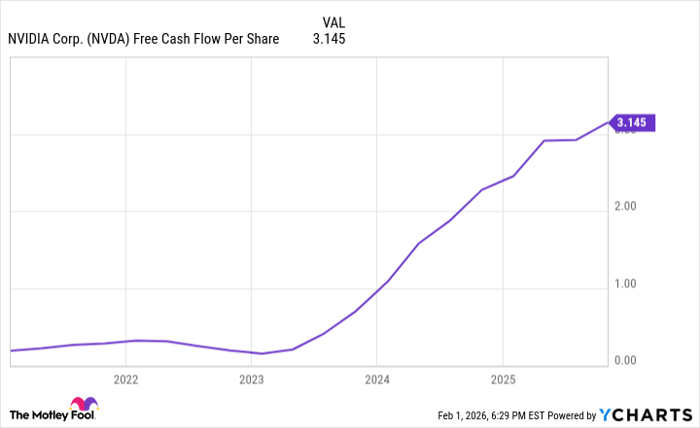
Data by YCharts.
This indicates Nvidia is producing cash that exceeds what's required to cover operations and capital expenditures, indicating strong financial health and the flexibility to allow the company to pursue a variety of initiatives.
This brings us back to Nvidia's valuation. Here's a comparison of its P/E ratio against one of its main rivals, AMD.
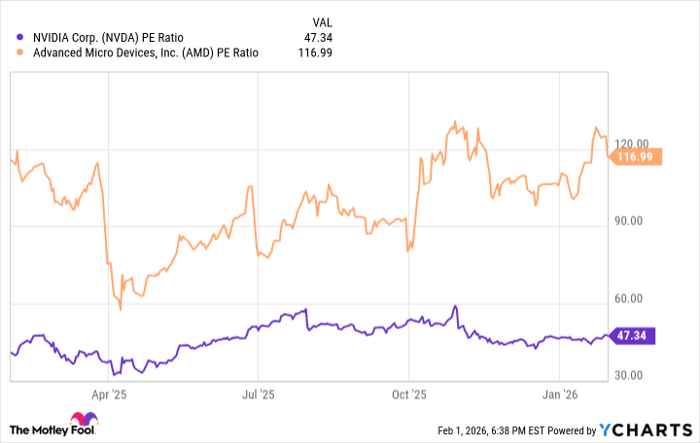
Data by YCharts.
The chart reveals Nvidia's earnings multiple is far lower than AMD's, indicating Nvidia shares are a superior value. Combined with its central role in the AI ecosystem, these factors suggest Nvidia's share price valuation may be warranted, making the stock a worthwhile investment.
You could wait for a dip in Nvidia's share price before deciding to buy, since the stock is very volatile as evidenced by a beta of about 2. But over the long term, Nvidia is poised to deliver solid shareholder returns as it increases its broad influence across the AI landscape.
Should you buy stock in Nvidia right now?
Before you buy stock in Nvidia, consider this:
The Motley Fool Stock Advisor analyst team just identified what they believe are the 10 best stocks for investors to buy now… and Nvidia wasn’t one of them. The 10 stocks that made the cut could produce monster returns in the coming years.
Consider when Netflix made this list on December 17, 2004... if you invested $1,000 at the time of our recommendation, you’d have $446,319!* Or when Nvidia made this list on April 15, 2005... if you invested $1,000 at the time of our recommendation, you’d have $1,137,827!*
Now, it’s worth noting Stock Advisor’s total average return is 932% — a market-crushing outperformance compared to 197% for the S&P 500. Don't miss the latest top 10 list, available with Stock Advisor, and join an investing community built by individual investors for individual investors.
See the 10 stocks »
*Stock Advisor returns as of February 4, 2026.
Robert Izquierdo has positions in Advanced Micro Devices, Intel, Nvidia, and Uber Technologies. The Motley Fool has positions in and recommends Advanced Micro Devices, Intel, Nvidia, and Uber Technologies. The Motley Fool recommends Stellantis. The Motley Fool has a disclosure policy.
Recommended Articles


