




1 Reason to Buy These 2 Fierce Rivals
Key Points
Both Ford and General Motors return significant value to shareholders, albeit in different ways.
Ford's dividend yields nearly 4.5%, and the company often dishes out supplemental dividends.
General Motors has announced $16 billion in share buybacks since 2023 -- a different approach.
- 10 stocks we like better than General Motors ›
When it comes to designing, producing, and selling highly profitable full-size trucks and SUVs, there may not be two closer rivals than Detroit's own Ford Motor Company (NYSE: F) and General Motors (NYSE: GM). Though fierce rivals in vehicle segments, the two automakers share a core value of returning significant value to shareholders.
Let's dive into how and why the automakers approach returning value differently, and why it's a big win for long-term investors.
Where to invest $1,000 right now? Our analyst team just revealed what they believe are the 10 best stocks to buy right now. Continue »
Paying you direct
One popular reason investors have for scooping up shares of Ford is the automaker's high-yield dividend. In fact, Ford offers investors a combination of value, as the company trades at a modest price-to-earnings ratio of 11, as well as a dividend yield of 4.4% -- much higher than the S&P 500's average yield of just over 1.1%.
The difference a dividend can make in a long-term investment is significant. Take Ford, for instance. Over the past decade you can see the modest share price returns compared to the much larger total value returns that include dividends.
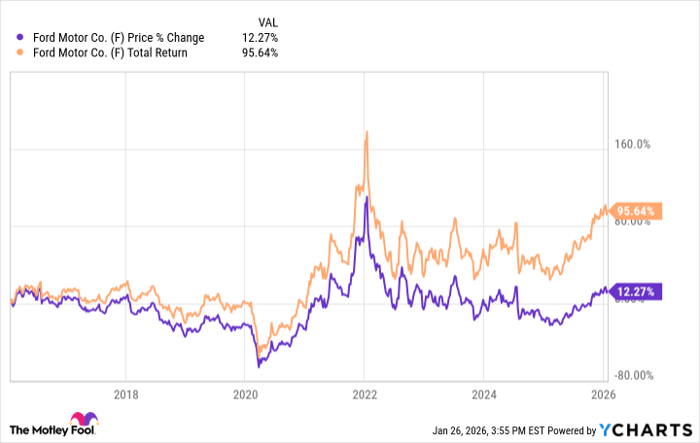
F data by YCharts
One unique aspect of Ford's dividend is that the interests of the Ford family are aligned with shareholders'. That's because the automaker has a special class of shares held by the Ford family that come with not only the common dividend but also substantial voting rights. It's well known that the Ford family enjoys the significant payout, and would prefer the company's dividend payments remain consistent and strong.
Ford is aiming to return 40% to 50% of its annual free cash flow (FCF) to shareholders through its quarterly dividends, as well as its supplemental dividends that it will dish out to shareholders during years of stronger FCF. The upside is that when Ford can reverse billions in electric vehicle losses in the near to medium term, more cash will be freed up for potential dividend increases.
A different path
While Ford focuses on its lucrative dividend to return value to shareholders, rival General Motors drives down a different path. Rather than pay shareholders directly with dividends, GM focuses on stock buybacks to boost per-share earnings. For investors it's not important that GM is returning value to shareholders differently than its rival, but it is important for investors to understand just how substantial the automaker's share buybacks have been.

Image source: General Motors.
General Motors is clicking on all cylinders, having just beaten Wall Street estimates during the fourth quarter, announcing a 20% increase to its quarterly dividend, and initiating a brand-new $6 billion share repurchase authorization.
It's not a new move for the Detroit automaker. Since the beginning of 2023, GM has announced $22 billion in share buybacks and retired hundreds of thousands of shares outstanding. To put that information in context, it's best to view the company's significant decline in shares outstanding, which coincides with a rising share price over that time period.
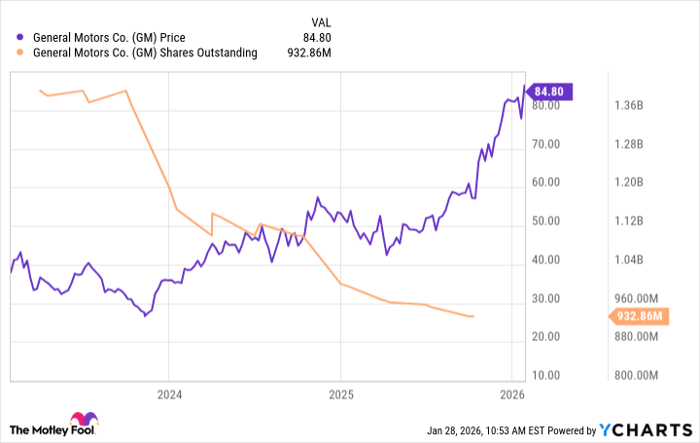
GM data by YCharts
What it all means
Currently, one primary reason to invest in Ford or General Motors is their commitment to returning significant value to shareholders, whether it's a lucrative dividend payment or significant share repurchases. For investors, the fact that these two automakers return so much value to shareholders is proof the companies are confident in their current investments for profitable growth and can maintain a strong balance sheet.
Should you buy stock in General Motors right now?
Before you buy stock in General Motors, consider this:
The Motley Fool Stock Advisor analyst team just identified what they believe are the 10 best stocks for investors to buy now… and General Motors wasn’t one of them. The 10 stocks that made the cut could produce monster returns in the coming years.
Consider when Netflix made this list on December 17, 2004... if you invested $1,000 at the time of our recommendation, you’d have $450,256!* Or when Nvidia made this list on April 15, 2005... if you invested $1,000 at the time of our recommendation, you’d have $1,171,666!*
Now, it’s worth noting Stock Advisor’s total average return is 942% — a market-crushing outperformance compared to 196% for the S&P 500. Don't miss the latest top 10 list, available with Stock Advisor, and join an investing community built by individual investors for individual investors.
See the 10 stocks »
*Stock Advisor returns as of February 1, 2026.
Daniel Miller has positions in Ford Motor Company and General Motors. The Motley Fool recommends General Motors. The Motley Fool has a disclosure policy.
Recommended Articles


