




The Best Tech ETF to Invest $2,000 in Right Now
Key Points
The Nasdaq-100 tracks the largest 100 non-financial companies on the Nasdaq stock exchange.
The Invesco Nasdaq 100 ETF (QQQM) holds a portfolio consisting of over 63% tech stocks.
QQQM is the cheaper version of the Invesco QQQ ETF, helping to reduce costs over time.
- 10 stocks we like better than Invesco NASDAQ 100 ETF ›
In the past two decades, the tech sector has expanded to include dozens of industries. Instead of investing in many different companies to gain exposure to these industries, a more efficient approach is to invest in a tech exchange-traded fund (ETF).
A good tech ETF can be a one-stop shop for investors looking for tech companies without the hassle of picking the "right" winners. With $2,000 available to invest, I'd consider investing in the Invesco Nasdaq 100 ETF (NASDAQ: QQQM). It checks a lot of the boxes investors should look for, with a built-in hedge.
Where to invest $1,000 right now? Our analyst team just revealed what they believe are the 10 best stocks to buy right now, when you join Stock Advisor. See the stocks »
Image source: Getty Images.
The primary companies leading the way
QQQM mirrors the Nasdaq-100, an index tracking around 100 of the largest non-financial companies on the Nasdaq stock exchange. This means you won't see banks, insurance companies, or real estate investment trusts (REITs). What you will see, though, is many of the world's top tech companies.
The tech sector accounts for over 63% of QQQM, and nine of its top 10 holdings are tech companies (Walmart is the lone exception):
- Nvidia: 8.63% of the ETF
- Apple: 7.19%
- Microsoft: 6.65%
- Amazon: 4.85%
- Meta: 3.76%
- Alphabet (Class A): 3.69%
- Tesla: 3.67%
- Alphabet (Class C): 3.43%
- Walmart: 3.02%
- Broadcom: 2.92%
Having nearly 48% of a 104-stock ETF in just 10 stocks isn't the textbook definition of diversification, but it's ideal if you're looking for exposure to some of the world's most notable tech companies and growing industries. Between just the above tech companies, you have leaders in software, consumer hardware, semiconductors, digital advertising, cloud computing, electric vehicles, and artificial intelligence.
And since QQQM isn't 100% tech companies, there's a natural hedge against tech-specific issues, such as regulations. The top three non-tech sectors are consumer discretionary (17.9%), healthcare (5.4%), and industrials (3.8%).
A history of impressive results
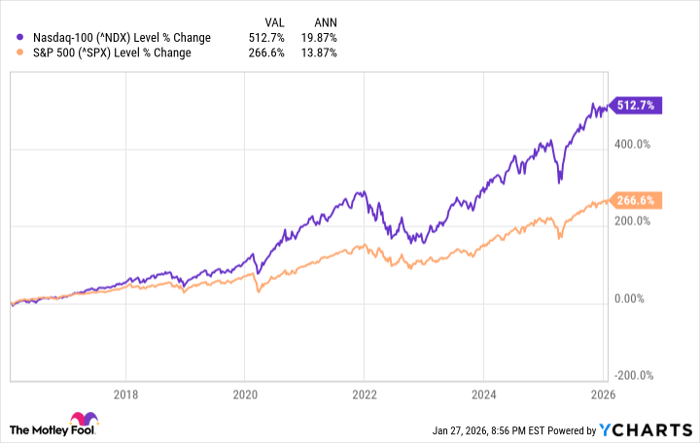
Over the past decade, the Nasdaq-100 has averaged over 19% annual returns. A single $2,000 investment in the index back then would be worth around $12,250 as of market close on Jan. 27. QQQM just began trading in October 2020 and has averaged 15.5% annual returns since then. I wouldn't invest in QQQM expecting that to be the long-term norm, but it's got all the tools to be a consistent market-beating ETF.
^NDX data by YCharts
Even averaging a "modest" 10% annual return would mean doubling your investment every 7.2 years. Of course, nothing is guaranteed in the stock market, and past performance doesn't guarantee future results. However, the companies leading the way for QQQM are some of the most thorough that you'll find in any sector.
A little difference, but potentially a lot of money
If you've been thinking QQQM looks familiar, it's probably because you've seen its predecessor, the Invesco QQQ Trust ETF (NASDAQ: QQQ). They're essentially the same, since they both mirror the Nasdaq-100, but one key difference is the fee. QQQM's expense ratio is 0.15% compared to QQQ's 0.18%.
Granted, the difference looks small on paper, but over time it can truly make a difference. For perspective, let's assume you invest $500 monthly into both ETFs and average 10% annual returns. Below are the differences in fees paid over various numbers of years.
| Years Invested | Investment Value Without Fees | Fees Paid With QQQM | Fees Paid With QQQ |
|---|---|---|---|
| 10 | $95,920 | $990 | $1,120 |
| 15 | $190,630 | $2,250 | $2,700 |
| 20 | $343,650 | $5,800 | $6,950 |
| 25 | $590,080 | $13,150 | $15,740 |
| 30 | $986,960 | $27,600 | $33,020 |
Table by author. Values rounded to the nearest 10.
You're able to invest in the same thing (the Nasdaq-100) and save money over time by doing so. Although it's not a pure-play tech ETF, QQQM is one of the better tech ETFs on the market right now.
Should you buy stock in Invesco NASDAQ 100 ETF right now?
Before you buy stock in Invesco NASDAQ 100 ETF, consider this:
The Motley Fool Stock Advisor analyst team just identified what they believe are the 10 best stocks for investors to buy now… and Invesco NASDAQ 100 ETF wasn’t one of them. The 10 stocks that made the cut could produce monster returns in the coming years.
Consider when Netflix made this list on December 17, 2004... if you invested $1,000 at the time of our recommendation, you’d have $450,256!* Or when Nvidia made this list on April 15, 2005... if you invested $1,000 at the time of our recommendation, you’d have $1,171,666!*
Now, it’s worth noting Stock Advisor’s total average return is 942% — a market-crushing outperformance compared to 196% for the S&P 500. Don't miss the latest top 10 list, available with Stock Advisor, and join an investing community built by individual investors for individual investors.
See the 10 stocks »
*Stock Advisor returns as of February 1, 2026.
Stefon Walters has positions in Apple, Microsoft, and Walmart. The Motley Fool has positions in and recommends Alphabet, Amazon, Apple, Meta Platforms, Microsoft, Nvidia, Tesla, and Walmart. The Motley Fool recommends Broadcom. The Motley Fool has a disclosure policy.
Recommended Articles


