




Did Fed Chair Jerome Powell Just Throw President Donald Trump Under the Bus Concerning Inflation?
Key Points
The Federal Open Market Committee (FOMC) held interest rates steady at last week's meeting.
Inflation "remains somewhat elevated," according to Powell, with tariffs in the goods sector footing the blame.
Donald Trump's China tariffs in 2018-2019 tell a potentially challenging tale of what's to come for the stock market and U.S. economy.
- 10 stocks we like better than S&P 500 Index ›
The third year of Wall Street's bull market rally didn't disappoint. When the closing bell rang on Dec. 31, the iconic Dow Jones Industrial Average (DJINDICES: ^DJI), widely followed S&P 500 (SNPINDEX: ^GSPC), and growth-propelled Nasdaq Composite (NASDAQINDEX: ^IXIC) surged by 13%, 16%, and 20% in 2025. For the S&P 500, it marked the third consecutive year of gains totaling at least 16%.
While technology trends are certainly fueling this rally (e.g., the evolution of artificial intelligence and the advent of quantum computing), a strong argument can be made that the Federal Reserve's ongoing rate-easing cycle is just as, if not more, important.
Where to invest $1,000 right now? Our analyst team just revealed what they believe are the 10 best stocks to buy right now, when you join Stock Advisor. See the stocks »

Fed Chair Jerome Powell speaking with President Donald Trump. Image source: Official White House Photo by Daniel Torok.
Fed Chair Jerome Powell points the finger at President Trump's tariffs
Although the Federal Open Market Committee (FOMC) -- the 12-person body, including Fed Chair Jerome Powell, responsible for implementing and directing our nation's monetary policy -- chose to keep the federal funds target rate unchanged at this past week's meeting, it had effected 25-basis-point reductions in each of the three prior meetings.
Lowering the fed funds rate ultimately reduces borrowing rates for consumers and businesses. This can encourage lending, leading to increased hiring, acquisition activity, and innovation for corporations. In other words, it's viewed as a positive for the U.S. economy and the stock market.
But things may not be as picture-perfect as the rapidly rising Dow, S&P 500, and Nasdaq Composite indicate. In Powell's prepared remarks following the Jan. 28 FOMC decision, he notes that inflation "remains somewhat elevated relative to our 2 percent longer-run goal" -- and he laid the blame for this on one factor: President Donald Trump's tariffs.
Although Powell made sure to add the distinction that tariffs will eventually pass through and enable the prevailing inflation rate to move toward the Fed's 2% long-term target (assuming President Trump adds no additional tariffs), he explained that the "somewhat elevated" inflation rate at present "largely reflect inflation in the goods sector, which has been boosted by the effect of tariffs." In comparison, the nation's central bank has observed disinflation in the services sector.
Fed Chair Powell expounded further in the Q&A session with reporters following his prepared remarks that "there's an expectation that sometime in the middle quarters of the year, we'll see tariff inflation topping out."
In other words, things are expected to get a bit worse before they begin to improve, which is all the more reason for the nation's central bank to be hesitant about aggressively lowering interest rates.
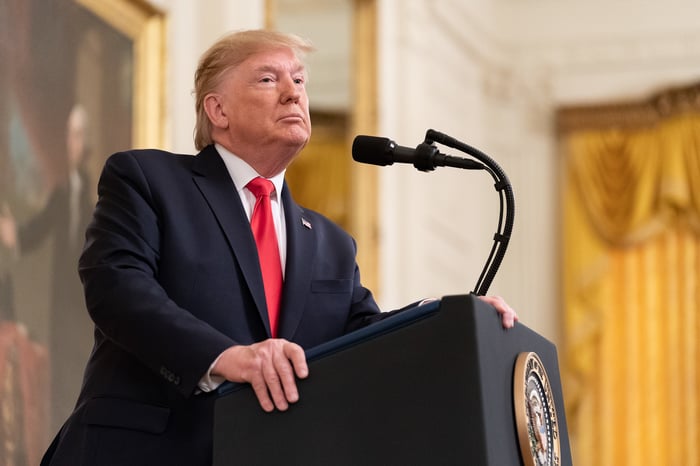
President Trump delivering remarks. Image source: Official White House Photo by Shealah Craighead, courtesy of the National Archives.
Statistically speaking, Trump's tariffs have been problematic for the U.S. economy and stock market
In early April, Trump unveiled his long-touted trade policy by introducing a 10% global tariff, as well as higher "reciprocal tariffs" on dozens of countries deemed to have adverse trade imbalances with America. These reciprocal tariff rates have changed several times as trade deals have been announced or tariff pauses extended.
Donald Trump's goal with tariffs is to encourage domestic production and protect American jobs. If tariffs raise the cost of imported goods, multinational businesses will be incentivized to manufacture their U.S.-focused products on American soil. But things don't always work in the real world as they do on paper.
In December 2024, four New York Federal Reserve economists, writing for Liberty Street Economics, published a report ("Do Import Tariffs Protect U.S. Firms?") that examined the effect of Trump's China tariffs in 2018-2019 on the U.S. economy and stock market.
Perhaps the least surprising finding was that the publicly traded companies directly impacted by Trump's China tariffs during his first term underperformed on tariff announcement days.
However, there were two bigger takeaways from Liberty Street Economics' analysis that hit home with the U.S. economy and stock market.
First, the average publicly traded company affected by Trump's China tariffs experienced declines in labor productivity, employment, sales, and profits from 2019 to 2021. In other words, the adverse impact of tariffs lasted well beyond their initial announcement.
The second, and arguably more important, concern is that input tariffs negatively impacted U.S. companies. An input tariff is a duty placed on an imported good used to complete the domestic manufacture of a product. Input tariffs were found to increase domestic production costs, making American goods less cost-competitive with those from China. These higher costs were typically passed along to U.S. consumers, which can increase the prevailing inflation rate.
Though what happened in the past can't guarantee what will occur in the future, Powell's projection of tariff-induced inflation peaking in the middle quarters of 2026 would indicate that history is somewhat repeating.
What's more, Powell made clear that the FOMC's inflation assumptions were based on no additional tariffs being added by President Trump. However, Trump's trade policy approach has been inconsistent, with the president threatening to implement tariffs and wavering on his claims to do so on several occasions since last April.
While a historic level of division at the Federal Reserve is a big problem of its own for the Dow Jones Industrial Average, S&P 500, and Nasdaq Composite, the impact of President Trump's tariff and trade policy, based on historical data, shouldn't be overlooked. Tariffs run the risk of creating unique challenges that a historically pricey stock market may struggle to deal with.
Should you buy stock in S&P 500 Index right now?
Before you buy stock in S&P 500 Index, consider this:
The Motley Fool Stock Advisor analyst team just identified what they believe are the 10 best stocks for investors to buy now… and S&P 500 Index wasn’t one of them. The 10 stocks that made the cut could produce monster returns in the coming years.
Consider when Netflix made this list on December 17, 2004... if you invested $1,000 at the time of our recommendation, you’d have $448,476!* Or when Nvidia made this list on April 15, 2005... if you invested $1,000 at the time of our recommendation, you’d have $1,180,126!*
Now, it’s worth noting Stock Advisor’s total average return is 945% — a market-crushing outperformance compared to 197% for the S&P 500. Don't miss the latest top 10 list, available with Stock Advisor, and join an investing community built by individual investors for individual investors.
See the 10 stocks »
*Stock Advisor returns as of January 31, 2026.
Sean Williams has no position in any of the stocks mentioned. The Motley Fool has no position in any of the stocks mentioned. The Motley Fool has a disclosure policy.
Recommended Articles


