




The Market Just Did This For the 1st Time in 30 Years. Here's What History Says Happens Next.
Key Points
The Russell 2000 just outperformed the S&P 500 on each of the past 14 straight trading days.
Historically, these streaks have occurred during dangerous periods for the markets and the economy.
Let's break down the numbers to get a sense of what investors might be able to expect looking forward.
- 10 stocks we like better than S&P 500 Index ›
The first month of 2026 has seen a significant market rotation from what investors have been used to over the past three years. A market that had been dominated by tech, growth, and the "Magnificent Seven" stocks has gotten leadership instead from small caps, value stocks, and precious metals.
Investors who have maintained diversification in their portfolio have probably welcomed the improving breadth. However, those who are still overweight in last year's leaders have probably enjoyed little return, if any.
Where to invest $1,000 right now? Our analyst team just revealed what they believe are the 10 best stocks to buy right now, when you join Stock Advisor. See the stocks »
But one of the biggest stories of the year so far has to be what the Russell 2000 is doing. After years of underperformance, the index has pulled off an historic feat to start the new year.

Source: Getty Images.
Small caps begin outperforming large caps
For the past three years, the S&P 500 (SNPINDEX: ^GSPC) has seen outperformance that has been steady and sustained. But as artificial intelligence (AI) enthusiasm wanes, the geopolitical background gets more tense, and the labor market continues to slow, investors have begun looking for more undervalued areas of the market for a bit of protection.
One place they've found it is in small caps. And the pivot hasn't just been a small one. It's been historic. Starting on Jan. 2 and ending only recently on Jan. 22, the Russell 2000 outperformed the S&P 500 in 14 straight trading days. That's a feat that hasn't been accomplished since April and May of 1996.
| Date | Russell 2000 Return | S&P 500 Return |
Outperformance in Percentage Points |
|---|---|---|---|
| 1/2/2026 | 1.06% | 0.19% | 0.87 |
| 1/5/2026 | 1.58% | 0.64% | 0.94 |
| 1/6/2026 | 1.37% | 0.62% | 0.75 |
| 1/7/2026 | -0.29% | -0.34% | 0.05 |
| 1/8/2026 | 1.11% | 0.01% | 1.10 |
| 1/9/2026 | 0.78% | 0.65% | 0.13 |
| 1/12/2026 | 0.44% | 0.16% | 0.28 |
| 1/13/2026 | -0.10% | -0.19% | 0.10 |
| 1/14/2026 | 0.70% | -0.53% | 1.23 |
| 1/15/2026 | 0.86% | 0.26% | 0.60 |
| 1/16/2026 | 0.12% | -0.06% | 0.18 |
| 1/20/2026 | -1.21% | -2.06% | 0.85 |
| 1/21/2026 | 2.02% | 1.16% | 0.86 |
| 1/22/2026 | 0.74% | 0.55% | 0.19 |
Over the entirety of the streak, the small-cap index has beaten the S&P 500 by about 850 basis points, perhaps the best stretch relative to large caps in about a year and a half. Given the rarity of something like this, there isn't a lot of historical precedent to use for guidance. But if we dig in, there's some good and some bad to be found.
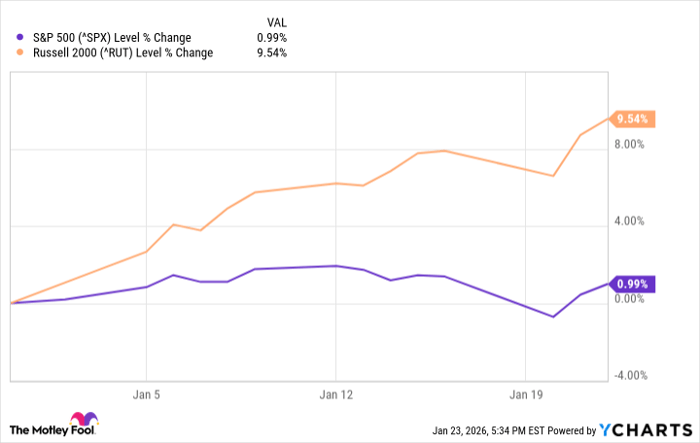
^SPX data by YCharts.
When has this type of Russell 2000 outperformance occurred in the past?
Since 14 straight days is such a lofty number, let's loosen the criteria a bit and see what the market has done after 10 straight days of Russell 2000 outperformance. According to Yahoo! Finance data, here are the eight instances where this has happened over the past 40 years:
- February 1991
- April 1996
- June 2000
- December 2001
- April 2002
- June 2003
- June 2008
- January 2026
It's not difficult to see an immediate red flag here: 2000, 2001, 2002, 2008. Half of the occurrences happened either during the tech bubble or the financial crisis. In 2001, we had one of the few cases where small caps were outperforming while the S&P 500 was still posting positive returns. In most cases, large caps were flat to down during the streak. The Russell 2000 didn't need to necessarily produce big gains; it just needed to lose less or remain steady.
In other cases, as in 2000, small caps sharply underperformed in the weeks leading up to the streak. The Russell 2000 was simply getting back what it had lost. In 1991, we had what was the initial comeback following a recession. But during the corresponding bear market decline, the S&P 500 fell around 20% and the Russell 2000 fell by about 30%. Small caps had more ground to make up, and they did once sentiment began to improve.
And 1996 is the only instance where stocks were in relatively good shape at the time and the Russell 2000 simply powered ahead.
How do stocks perform after Russell 2000 outperformance?
Here's how the S&P 500 performed in the 200 trading days following the point where the Russell 2000 hit 10 in a row.
- February 1991: 15.8%
- April 1996: 20.1%
- June 2000: -22%
- December 2001: -24.5%
- April 2002: -22.1%
- June 2003: 14.9%
- June 2008: -42.3%
- January 2026: ?
As you can see, it's a very mixed bag of results. More often than not, streaks of outperformance for the Russell 2000 like the one that just concluded have come around rougher periods for the markets and the economy. The only consistent thing seems to be that performance over the following year is either very good or very bad -- there hasn't been any in-between.
Everything seems fine right now, but a lot can change over the next year. There are already concerns around valuations and the labor market. Whether that triggers recessionary conditions that pull stocks sharply lower remains to be seen. But the big takeaway might be to prepare for anything at this point.
Should you buy stock in S&P 500 Index right now?
Before you buy stock in S&P 500 Index, consider this:
The Motley Fool Stock Advisor analyst team just identified what they believe are the 10 best stocks for investors to buy now… and S&P 500 Index wasn’t one of them. The 10 stocks that made the cut could produce monster returns in the coming years.
Consider when Netflix made this list on December 17, 2004... if you invested $1,000 at the time of our recommendation, you’d have $461,527!* Or when Nvidia made this list on April 15, 2005... if you invested $1,000 at the time of our recommendation, you’d have $1,155,666!*
Now, it’s worth noting Stock Advisor’s total average return is 950% — a market-crushing outperformance compared to 197% for the S&P 500. Don't miss the latest top 10 list, available with Stock Advisor, and join an investing community built by individual investors for individual investors.
See the 10 stocks »
*Stock Advisor returns as of January 29, 2026.
David Dierking has no position in any of the stocks mentioned. The Motley Fool has no position in any of the stocks mentioned. The Motley Fool has a disclosure policy.
Recommended Articles


